
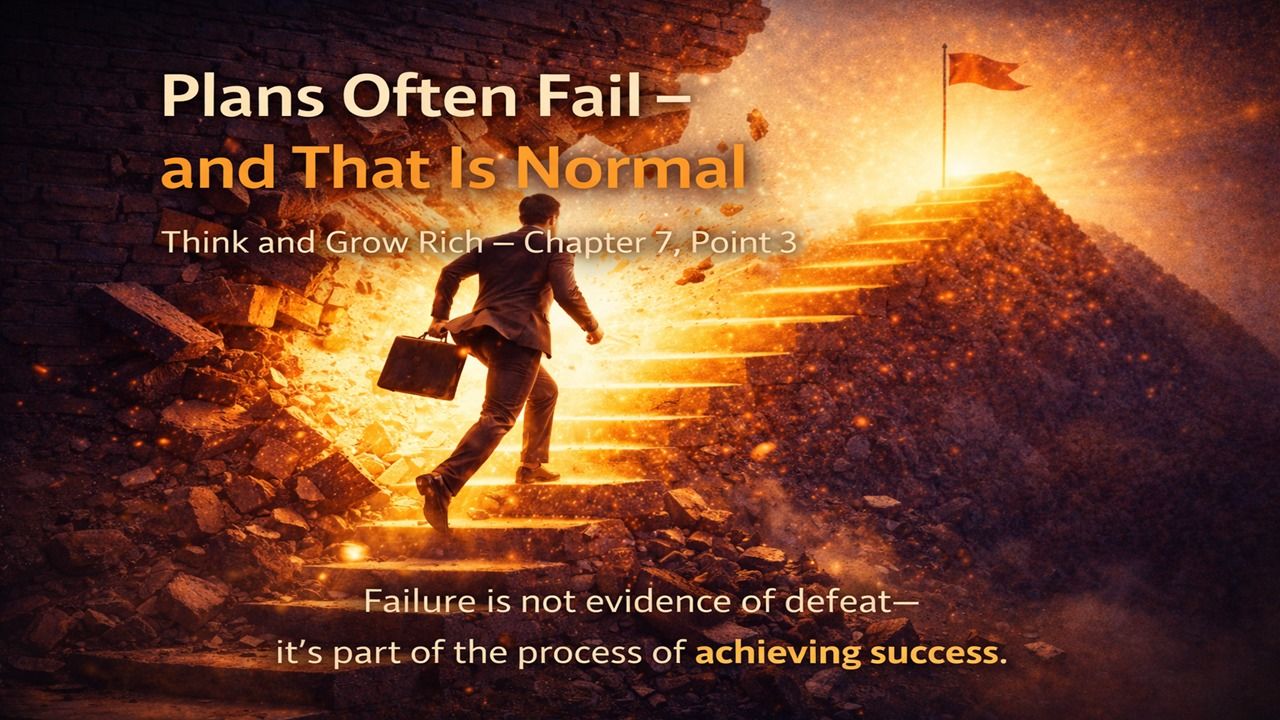
Your Plan Failed? Good. That’s How Success Is Built
Apr 09, 2026What if your plan failing wasn’t a sign to quit… but proof that you’re finally doing the work that leads to success?
Napoleon Hill noticed something that most people misunderstand about success. They believe a good plan should work the first time. They assume failure means they chose the wrong path. They interpret resistance as a warning to retreat.
Hill saw the opposite. He observed that nearly every successful person failed repeatedly at the planning stage, not because their desire was wrong, but because plans evolve through action. That insight forms Point 3 of Chapter 7 in Think and Grow Rich.
Plans Often Fail, and That Is Normal
Hill states this principle plainly: If the first plan fails, try another. And if that fails, try still another. This isn’t encouragement, it’s instruction. Hill is telling you that failure is built into the planning process. Plans are hypotheses. Action tests them. Feedback refines them.
Failure here is not defeat. It is data.
What Hill Is Really Teaching
Hill is dismantling a dangerous belief: “If this were meant to work, it wouldn’t be this hard.” In reality difficulty exposes weak assumptions, failure reveals missing elements, and resistance highlights what needs correction. Hill understood that no plan survives contact with reality unchanged.
The successful do not cling to their first plan. They cling to their goal.
Why Most People Quit at This Stage
Hill observed that people abandon plans because failure triggers self-doubt, feels personal, threatens identity, and invites criticism. Instead of adjusting the plan, they question the desire. Hill would say: Temporary defeat tests commitment, not capability.
How This Principle Helps You Reach $10,000/Month
An additional $10,000 per month will not come from a flawless first attempt. It comes from testing offers, refining messaging, adjusting delivery, learning the market, and responding to feedback. Every income stream is built through iterations, not inspiration. Here’s how this principle directly supports income creation:
- Failure becomes feedback: You stop guessing and start learning.
- Momentum replaces discouragement: Each adjustment keeps you moving.
- Confidence grows through resilience: You learn you can recover.
- Skill compounds: Every revision sharpens execution.
- Income stabilizes: Refined plans produce consistent results. Hill’s lesson is freeing: You are not failing, you are refining.
Why This Is Hard to Navigate Alone
Left alone, people personalize failure, overcorrect emotionally. abandon plans prematurely, and lose perspective. Hill understood that perspective is fragile in isolation. That’s why he repeatedly emphasized association.
How a Master Mind Turns Failure Into Progress
A Master Mind reframes failure immediately and correctly.
- Failure Is Interpreted Objectively: The group separates you from the plan.
- Feedback Arrives Faster: Others spot flaws you can’t see.
- Emotional Balance Is Restored: Discouragement is diffused.
- Alternatives Appear Quickly: New approaches replace stalled ones.
- Persistence Is Normalized: Iteration becomes expected, not embarrassing.
Practical Action Steps (Hill-Aligned)
Here’s how to use failed plans productively:
- Action 1: Treat Every Plan as a Draft: Expect revision from the start.
- Action 2: Ask “What Did This Reveal?”: Replace judgment with curiosity.
- Action 3: Adjust One Variable at a Time: Clarity comes from controlled change.
- Action 4: Document Lessons Immediately: Failure teaches quickly, capture it.
- Action 5: Review Setbacks with the Master Mind: Insight multiplies through discussion.
- Action 6: Recommit to the Goal: Change the plan, not the destination.
- Action 7: Act Again Without Delay: Momentum matters more than perfection.
Why Hill Includes This Point
Because most people quit exactly where progress begins. Hill wanted readers to understand: Plans are not proven right by ease, but by persistence. Failure does not signal retreat. It signals adjustment.
Final Reflection
If failure were simply a message, not a verdict, what would you try again this week with a better plan?
Hill’s lesson is exact and empowering: Temporary defeat is not the opposite of success. It is part of the process of organizing desire into reality.
What If You Could Start Creating More Financial Momentum in Just 7 Days?
Reading about financial success can give you ideas. Taking action is what begins to create change.
That's why I created the FREE Money Momentum Starter Guide Workbook—a practical starting point for anyone who wants to make greater financial progress by managing their money more intentionally, exploring opportunities to create additional income, and developing habits that keep them moving forward.
Inside the FREE Starter Guide, you'll discover:
- Where you are financially today and where you'd like to make progress
- Opportunities to take greater control of the money already flowing through your life
- Skills, knowledge, and experience you may be able to turn into additional income
- Practical actions you can begin taking right away
- How to create your own 7-Day Money Momentum Action Plan
You don't need to have everything figured out. You don't need a perfect financial plan or a great business idea. You simply need a starting point and a willingness to take the next step.
Want Some Help Working Through It?
You can complete the Money Momentum Starter Guide entirely on your own for free, or for a one-time $5 upgrade, get 30 days of access to your own Money Momentum AI Assistant to help you work through the workbook.
Your AI Assistant can help you think through questions, explore possibilities when you're unsure what to write, dig deeper into your answers, and turn what you discover into practical next steps and your personalized 7-Day Money Momentum Action Plan.
Start Building Your Money Momentum Today. Download your FREE Money Momentum Starter Guide Workbook and take your first step toward greater financial progress.
