
Your Past Isn’t a Setback, It’s Your Highest-Paid Asset
Mar 26, 2026What if the very experiences you once saw as setbacks are the reason someone will gladly pay you $10,000 a month?
That question forces a pause. Most people overlook their greatest asset because it doesn’t look impressive on paper. Napoleon Hill noticed this pattern repeatedly while studying successful men and women: They did not always succeed because of what they studied. They succeeded because of what they had lived through. That insight leads us directly to Point 3 of Chapter 5, one of the most quietly powerful ideas in Think and Grow Rich.
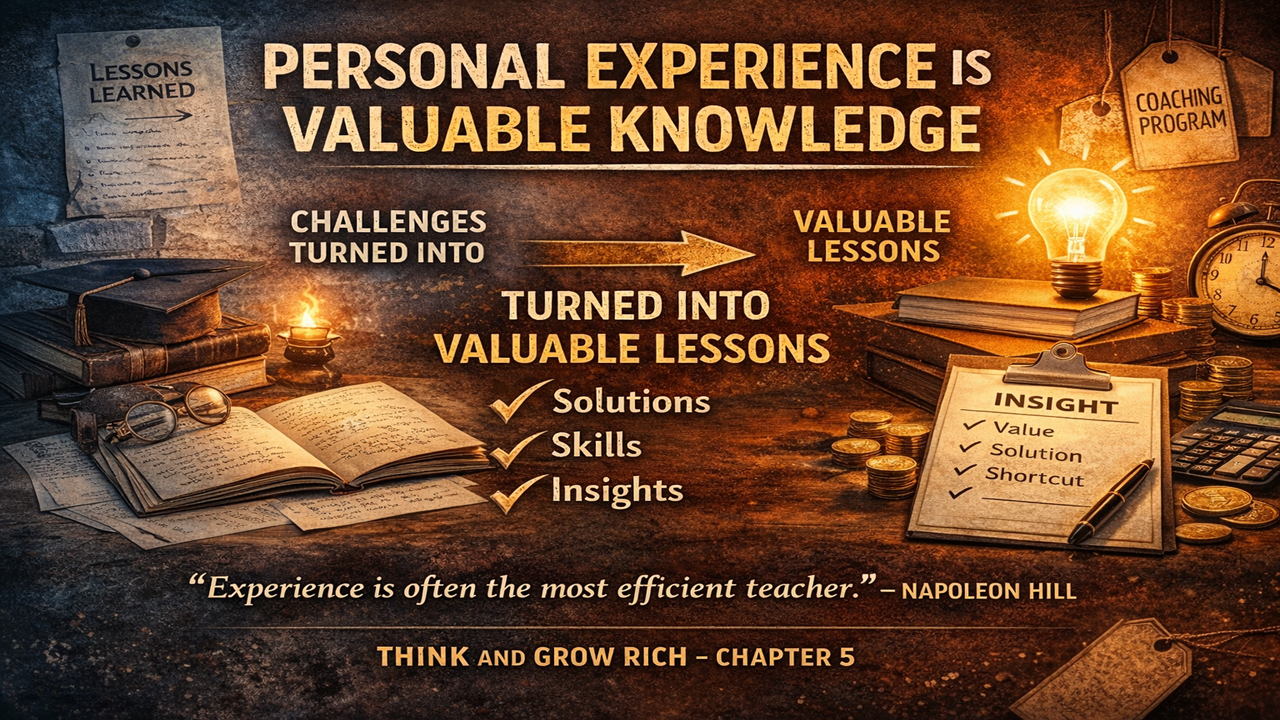
Personal Experience Is One of the Most Valuable Forms of Specialized Knowledge
Hill elevates personal experience to a status most people never give it. Why? Because experience does something theory cannot: It teaches judgment. Experience refines what works, what doesn’t, what matters, and what to avoid. Hill understood that money responds to results, not credentials. Results are born from experience.
What Hill Really Means by “Personal Experience”
Hill is not talking about random life events. He is talking about problems you’ve solved, obstacles you’ve navigated, failures you survived, patterns you recognized, and adjustments you learned to make. Experience compresses learning. A lesson learned through action is remembered deeply, applied instinctively, and communicated with authority. That authority is what others trust and pay for.
Why Experience Often Goes Unrecognized
Hill noticed something troubling: People routinely dismiss their own experience as “ordinary.” They say: “Anyone could do that.” “That wasn’t a big deal.” “I just figured it out.” “It happened by accident.” Hill would say: The market does not value what feels easy to you, it values what saves others time, pain, or uncertainty. Ease is often evidence of mastery.
How Personal Experience Supports Your $10K/Month Goal
An additional $10,000 per month is rarely created by abstract ideas. It is created by solving a specific problem, guiding others through a process, or helping someone avoid a costly mistake. Personal experience gives you earned shortcuts. Here’s how it directly supports income creation:
- It creates immediate credibility: You speak from reality, not theory.
- It shortens trust-building: People trust those who’ve “been there.”
- It simplifies solutions: You know what actually works, not what sounds good.
- It differentiates you: Experience cannot be copied.
- It allows premium pricing: People pay more for certainty than information. Income follows trust.
Why This Is Hard to Leverage Alone
Left alone, people struggle to identify which experiences matter, articulate lessons clearly, package experience into value, and see patterns in their own story. Hill understood this blind spot. That’s why he emphasized association, not just for ideas, but for clarity.
How a Master Mind Unlocks the Value of Experience
A Master Mind reveals the worth of what you already know.
- The Group Reflects Your Value Back to You: Others hear your story and say: “That’s not normal, that’s valuable.” Perspective shifts instantly.
- Patterns Emerge Through Dialogue: What felt like isolated events becomes a repeatable framework. Experience becomes teachable.
- Language Sharpens Authority: The group helps you articulate lessons, steps, warnings, and insights. Clarity increases confidence.
- Experience Becomes an Offer: Discussion turns lived knowledge into services, coaching, programs, and solutions. Income pathways emerge.
- Validation Replaces Self-Doubt: When others benefit from your experience, the subconscious accepts: “I have something worth offering.” Belief follows evidence.
Practical Action Steps (Hill-Aligned)
Here’s how to convert personal experience into specialized knowledge:
- Action 1: Identify 3 Problems You’ve Solved Repeatedly: These are clues to value.
- Action 2: Write the Turning Points: What changed the outcome? Those are teachable moments.
- Action 3: Extract Simple Principles: What rules emerged from experience? Simplicity increases usefulness.
- Action 4: Apply Your Experience to One Person: Test value in real time. Feedback refines it.
- Action 5: Share Your Story in the Master Mind: Listen for what resonates. That’s market signal.
- Action 6: Package the Lesson, Not the Story: People buy outcomes, not autobiography.
- Action 7: Repeat and Refine Weekly: Experience becomes leverage through repetition.
Why Hill Includes This Point
Because without recognizing the value of experience people over-study, undercharge, delay offering value, and dismiss their own authority. Hill’s deeper message is empowering: Your experience is not incidental. It is specialized knowledge earned the hard way.
Final Reflection
If your experience could prevent someone else’s costly mistake, what responsibility do you have to stop hiding it?
Hill’s insight remains precise: Experience, intelligently applied, is often more valuable than education alone.
What If You Could Start Creating More Financial Momentum in Just 7 Days?
Reading about financial success can give you ideas. Taking action is what begins to create change.
That's why I created the FREE Money Momentum Starter Guide Workbook—a practical starting point for anyone who wants to make greater financial progress by managing their money more intentionally, exploring opportunities to create additional income, and developing habits that keep them moving forward.
Inside the FREE Starter Guide, you'll discover:
- Where you are financially today and where you'd like to make progress
- Opportunities to take greater control of the money already flowing through your life
- Skills, knowledge, and experience you may be able to turn into additional income
- Practical actions you can begin taking right away
- How to create your own 7-Day Money Momentum Action Plan
You don't need to have everything figured out. You don't need a perfect financial plan or a great business idea. You simply need a starting point and a willingness to take the next step.
Want Some Help Working Through It?
You can complete the Money Momentum Starter Guide entirely on your own for free, or for a one-time $5 upgrade, get 30 days of access to your own Money Momentum AI Assistant to help you work through the workbook.
Your AI Assistant can help you think through questions, explore possibilities when you're unsure what to write, dig deeper into your answers, and turn what you discover into practical next steps and your personalized 7-Day Money Momentum Action Plan.
Start Building Your Money Momentum Today. Download your FREE Money Momentum Starter Guide Workbook and take your first step toward greater financial progress.
