
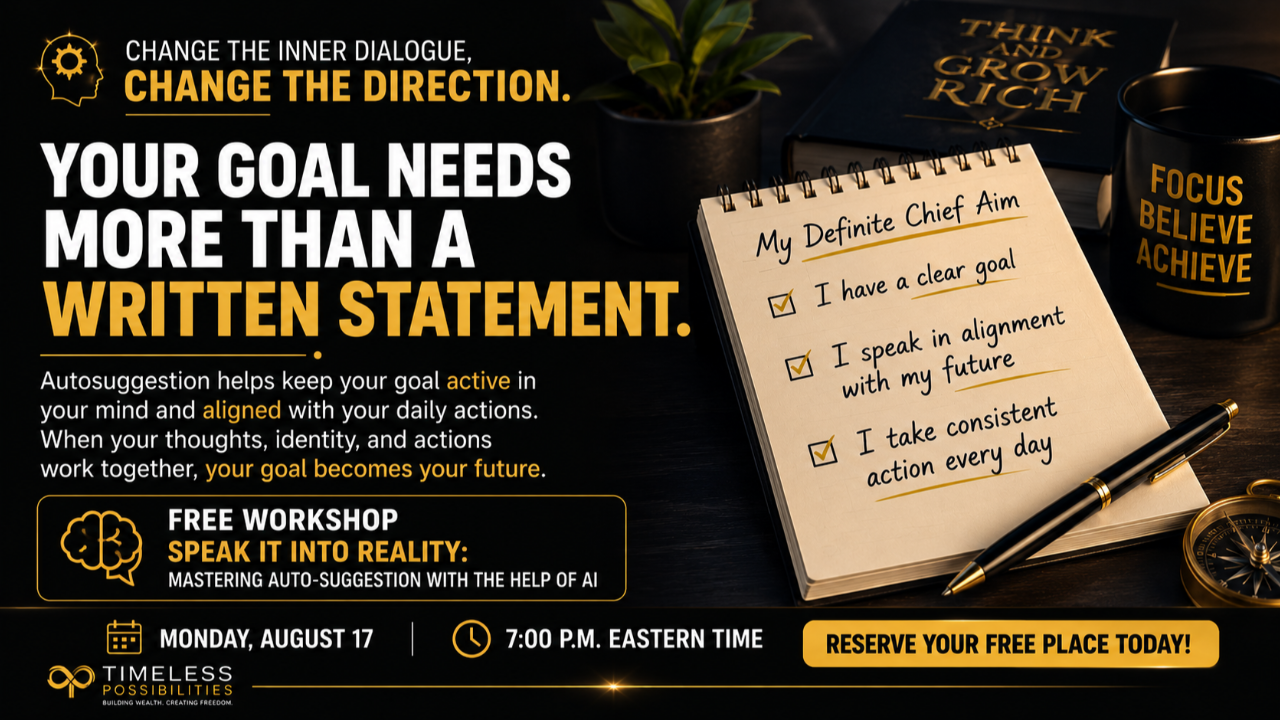
Your Goal Needs More Than a Written Statement
Aug 13, 2026What happens after you write down a goal?
For many people, that is where the process quietly stops. They create a clear statement, feel motivated for a few days, and then return to the same routines, the same doubts, and the same internal language they were using before. The goal may still be sitting on the page, but the thinking that shapes their daily behaviour has not changed.
That is why a written goal, by itself, is not always enough.
A Definite Chief Aim gives you direction, but autosuggestion helps you keep that direction active in your mind. When the words you repeat internally begin supporting the future you have written down, the goal becomes more than something you hope to achieve. It becomes something you are learning to think, speak, and act in alignment with.
A Goal Can Be Clear While Your Thinking Still Works Against It
Imagine someone writes a goal that says they intend to create an additional source of income. The statement is clear, the date is specific, and the plan makes sense. Yet throughout the day, their inner dialogue continues saying, “I do not know enough,” “Nobody will buy from me,” or “I always start things and then lose momentum.”
Now there is a conflict.
The written goal points in one direction, while the repeated internal message points in another. The person may genuinely want the result, but the thoughts they keep rehearsing can influence the way they interpret every setback, opportunity, and decision.
This is where autosuggestion becomes valuable. It gives you a practical way to reinforce the direction you have already chosen instead of allowing old thinking patterns to continually compete with it.
Repetition Helps Keep the Goal Mentally Active
A written goal becomes more useful when you return to it consistently.
The purpose is not simply to reread the same words mechanically. The purpose is to keep the result visible enough that it continues influencing what you notice, what you expect, and what you decide to do next.
When a goal fades into the background, daily responsibilities quickly take over. You become busy with whatever feels urgent, and the future you said you wanted receives less attention. Autosuggestion helps bring that future back into your awareness.
By intentionally repeating language connected to your goal, you give your mind a clearer point of reference. You begin reinforcing the result you are working toward rather than leaving your attention entirely at the mercy of circumstances.
Your Autosuggestion Should Support the Goal, Not Compete With Reality
This does not mean repeating exaggerated statements that feel disconnected from your experience.
If someone has never earned income from a side business, repeatedly saying, “I am already earning millions every month” may feel so unbelievable that the statement creates more resistance than confidence. A more useful autosuggestion can connect the future goal with the behaviour required to reach it.
For example, someone might say, “I am becoming more confident at creating value and speaking with people about what I offer.” That statement points toward growth and can be supported by real action.
The goal is not to convince yourself that the work has already been completed. The goal is to reinforce the direction you have chosen and the qualities you are developing as you move toward it.
Your Words Should Lead Somewhere
A strong autosuggestion should eventually influence behaviour.
If your written goal says you want to create additional income, your repeated language should help move you toward the actions that make that possible. It might reinforce your willingness to have conversations, make offers, follow up, improve your skills, or stay consistent when results are slower than expected.
This is where the connection between thought and action becomes important.
The words are not the result. They help shape the mindset from which you act.
If you repeatedly remind yourself that you are becoming someone who follows through, then completing the next important action gives that statement evidence. If you tell yourself that you are learning to create value, then solving a real problem for someone helps strengthen the belief.
The autosuggestion and the action begin supporting each other.
Repetition Helps You Return When You Drift
Even with a clear goal, there will be days when your focus slips.
You may become discouraged, distracted, or frustrated. A setback may cause you to question the entire plan, or an old habit may start pulling you back toward familiar behaviour.
Autosuggestion can become a way of returning.
A carefully chosen statement reminds you what you decided before the difficult moment arrived. It helps you reconnect with the direction instead of allowing one bad day to rewrite the entire story.
This is one of the most practical reasons to use autosuggestion consistently. It gives you language you can return to when your emotions are temporarily working against your larger intention.
The Goal and the Identity Need to Work Together
There is also a deeper connection between your written goal and the person you believe you are becoming.
A Definite Chief Aim describes the result you want. Autosuggestion can help reinforce the identity capable of producing it.
If your goal requires more discipline, your language can support that identity. If it requires confidence, persistence, patience, or stronger decision-making, your autosuggestion can help keep those qualities mentally active.
Over time, your actions begin providing evidence.
You stop simply saying, “I want this result,” and begin thinking, “This is how I am choosing to show up while I create it.”
That is a much stronger foundation.
Use Your Goal as the Starting Point
If you already have a written Definite Chief Aim, take it out and read it again.
Then ask yourself whether the language you repeat during the day supports that aim or works against it.
Notice the thoughts that appear when you imagine taking the actions the goal requires. If the goal says you will build a business but your internal language constantly says you are not capable of selling, that gap deserves attention.
Your autosuggestion can begin closing it.
Create a statement that connects the result you want with the person you are becoming and the actions you are willing to take. Keep it personal, believable, and specific enough that you can recognize when your behaviour is supporting it.
Join the Free Mastering Auto-Suggestion Workshop
On Monday, August 17, at 7:00 p.m. Eastern Time, I will be hosting the free online workshop Speak It Into Reality: Mastering Auto-Suggestion with the Help of AI.
During the workshop, we will explore how to use autosuggestion to reinforce a written goal rather than allowing old inner dialogue to compete with it. We will look at how to create statements that connect your goals, identity, and daily actions in a way that feels personal and believable.
We will also use AI to help refine the wording so your autosuggestion becomes something you can actually use consistently. The purpose is not to create a collection of generic affirmations, but to build language that supports the direction you have already chosen.
If you have recently created a Definite Chief Aim, this workshop is a natural next step. If you already know what you want but find that your thoughts often pull you in the opposite direction, this is an opportunity to bring those two parts into better alignment.
The workshop is completely free, it will be held online, and we will meet on Monday, August 17 at 7:00 p.m. Eastern Time.

Writing the goal gives you direction, but the thoughts you repeatedly return to help determine whether you continue moving in that direction. When your written aim, your inner language, and your actions begin supporting one another, the goal becomes much harder to ignore.
What If You Could Start Creating More Financial Momentum in Just 7 Days?
Reading about financial success can give you ideas. Taking action is what begins to create change.
That's why I created the FREE Money Momentum Starter Guide Workbook—a practical starting point for anyone who wants to make greater financial progress by managing their money more intentionally, exploring opportunities to create additional income, and developing habits that keep them moving forward.
Inside the FREE Starter Guide, you'll discover:
- Where you are financially today and where you'd like to make progress
- Opportunities to take greater control of the money already flowing through your life
- Skills, knowledge, and experience you may be able to turn into additional income
- Practical actions you can begin taking right away
- How to create your own 7-Day Money Momentum Action Plan
You don't need to have everything figured out. You don't need a perfect financial plan or a great business idea. You simply need a starting point and a willingness to take the next step.
Want Some Help Working Through It?
You can complete the Money Momentum Starter Guide entirely on your own for free, or for a one-time $5 upgrade, get 30 days of access to your own Money Momentum AI Assistant to help you work through the workbook.
Your AI Assistant can help you think through questions, explore possibilities when you're unsure what to write, dig deeper into your answers, and turn what you discover into practical next steps and your personalized 7-Day Money Momentum Action Plan.
Start Building Your Money Momentum Today. Download your FREE Money Momentum Starter Guide Workbook and take your first step toward greater financial progress.
