
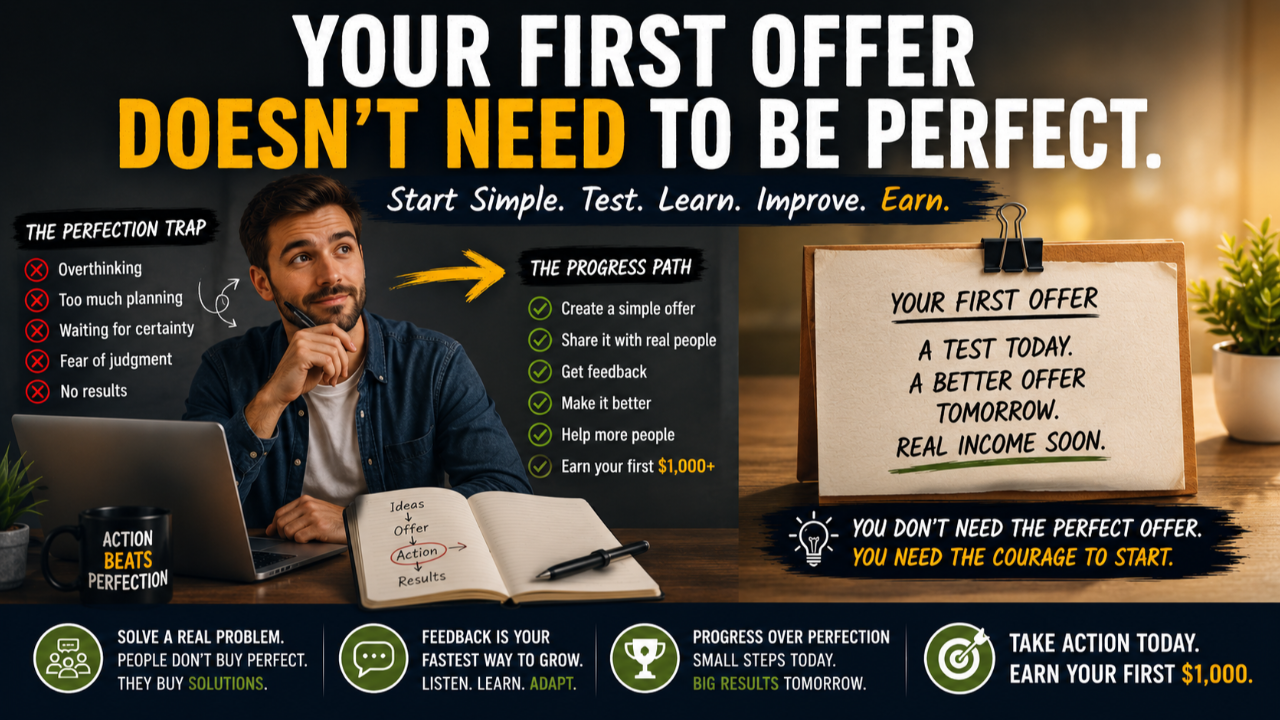
Your First Offer Doesn't Need to Be Perfect
Jun 28, 2026A friend of mine once spent three months creating what he believed was the perfect offer. He rewrote the description dozens of times. Changed the pricing several times. Redesigned the presentation. Adjusted the wording. Refined the details. Then refined them again. By the time he finally shared it with someone, he was exhausted.
The surprising part? The customer didn't buy. Not because the offer was bad. Not because the price was wrong. Not because the wording needed improvement. The customer didn't buy because they had a completely different problem than the one my friend thought they had.
Three months of planning could have been replaced by a single conversation. That's when I learned an important lesson: Perfection is often the enemy of progress. And nowhere is this more true than when creating your first offer.
Most People Think Their Offer Needs to Be Perfect
When people decide they want to earn extra income, they often become obsessed with creating the perfect offer. They want the perfect name. The perfect price. The perfect website. The perfect presentation. The perfect strategy.
The problem is that perfection creates delay. Weeks pass. Sometimes months. All while the offer remains hidden from the very people it was designed to help. The irony is that customers rarely care about perfection. They care about whether you can solve their problem.
The Marketplace Doesn't Reward Perfection
The marketplace rewards value. Think about some of the products and services you use every day. Many of them weren't perfect when they launched. They improved over time. The creators released something. Gathered feedback. Made adjustments, then improved it again.
That's how most successful offers evolve. Not through endless planning. Through interaction with real people.
Your First Offer Is a Test
One of the most helpful mindset shifts you can make is this: Your first offer is not your final offer. It's a test. It's a way to gather information. A way to discover what people want. A way to learn how customers think. A way to identify objections and opportunities.
When you view your offer as an experiment, the pressure disappears. You no longer need perfection. You only need participation.
Action Produces Information
Many people believe they need more information before they can make an offer. In reality, making the offer is often how you get the information. Customers tell you what they value. Customers tell you what they don't understand. Customers tell you what results they want. Customers tell you what concerns them. Those lessons are incredibly valuable and they only become available after you begin.
The Best Offers Are Built Through Feedback
Imagine two entrepreneurs. The first spends six months perfecting an offer behind closed doors. The second spends six months talking to potential customers and adjusting based on feedback.
Who do you think is more likely to create an offer people want? Almost always the second person. Why? Because they are building with the market instead of guessing about the market.
Feedback is one of the most valuable business assets you can acquire. Yet many people avoid it because they fear hearing criticism. The truth is that feedback often accelerates success.
Why Perfectionism Feels Productive
Perfectionism is dangerous because it feels responsible. It feels intelligent. It feels productive. After all, you're working hard, researching, planning, and improving, but sometimes perfectionism is simply fear in disguise. It's a way of avoiding the possibility of rejection.
As long as the offer isn't finished, nobody can say no. Unfortunately, nobody can say yes either.
The First Sale Teaches More Than Months of Planning
There is something powerful about your first customer. Not just because of the income. Because of what you learn. You discover how customers think, what they value, what questions they ask, and what concerns they have, and what language resonates with them.
These insights are difficult to obtain through theory alone. Real customers are the best teachers.
The Offer That Earns Your First $1,000 May Surprise You
Many people assume their first successful offer will be complicated. In reality, it's often remarkably simple. Helping someone organize their finances. Tutoring a student. Creating content for a business. Providing administrative support. Helping someone solve a problem. The simpler the offer, the easier it is to test. And the easier it is to improve.
What Napoleon Hill Would Say
Napoleon Hill repeatedly emphasized organized planning, but he never suggested waiting for perfect conditions. In fact, many of the successful people he studied started with imperfect plans. What separated them from everyone else was their willingness to act.
They adjusted as they learned. They improved as they gained experience. They didn't wait until everything was perfect. They started.
A Challenge for This Week
Take the offer you've been thinking about. Then ask yourself: "What if I shared this with someone today?" Not next month. Not after another course. Not after another revision. Today.
What feedback might you receive? What could you learn? What opportunities might appear? You may discover that the marketplace provides answers much faster than your imagination.
Progress Beats Perfection
Most people never earn their first $1,000 because they are waiting for the perfect opportunity, the perfect plan, or the perfect offer. Meanwhile, others are learning, adapting, and improving through action.
The goal is not perfection. The goal is progress. Every conversation creates information. Every offer creates feedback. Every step creates momentum. And momentum creates results.
Your first offer doesn't need to be perfect. It simply needs to exist.
Ready to Create and Test Your First Offer?
Download your FREE The First $1000 Side Income Starter Guidebook.
What If You Could Start Creating More Financial Momentum in Just 7 Days?
Reading about financial success can give you ideas. Taking action is what begins to create change.
That's why I created the FREE Money Momentum Starter Guide Workbook—a practical starting point for anyone who wants to make greater financial progress by managing their money more intentionally, exploring opportunities to create additional income, and developing habits that keep them moving forward.
Inside the FREE Starter Guide, you'll discover:
- Where you are financially today and where you'd like to make progress
- Opportunities to take greater control of the money already flowing through your life
- Skills, knowledge, and experience you may be able to turn into additional income
- Practical actions you can begin taking right away
- How to create your own 7-Day Money Momentum Action Plan
You don't need to have everything figured out. You don't need a perfect financial plan or a great business idea. You simply need a starting point and a willingness to take the next step.
Want Some Help Working Through It?
You can complete the Money Momentum Starter Guide entirely on your own for free, or for a one-time $5 upgrade, get 30 days of access to your own Money Momentum AI Assistant to help you work through the workbook.
Your AI Assistant can help you think through questions, explore possibilities when you're unsure what to write, dig deeper into your answers, and turn what you discover into practical next steps and your personalized 7-Day Money Momentum Action Plan.
Start Building Your Money Momentum Today. Download your FREE Money Momentum Starter Guide Workbook and take your first step toward greater financial progress.
