
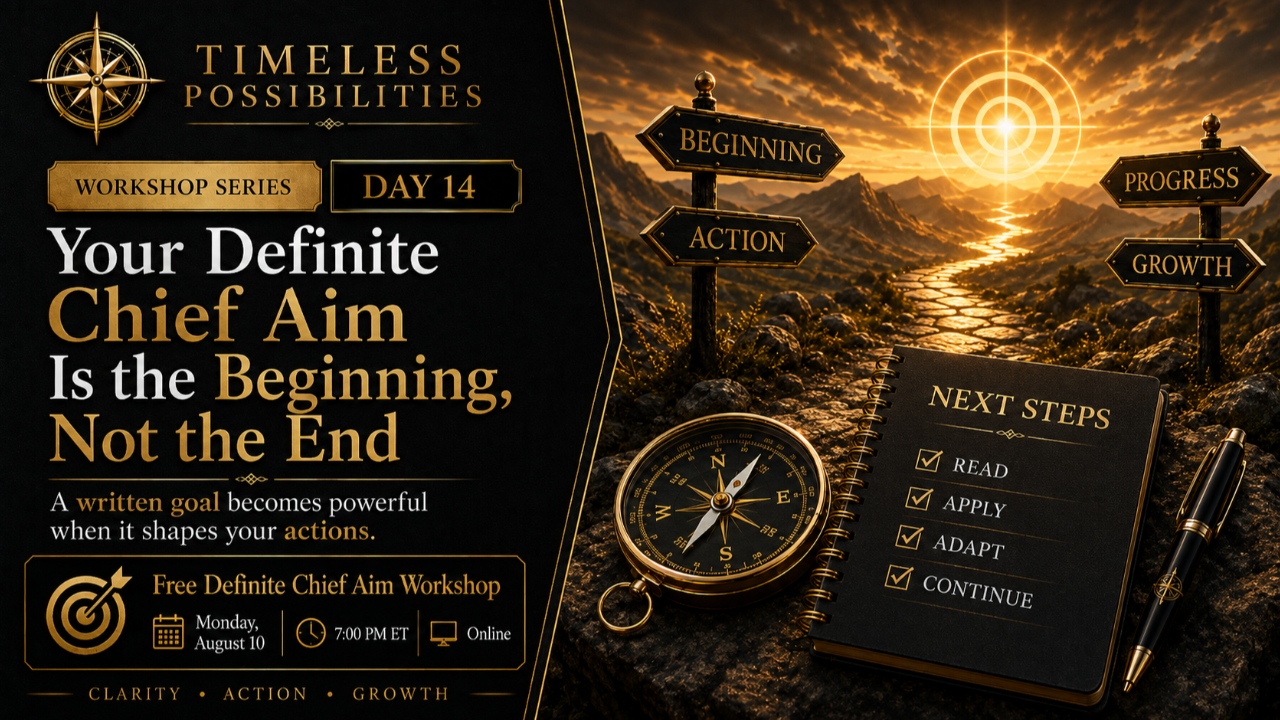
Your Definite Chief Aim Is the Beginning, Not the End
Aug 10, 2026In the last post, we brought the pieces of this series together by talking about the importance of putting your Definite Chief Aim into writing. Writing the goal gives it shape, forces greater clarity, and creates something you can return to when distractions or uncertainty begin pulling your attention elsewhere. But there is an important idea I do not want you to miss: writing your aim is not the finish line.
It is the beginning.
A written Definite Chief Aim becomes valuable when it begins influencing the way you think, the decisions you make, and the actions you take. The statement gives you direction, but your daily behaviour determines whether that direction eventually becomes a result. In other words, the goal on the page matters because of what you are willing to do after you write it.
The Written Statement Gives You a Starting Point
There is something powerful about finally being able to say clearly what you want. Instead of carrying around a collection of vague hopes, you now have a specific result, a date, an understanding of what you are willing to give in return, and a starting plan. That clarity can immediately make your future feel more manageable.
At the same time, it is important not to confuse clarity with completion. Writing a strong statement does not eliminate uncertainty, remove obstacles, or guarantee that everything will happen exactly as planned. What it does is give you a reference point from which you can begin making more intentional choices.
You no longer have to ask yourself what direction you should move in every morning. You have already chosen the direction. The next question becomes whether your actions are supporting it.
Your Aim Has to Enter Your Daily Life
A Definite Chief Aim should eventually become visible in more than your notebook. It should begin showing up in your calendar, your priorities, your conversations, and the way you use your time.
If your aim involves creating additional income, then some part of your week should be devoted to activities that could actually produce income. That might include developing an offer, starting conversations, serving customers, following up, or improving a skill that directly increases the value you can provide.
If your aim is connected to another area of your life, the same principle applies. The written statement should influence behaviour in a way that can be observed.
This is where a goal begins moving from intention into reality. The more consistently the aim influences your choices, the less likely it is to remain something you simply hoped would happen.
Your Plan Will Become Clearer Through Action
One of the most useful things you can accept from the beginning is that your first plan will probably not be your final plan. You will learn things once you begin that you could not have known while sitting at a desk trying to predict the future.
A conversation may reveal a better opportunity. Customer feedback may show you that your offer needs to change. You may discover that one activity produces much stronger results than another. You may also find that some assumptions you made when creating the plan were simply wrong.
That does not mean the Definite Chief Aim failed.
It means the plan is becoming more informed.
Action gives you evidence, and evidence helps you refine the route. This allows you to remain committed to the destination while becoming increasingly intelligent about how you intend to reach it.
Expect the Goal to Challenge Your Current Habits
The moment you begin acting seriously on a meaningful goal, you may also begin discovering habits that have been easier to ignore until now. Perhaps you procrastinate when an action feels uncomfortable, lose focus when results are slow, or move toward a new idea whenever the current one requires persistence.
A Definite Chief Aim can make these patterns easier to see because you now have a standard against which to evaluate them. You can ask whether the way you are behaving supports the direction you have chosen or keeps pulling you away from it.
This is where the identity work we discussed earlier in the series becomes important. You are not simply trying to force yourself through a collection of tasks. You are building the habits and characteristics that allow you to become more consistent, decisive, disciplined, and useful.
The goal gives those qualities somewhere to develop.
Progress May Look Smaller Than You Expect
Once a goal is written, there can be a temptation to expect visible results immediately. When they do not appear quickly enough, people sometimes assume the strategy is wrong or that they made a mistake choosing the goal.
But meaningful progress often begins quietly.
Your first evidence may be a better conversation, a clearer offer, a completed action, or a decision you previously would have avoided. Those changes may not look dramatic from the outside, but they matter because they indicate movement.
If you are working toward an income goal, your first victory may be identifying what someone is actually willing to pay for rather than receiving a large payment immediately. That information can become far more valuable than another month spent guessing.
Learning to recognize these smaller forms of progress helps you remain patient while still holding yourself accountable for action.
Review Without Constantly Starting Over
A written Definite Chief Aim also gives you a useful basis for reviewing your progress. You can look at what you intended to accomplish, compare it with what actually happened, and decide what needs to change.
The danger is turning every review into a reason to start over.
If something does not work immediately, you may be tempted to choose another goal, adopt another strategy, or abandon what you have already built. Constantly restarting can create the feeling of movement while preventing you from staying with anything long enough to learn from it.
A better approach is to separate the goal from the method.
Ask whether the destination still matters. If it does, then examine the strategy. Perhaps the offer needs improvement, your level of activity needs to increase, or you need to develop a skill that is currently limiting your results.
Refinement is different from abandonment.
Keep Bringing Your Attention Back
There will also be times when you simply lose focus. A busy week arrives, responsibilities increase, motivation decreases, and the actions connected to your aim begin slipping down the priority list.
That does not erase your progress.
The important habit is learning to return.
Your written aim gives you something to return to when you realize you have drifted. Instead of wasting another month criticizing yourself for losing focus, you can reread what you decided, identify the next meaningful action, and begin moving again.
The ability to return may be more important than the ability to remain perfectly focused all the time.
Very few people move toward a meaningful goal in a perfectly straight line. What matters is that the general direction remains intact.
Let the Aim Grow With You
As you continue acting, your understanding of the goal may deepen. The result you originally wanted may take on greater meaning, and you may begin seeing possibilities that were not visible when you first wrote the statement.
Your Definite Chief Aim can evolve as your knowledge improves.
That does not mean rewriting it every week based on your mood. It means remaining open to thoughtful refinement when evidence gives you a reason to change something.
Perhaps the goal remains the same but the plan becomes stronger. Perhaps you realize the result should be larger because you have developed more capability. Or you may discover that a slightly different direction is more aligned with the value you want to create.
The written aim provides stability while experience provides wisdom.
The Real Transformation Is Who You Become
Perhaps the most important idea in this entire series is that the goal is not only about what you eventually achieve. It is also about the person you become while pursuing it.
You may begin with a financial goal and discover that the real growth involves becoming more confident, disciplined, resourceful, or willing to take initiative. You may start because you want greater freedom and realize that creating that freedom requires stronger habits and better decisions.
Those changes often become more valuable than the original result because they travel with you into whatever goal comes next.
A person who learns how to choose a clear aim, make a plan, act consistently, learn from feedback, and adjust intelligently has developed a process that can be used repeatedly.
That is the deeper value of a Definite Chief Aim.
The Workshop Is Where We Put This Into Practice
Throughout this series, we have explored the major ideas behind creating and using a Definite Chief Aim. We have talked about stopping the drift, clarifying what you really want, making the goal specific, giving your actions a purpose, committing to the result, deciding what you will give in return, choosing a definite date, creating a simple plan, developing the identity required, staying focused, and putting the entire aim into writing.
The next step is to actually do the work.
On Monday, August 10, at 7:00 p.m. Eastern Time, I will be hosting a free online Definite Chief Aim Workshop where I will guide you through this process. Rather than simply listening to another presentation about goal setting, you will have the opportunity to think through your own goal and begin putting these principles into a form you can use.
We will work on clarifying what you want, deciding what you are willing to give in return, choosing your date, building a simple starting plan, and bringing those ideas together in your written Definite Chief Aim. The purpose is for you to leave with greater clarity about your future and a practical next step you can begin acting on.
If you have followed this series and found yourself thinking more seriously about what you want your next chapter to look like, I encourage you to join us. The workshop is completely free, it will be held online, and we will meet on Monday, August 10 at 7:00 p.m. Eastern Time.

Writing your Definite Chief Aim is an important moment, but it is only the beginning. The real change starts when that written decision begins shaping your actions, strengthening your identity, and helping you move intentionally toward the future you have chosen.
What If You Could Start Creating More Financial Momentum in Just 7 Days?
Reading about financial success can give you ideas. Taking action is what begins to create change.
That's why I created the FREE Money Momentum Starter Guide Workbook—a practical starting point for anyone who wants to make greater financial progress by managing their money more intentionally, exploring opportunities to create additional income, and developing habits that keep them moving forward.
Inside the FREE Starter Guide, you'll discover:
- Where you are financially today and where you'd like to make progress
- Opportunities to take greater control of the money already flowing through your life
- Skills, knowledge, and experience you may be able to turn into additional income
- Practical actions you can begin taking right away
- How to create your own 7-Day Money Momentum Action Plan
You don't need to have everything figured out. You don't need a perfect financial plan or a great business idea. You simply need a starting point and a willingness to take the next step.
Want Some Help Working Through It?
You can complete the Money Momentum Starter Guide entirely on your own for free, or for a one-time $5 upgrade, get 30 days of access to your own Money Momentum AI Assistant to help you work through the workbook.
Your AI Assistant can help you think through questions, explore possibilities when you're unsure what to write, dig deeper into your answers, and turn what you discover into practical next steps and your personalized 7-Day Money Momentum Action Plan.
Start Building Your Money Momentum Today. Download your FREE Money Momentum Starter Guide Workbook and take your first step toward greater financial progress.
