
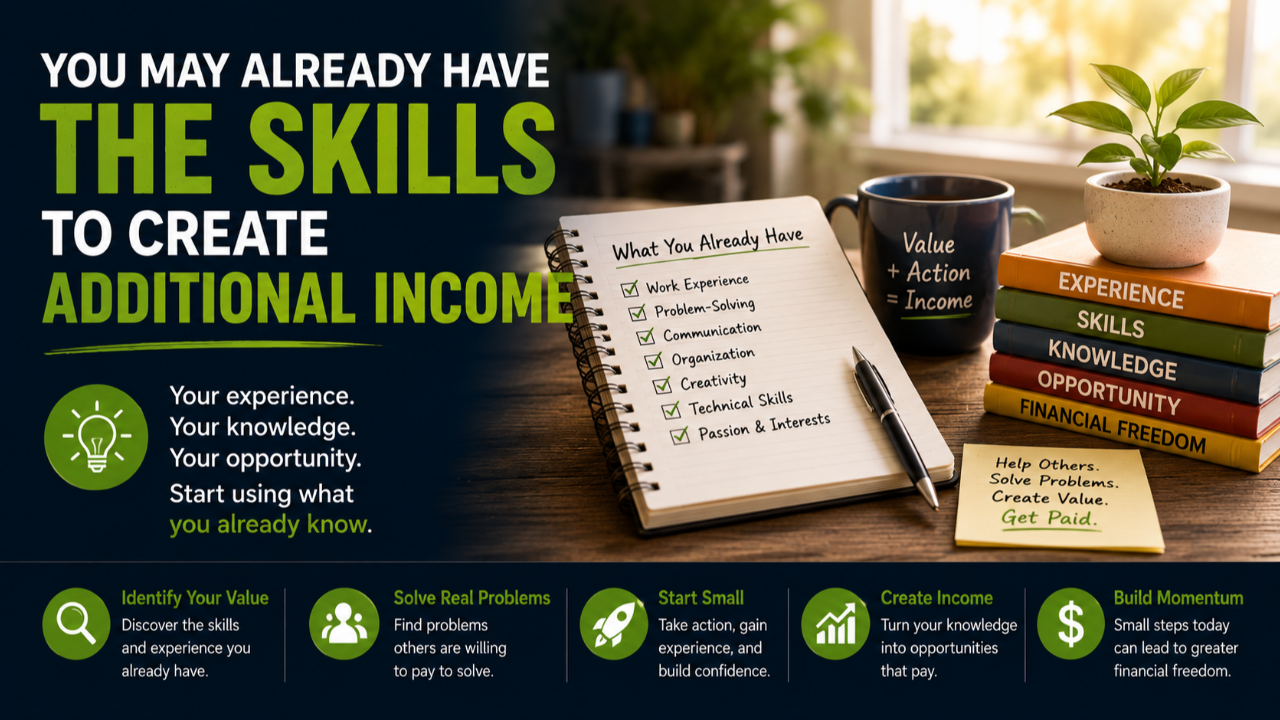
You May Already Have the Skills to Create Additional Income
Aug 20, 2026When people begin thinking about creating additional income, one of the first questions they often ask is, “What could I possibly do?” They search online for side hustles, business ideas, new trends, and ways to make money from home. Before long, they may conclude that they need to learn an entirely new skill, start a complicated business, or become an expert in something before they can earn their first additional dollar.
But what if the better place to start isn't with something new? What if you already possess knowledge, skills, and experience that someone else would find valuable?
Over the course of your life, you've learned how to do things that other people haven't. You've solved problems, developed professional skills, pursued hobbies, overcome challenges, made mistakes, and discovered better ways of doing things. Because much of this knowledge has become familiar to you, it's easy to overlook its potential value. Yet somewhere within what you already know could be the beginning of an additional source of income.
Why We Often Undervalue What We Already Know
One of the biggest obstacles to recognizing our own value is familiarity. When you've done something for years, it can become so natural that you no longer think of it as a valuable skill. You may even assume that almost everyone knows how to do it.
Someone who has spent twenty years working with spreadsheets, for example, may consider creating formulas and organizing information relatively simple. Yet another person may struggle for hours trying to accomplish the same thing. Someone who is naturally organized may not appreciate how valuable that ability is to a person who constantly feels overwhelmed. The same can be true of people who know how to repair things, manage projects, use technology, communicate effectively, cook, garden, take photographs, train employees, or solve technical problems.
The fact that something has become easy for you doesn't mean it has little value. In many cases, it means you've developed competence through years of practice and experience. What feels ordinary to you could be extremely useful to someone who hasn't had the opportunity to develop the same ability.
Start by Looking for Problems You Can Solve
Creating additional income can sound intimidating when you begin by asking, “What business should I start?” That question can immediately bring to mind websites, logos, advertising, social media, business plans, accounting, and all the other things we associate with building a business. It's easy to become overwhelmed before you've even determined whether anyone wants what you're considering offering.
A simpler place to begin is by asking, “What problem could I help someone solve?”
Almost every successful product or service exists because someone wanted a problem solved, a need met, or a result achieved. People pay others to save them time, reduce frustration, teach them something, organize something, repair something, create something, or help them accomplish a result they find difficult to achieve on their own.
You don't necessarily need an innovative idea that nobody has ever thought of before. You need to identify something useful you can do and connect it with someone who needs that help. That shift from finding the perfect business to solving a useful problem can make creating additional income feel much more achievable.
Pay Attention to What People Already Ask You About
One of the best clues to what you could potentially offer is already happening around you. Think about the things friends, family members, coworkers, or acquaintances regularly ask you to help them with.
Perhaps coworkers come to you when they don't understand a piece of software. Friends may ask for your help organizing an event, fixing something around the house, setting up technology, preparing a résumé, planning a trip, taking photographs, or understanding a financial spreadsheet. You may simply see these requests as helping someone out, but they can also tell you something important about how other people perceive your abilities.
People generally seek help from someone they believe understands something better than they do. You may not consider yourself an expert because you're comparing yourself with people who know considerably more. But the person asking for your help isn't necessarily looking for the world's leading authority. They may simply need someone who knows enough to help them get from where they are to where they want to be.
Your Career Has Probably Taught You More Than You Realize
Another place to look for potential income-producing skills is your career. The mistake is assuming that your job title represents everything you know how to do.
Consider someone who has spent years managing employees. Their job title might simply say “manager,” but their actual experience could include hiring, training, scheduling, communication, conflict resolution, budgeting, leadership, project planning, customer service, and problem-solving. Someone who has spent years working in administration may have developed valuable abilities involving organization, documentation, software, scheduling, processes, and communication.
This applies to almost every occupation. Years spent working in a particular environment expose you to situations and problems that someone outside that field may know very little about. Even if you no longer want to perform your exact job outside your regular working hours, some of the individual skills you've developed may be useful in entirely different situations.
Instead of asking only, “What do I do for a living?” try asking, “What have I learned because of what I've done for a living?” The second question can reveal possibilities that a job title never will.
Valuable Skills Don't Only Come From Work
Your professional experience is only one part of what you know. Some of your most useful abilities may have been developed outside the workplace through hobbies, volunteering, family responsibilities, community involvement, personal interests, or simply years of life experience.
Someone who has spent years gardening may know far more about plants than the average homeowner. A person who enjoys woodworking, photography, baking, sewing, music, automobiles, computers, pets, fitness, crafts, or home organization may have developed significant practical knowledge without ever thinking of it as an income-producing skill. The fact that nobody has paid you for something in the past doesn't determine whether it has value.
What matters is whether your knowledge or ability can help someone achieve a result they want. When you begin looking at your experience through that lens, you may discover opportunities that you've been overlooking simply because you've never thought of yourself as someone who could charge for what you know.
You Don't Need to Be the World's Leading Expert
A common reason people hesitate to offer their knowledge or skills is that they don't feel qualified enough. They compare themselves with someone who has decades of experience, impressive credentials, thousands of followers, or an established business and conclude that nobody would ever pay them.
But expertise is relative to the problem being solved. Someone who has never created a spreadsheet doesn't need the world's greatest spreadsheet expert to help them build a simple household tracking system. They need someone who understands spreadsheets well enough to help them accomplish the result they want.
The same principle applies in many areas. You don't always need to be ten years ahead of someone before you can help them. Sometimes being several steps ahead, combined with the ability to clearly explain what you know, is enough to provide genuine value. Naturally, there are areas where professional qualifications, licensing, or specialized expertise are essential, but many everyday problems can be solved using practical knowledge and experience.
Think About the Result, Not Just the Skill
Another useful shift is to stop thinking only about what you know how to do and begin thinking about the result your ability could create for someone else.
Saying “I'm good with spreadsheets” identifies a skill, but it doesn't immediately communicate why anyone should pay for it. Saying “I can help a small business owner create a simple system for tracking expenses” describes a useful result. Similarly, “I enjoy photography” is an interest, while “I can create professional-looking photographs for a local business's website” begins to describe value.
The same thinking can be applied to almost any ability. Years of project-management experience might become helping someone organize a complicated project and develop a realistic action plan. Strong organizational skills might become helping a busy professional create a more efficient filing or scheduling system.
People aren't usually paying simply because you possess knowledge. They're paying because that knowledge helps them accomplish something they want.
Start Small and Let the Market Teach You
Once you've identified something you might be able to offer, there can be a temptation to immediately build a business around it. You might start thinking about creating a website, designing a logo, opening social media accounts, printing business cards, or developing an elaborate product.
Before doing all of that, consider something much simpler: talk to people.
Describe the problem you believe you can solve and listen to how people respond. Ask questions about how they currently deal with the problem, what frustrates them, and what kind of help would actually be useful. Those conversations can teach you much more than sitting alone trying to design the perfect offer.
Eventually, try helping one person. That first experience will show you which parts of your knowledge are most useful, what questions people ask, how long the work takes, and what you might improve next time. A small real-world experiment can provide more valuable information than months spent planning a hypothetical business.
Your First Additional Income Can Change More Than Your Bank Account
When people think about creating additional income, they naturally focus on the amount of money they would like to earn. But your first small success can be valuable for another reason: it provides evidence that you can create income beyond your normal source.
Imagine earning your first $50 from a skill you've never previously been paid to use. Fifty dollars probably isn't going to dramatically change your financial situation, but it can change something important in your thinking. Someone valued what you could do enough to exchange money for it.
Once that happens, the question begins to change. Instead of wondering, “Could I actually create additional income?” you can begin asking, “How could I do that again, and how could I get better at it?”
Perhaps the next opportunity is worth $100. Maybe you improve your offer, help another person, increase the price as your confidence and ability grow, or discover another problem your customers would like you to solve. What started as a small experiment can gradually become a meaningful additional source of income.
That is how financial momentum often develops. It doesn't always begin with a brilliant idea or a dramatic breakthrough. Sometimes it begins with a small piece of evidence that proves you are capable of creating value.
Look at What You Already Have Before Searching for Something New
Before spending hours searching for the latest side hustle, take some time to examine your own experience. Think about the work you've done, responsibilities you've handled, hobbies you've pursued, problems you've solved, subjects you've studied, and lessons you've learned. Pay particular attention to things other people regularly ask you for help with and tasks that seem relatively easy to you but difficult to others.
Then begin looking for connections between what you know and problems other people would like solved. You don't need to identify the perfect opportunity immediately. The purpose is to begin recognizing that your ability to create additional income may not depend entirely on learning something new.
You may already possess much of what you need.
Creating additional income isn't always about discovering the next great opportunity. Sometimes it's about recognizing the value that's been sitting in front of you all along and finding a practical way to use it to help someone else.
That's an important part of building Money Momentum. Greater financial progress isn't only about managing the money already flowing through your life. It's also about recognizing your ability to create value, develop new opportunities, and increase the amount of money available to support the future you're trying to build.
So before asking yourself, “What new thing should I learn so I can make more money?”, consider a different question:
What do I already know that could help someone else?
Your next source of additional income may be closer than you think.
What If You Could Start Creating More Financial Momentum in Just 7 Days?
Reading about financial success can give you ideas. Taking action is what begins to create change.
That's why I created the FREE Money Momentum Starter Guide Workbook—a practical starting point for anyone who wants to make greater financial progress by managing their money more intentionally, exploring opportunities to create additional income, and developing habits that keep them moving forward.
Inside the FREE Starter Guide, you'll discover:
- Where you are financially today and where you'd like to make progress
- Opportunities to take greater control of the money already flowing through your life
- Skills, knowledge, and experience you may be able to turn into additional income
- Practical actions you can begin taking right away
- How to create your own 7-Day Money Momentum Action Plan
You don't need to have everything figured out. You don't need a perfect financial plan or a great business idea. You simply need a starting point and a willingness to take the next step.
Want Some Help Working Through It?
You can complete the Money Momentum Starter Guide entirely on your own for free, or for a one-time $5 upgrade, get 30 days of access to your own Money Momentum AI Assistant to help you work through the workbook.
Your AI Assistant can help you think through questions, explore possibilities when you're unsure what to write, dig deeper into your answers, and turn what you discover into practical next steps and your personalized 7-Day Money Momentum Action Plan.
Start Building Your Money Momentum Today. Download your FREE Money Momentum Starter Guide Workbook and take your first step toward greater financial progress.
