
You Already Know Enough, You’re Just Not Using It
Mar 30, 2026Most People Already Possess Valuable Specialized Knowledge, but Fail to Recognize It
What if the knowledge you’re searching for is already inside your lived experience and you’ve been overlooking it the whole time?”
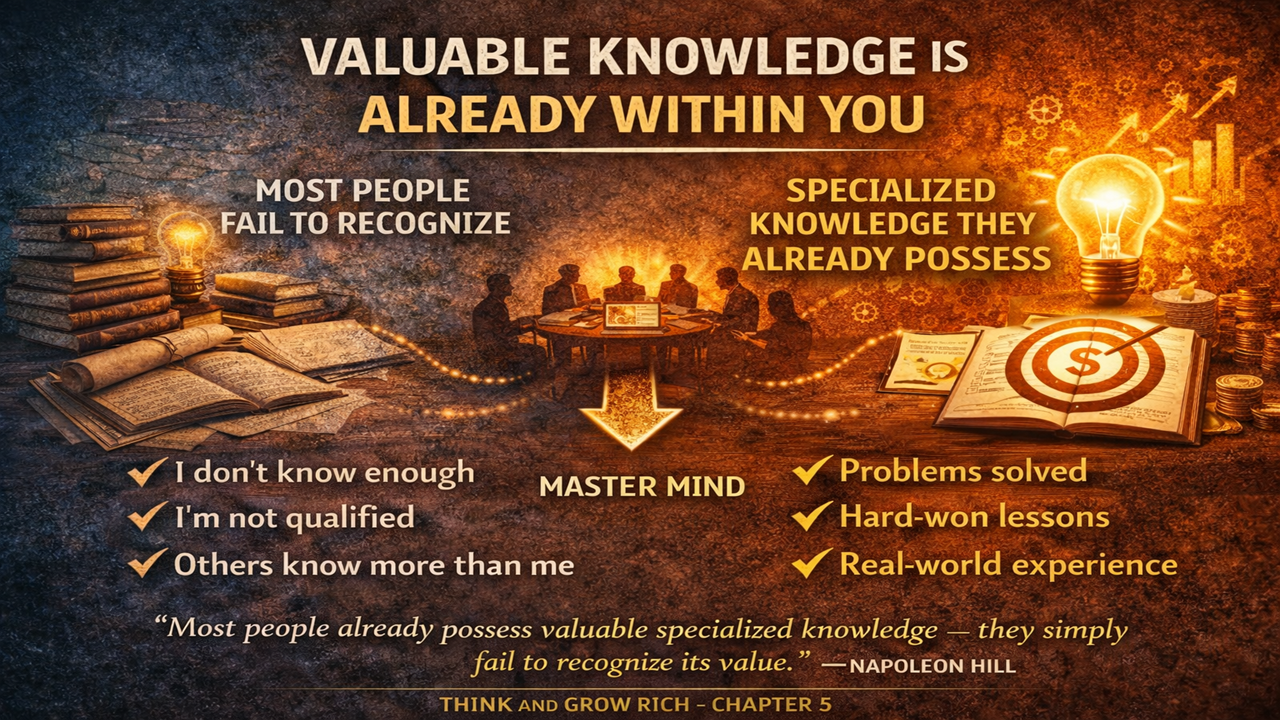
That question stops people cold. Napoleon Hill discovered something quietly tragic in his research: many people chase new information endlessly while standing on untapped value they already possess. They assume: “I don’t know enough.” “I’m not qualified.” “Others know more than me.” Hill saw the opposite to be true. Most people already possess specialized knowledge, they simply fail to recognize its value. This insight forms Point 7 of Chapter 5, and it is one of the most empowering ideas in Think and Grow Rich.
Hill observed that success rarely comes from rare genius. It comes from applied familiarity. People underestimate their own knowledge because it feels obvious, normal, hard-earned but unremarkable, or learned “the long way.” But Hill understood a crucial truth: Ease is often evidence of mastery, not insignificance. What feels simple to you may be precisely what others struggle with.
What Hill Really Means by “Failing to Recognize Value”
Hill is describing a perception error. People judge the worth of their knowledge by how hard it was to learn, whether it came from formal education, how impressed others seem, or how long they’ve known it. The market judges value differently. The market asks: “Does this save time?” “Does this reduce risk?” “Does this simplify a problem?” “Does this produce results?” Experience that removes uncertainty is extremely valuable, even if it feels routine to you.
Why People Dismiss Their Own Expertise
Hill noticed several patterns: People say: “That’s just common sense.” “Anyone could figure that out.” “I just learned by doing.” “I’m not an expert.” Hill would say Common sense is not common, it is learned. Learning through experience often produces the most reliable knowledge. The irony is this: The more natural your skill feels, the less you value it, while others see it as rare.
How Recognizing Your Existing Knowledge Supports Your $10K/Month Goal
An additional $10,000 per month is rarely created by brand-new information. It is created by packaging insight you already have, applying experience intentionally, offering clarity to someone behind you, or solving problems you’ve already solved. Here’s how this principle directly supports income creation:
- It eliminates unnecessary delay: You stop waiting to “become ready” and start acting from where you are.
- It restores confidence: Confidence grows when you recognize what you already know.
- It clarifies your offer: Your experience naturally points to the problems you’re best equipped to solve.
- It accelerates execution: Less learning, more applying.
- It increases perceived authority: Experience carries trust. Income follows trust.
Why This Is Hard to See Alone
Left alone, people remain blind to their own value. Why? Because you cannot objectively evaluate what feels normal to you. Hill understood this limitation. That’s why he emphasized association, not just for ideas, but for reflection.
How a Master Mind Reveals Hidden Value
A Master Mind does something powerful: It shows you what you’ve been standing on.
- Others Hear Value You Don’t Notice: When you share your story, others say: “That’s not ordinary, that’s useful.” Perspective changes instantly.
- Patterns Emerge Through Discussion: What felt random becomes repeatable. Experience becomes a framework.
- Language Sharpens Authority: The group helps you articulate what you do well, why it works, and who it helps. Clarity creates confidence.
- Experience Becomes a Marketable Asset: Conversation turns lived experience into offers, services, coaching, and guidance. Income pathways appear naturally.
- Validation Reprograms the Subconscious: When others benefit from your knowledge, your subconscious accepts: “I have value to offer.” Belief strengthens.
Practical Action Steps (Hill-Aligned)
Here’s how to identify and activate the knowledge you already possess:
- Action 1: List Problems You’ve Solved Repeatedly: These are signals of specialization.
- Action 2: Identify What People Ask You For: Requests reveal perceived value.
- Action 3: Write the Lessons You Learned the Hard Way: Pain often produces premium insight.
- Action 4: Apply That Knowledge Intentionally: Test value through service.
- Action 5: Share Your Experience in the Master Mind: Listen for what resonates. That’s market feedback.
- Action 6: Package the Lesson, Not the Story: People buy clarity and outcomes.
- Action 7: Repeat and Refine Weekly: Recognition grows through use.
Why Hill Ends Chapter 5 This Way
Because confidence collapses when people believe they lack value. Hill wanted readers to understand this: You do not need to become someone else to succeed. You need to recognize and apply what you already are.
Final Reflection
If someone else had lived your experiences, solved your problems, and learned your lessons, would you consider their knowledge valuable?
Hill’s insight remains exact: Most people are rich in experience, but poor in recognition of its worth.
What If You Could Start Creating More Financial Momentum in Just 7 Days?
Reading about financial success can give you ideas. Taking action is what begins to create change.
That's why I created the FREE Money Momentum Starter Guide Workbook—a practical starting point for anyone who wants to make greater financial progress by managing their money more intentionally, exploring opportunities to create additional income, and developing habits that keep them moving forward.
Inside the FREE Starter Guide, you'll discover:
- Where you are financially today and where you'd like to make progress
- Opportunities to take greater control of the money already flowing through your life
- Skills, knowledge, and experience you may be able to turn into additional income
- Practical actions you can begin taking right away
- How to create your own 7-Day Money Momentum Action Plan
You don't need to have everything figured out. You don't need a perfect financial plan or a great business idea. You simply need a starting point and a willingness to take the next step.
Want Some Help Working Through It?
You can complete the Money Momentum Starter Guide entirely on your own for free, or for a one-time $5 upgrade, get 30 days of access to your own Money Momentum AI Assistant to help you work through the workbook.
Your AI Assistant can help you think through questions, explore possibilities when you're unsure what to write, dig deeper into your answers, and turn what you discover into practical next steps and your personalized 7-Day Money Momentum Action Plan.
Start Building Your Money Momentum Today. Download your FREE Money Momentum Starter Guide Workbook and take your first step toward greater financial progress.
