
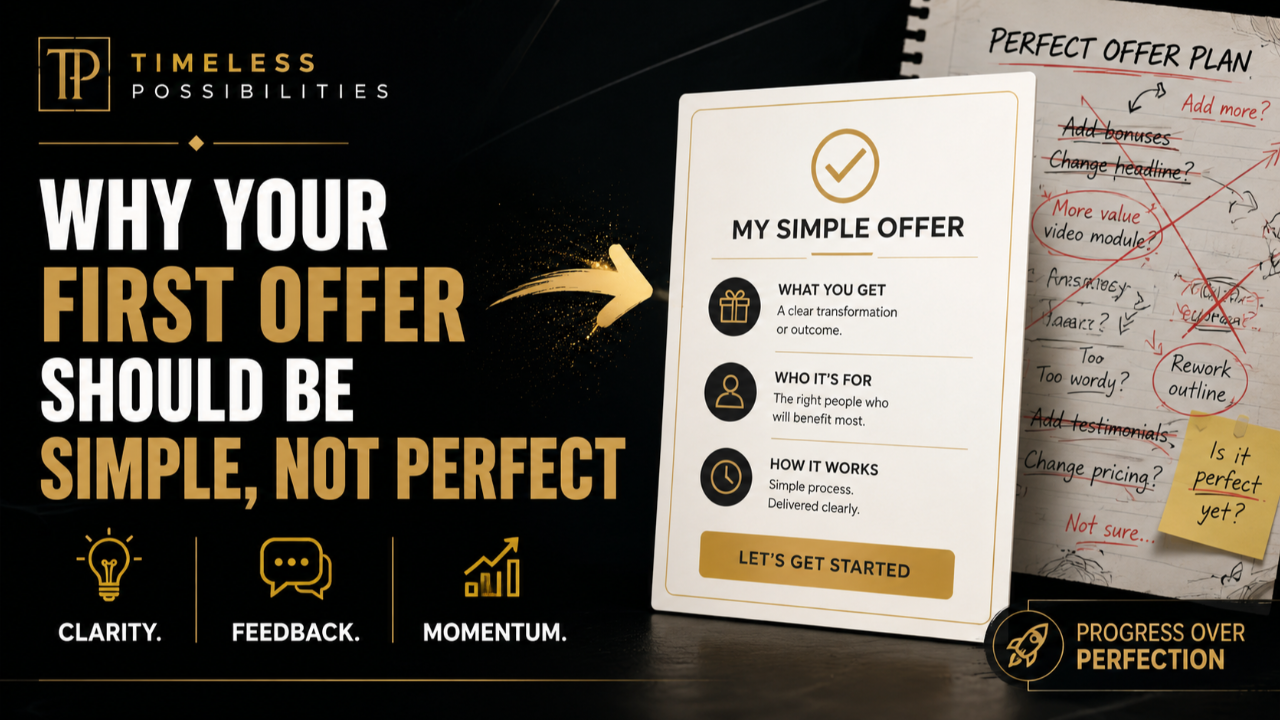
Why Your First Offer Should Be Simple, Not Perfect
Jul 09, 2026Many people never earn their first dollar from a side income because they keep improving an offer that no one has seen yet.
They rewrite the wording. They adjust the package. They think about the price. They wonder whether they need a better logo, a better website, a better social media page, or more confidence before they begin.
At first, this feels responsible. It feels like preparation. But often, it is really procrastination disguised as planning.
If you want to earn your first $1,000 in extra income, your first offer does not need to be perfect. It needs to be clear enough to share with real people.
That is where progress begins.
Perfection Keeps Your Offer Hidden
A hidden offer cannot help anyone. It cannot create conversations, feedback, referrals, customers, or income. No matter how much you improve it privately, it remains only an idea until someone else sees it, understands it, and has the opportunity to respond.
This is where many people get stuck. They keep working on the offer because working on it feels safer than sharing it. When the offer stays private, no one can reject it. No one can question it. No one can ignore it. But no one can buy it either.
Perfection may feel protective, but it often delays the very experience that would help you improve.
Simple Is Easier to Understand
Your first offer should be simple because simple offers are easier for people to understand. If someone cannot quickly understand who you help, what problem you solve, and what result you create, they will struggle to see the value.
A simple offer does not need to explain everything you can do. It should focus on one person, one problem, and one clear result. For example, “I help busy homeowners keep their yards looking cared for so they can enjoy their weekends” is much stronger than trying to explain every possible yard service, package, add-on, and future plan.
Clarity helps people make decisions. It also makes your offer easier to remember and easier to refer.
Your First Offer Is a Test
It is helpful to think of your first offer as a test, not a final product. You are not trying to create the perfect version before anyone sees it. You are trying to create a clear starting point so you can learn from real conversations.
Once you share your offer, you may discover that people respond better to a different result. You may learn that your price needs adjusting. You may hear questions you did not expect. You may realize that one part of your offer matters more to people than another.
That feedback is valuable. But you cannot receive it while you are only thinking, planning, and editing in private.
Real People Help You Improve Faster
The marketplace teaches faster than guessing. You can spend weeks trying to decide whether your offer is good, or you can share a simple version and learn from how real people respond.
If people seem confused, your wording may need to be clearer. If people understand but do not care, the problem may not be painful enough. If people ask about price, timing, or details, that may be a sign of interest. If someone says, “I know someone who needs that,” you may be closer than you think.
Each conversation gives you information. Even when the conversation does not lead to a sale, it can help you improve your message, your confidence, and your understanding of the customer.
A Simple Offer Reduces Overwhelm
Trying to create a perfect offer can become overwhelming because there are too many decisions. What should be included? What should it cost? How should it be delivered? What should the name be? What if someone asks for something different?
A simple offer reduces that pressure. You choose one clear problem to solve and one practical result to help create. That allows you to focus on action instead of endless preparation.
For example, instead of offering “home organization services,” you might begin with “a two-hour pantry reset for busy families who feel overwhelmed by clutter.” Instead of offering “business support,” you might begin with “a simple spreadsheet setup to help a small business owner track income and expenses.”
Specific offers are easier to explain, easier to price, and easier to test.
You Can Improve After You Begin
Many people believe they need confidence before they share their offer, but confidence usually comes after action. The first time you explain your offer, it may feel awkward. The second time may feel slightly better. By the fifth or tenth conversation, you will likely sound clearer and more natural.
That is how confidence grows. It is built through practice, not waiting.
You can improve your offer as you go. You can adjust the wording. You can refine the price. You can simplify the result. You can create a better process after you have served a few people. Beginning with a simple offer does not mean staying basic forever. It means giving yourself permission to start.
Do Not Build Before You Validate
One of the most expensive mistakes beginners make is building too much before they know whether people want the offer. They create a website, design graphics, write long sales pages, record content, and build complicated systems before having enough real conversations.
Those things may be useful later, but they are not the first step.
The first step is finding out whether real people have the problem, care enough to solve it, and understand the value of your offer. A simple offer allows you to test that quickly. It helps you avoid spending weeks building something that still has not been validated by the marketplace.
A Simple Challenge for This Week
This week, take your current offer and simplify it into one sentence:
I help [who] solve [problem] so they can [result].
Then ask yourself whether a real person could understand it in less than thirty seconds. If the answer is no, simplify it again. Remove extra details, avoid clever wording, and focus on the problem and result.
After that, share your simple offer with three people. Do not try to make a perfect pitch. Just start a conversation and notice what happens. Pay attention to what people understand, what they ask, and whether anyone comes to mind who might need that kind of help.
Your goal is not perfection. Your goal is feedback.
Progress Comes From Sharing
Your first $1,000 will not come from having the most polished offer hidden in your notebook. It will come from sharing a clear offer with real people, listening to their responses, and improving as you go.
Simple does not mean weak. Simple means understandable. Simple means focused. Simple means ready to test.
The sooner you share your offer, the sooner you can learn. The sooner you learn, the sooner you can improve. And the sooner you improve, the closer you move toward your first customer and your first $1,000.
Do not wait until it is perfect.
Make it clear.
Make it simple.
Then put it in front of real people.
Download Your Free First $1,000 Side Income Starter Guide
If this article helped you see why your first offer should be simple instead of perfect, your next step is to begin putting that clarity into action. That is why I created The First $1,000 Side Income Starter Guide.
This free guide will help you think through your skills, identify real problems, clarify your offer, and begin taking practical steps toward your first $1,000 in extra income.
You do not need a perfect offer before you begin. You need a clear starting point, real conversations, and the willingness to improve through action.
Download your free First $1,000 Side Income Starter Guide today and start building your side income with clarity, confidence, and momentum.
And when you are ready for a complete step-by-step process, The First $1,000 Side Income Action Plan will guide you through the full 12-week journey of choosing one opportunity, creating a simple offer, taking consistent action, and earning your first $1,000.
What If You Could Start Creating More Financial Momentum in Just 7 Days?
Reading about financial success can give you ideas. Taking action is what begins to create change.
That's why I created the FREE Money Momentum Starter Guide Workbook—a practical starting point for anyone who wants to make greater financial progress by managing their money more intentionally, exploring opportunities to create additional income, and developing habits that keep them moving forward.
Inside the FREE Starter Guide, you'll discover:
- Where you are financially today and where you'd like to make progress
- Opportunities to take greater control of the money already flowing through your life
- Skills, knowledge, and experience you may be able to turn into additional income
- Practical actions you can begin taking right away
- How to create your own 7-Day Money Momentum Action Plan
You don't need to have everything figured out. You don't need a perfect financial plan or a great business idea. You simply need a starting point and a willingness to take the next step.
Want Some Help Working Through It?
You can complete the Money Momentum Starter Guide entirely on your own for free, or for a one-time $5 upgrade, get 30 days of access to your own Money Momentum AI Assistant to help you work through the workbook.
Your AI Assistant can help you think through questions, explore possibilities when you're unsure what to write, dig deeper into your answers, and turn what you discover into practical next steps and your personalized 7-Day Money Momentum Action Plan.
Start Building Your Money Momentum Today. Download your FREE Money Momentum Starter Guide Workbook and take your first step toward greater financial progress.
