
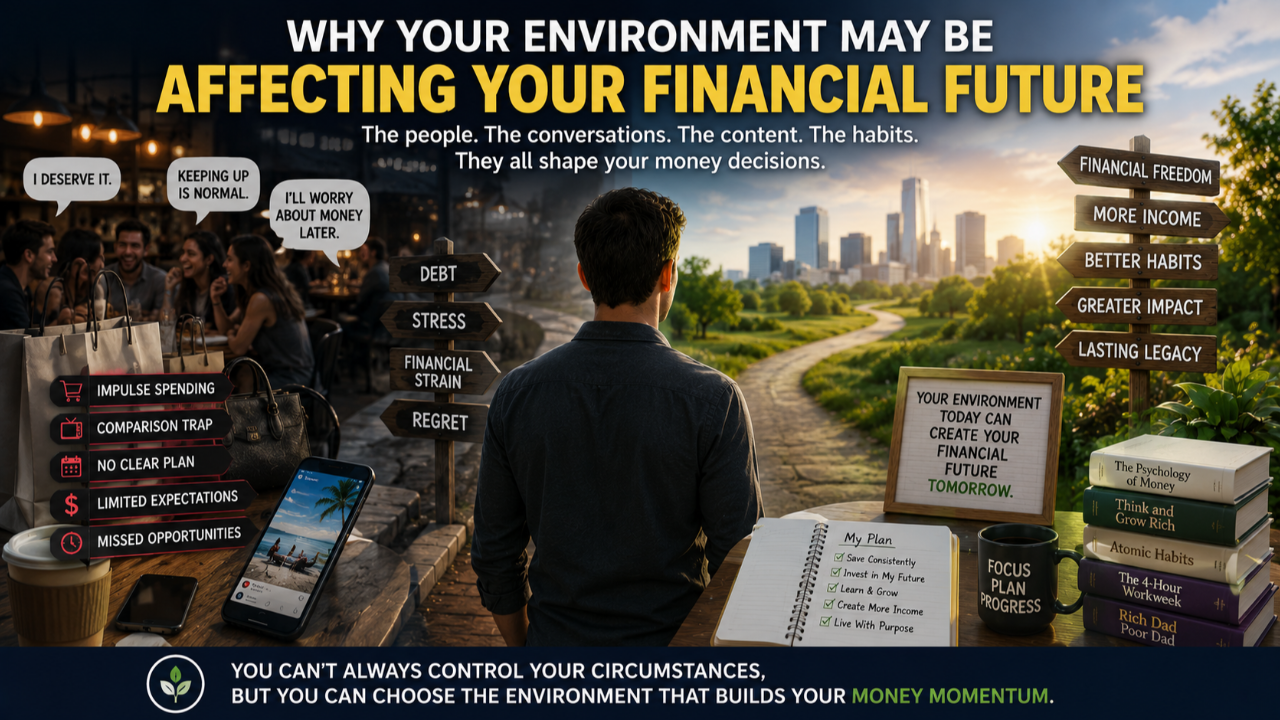
Why Your Environment May Be Affecting Your Financial Future
Aug 25, 2026When we think about improving our finances, we usually focus on things such as earning more, spending less, saving consistently, or making better financial decisions. Those things certainly matter. But there is another influence on our financial behaviour that is easy to overlook: the environment we live in every day.
Your environment includes more than your physical surroundings. It includes the people you spend time with, the conversations you hear, the content you consume, the expectations around you, and even the habits that have become normal within your social circle. Over time, these influences can quietly shape what you believe about money, success, income, and what is possible for your financial future.
Your Financial Habits Don't Develop in Isolation
Think about some of the attitudes toward money you were exposed to growing up. Perhaps money was discussed openly in your family, or perhaps it was something nobody talked about. Maybe saving was encouraged, debt was considered normal, investing was rarely discussed, or earning more was viewed as something available only to certain people.
Those experiences can influence us long after childhood. We may carry assumptions about money without ever stopping to ask where they came from or whether they are still useful.
The same process continues throughout adulthood. If the people around you frequently spend beyond their means, financing purchases may begin to seem completely normal. If your friends regularly discuss investing, business opportunities, career advancement, or ways of creating additional income, those possibilities may start to feel more normal instead.
Neither environment automatically determines your future, but both can influence the decisions you make.
What Feels Normal Can Be More Powerful Than We Realize
Human beings naturally compare themselves with the people around them. That can influence financial behaviour in surprisingly subtle ways.
Imagine several coworkers regularly upgrading their vehicles, taking expensive vacations, or buying larger homes. Even if nobody directly pressures you to do the same, your idea of a normal lifestyle may gradually change. Purchases that once seemed unnecessary can begin to feel reasonable simply because people around you are making them.
The opposite can happen too. Spend time around people who regularly talk about saving a portion of their income, building assets, learning new skills, or creating additional sources of income, and those behaviours can begin to seem normal as well.
This is one reason financial progress isn't only about knowing what to do. Your surroundings can either reinforce the habits you're trying to develop or continually pull you back toward the habits you're trying to change.
Your Digital Environment Matters Too
Today, some of the strongest influences on our financial behaviour may not be people we know personally. They may be people we follow online.
Social media can expose us to hundreds of examples of what other people appear to own, experience, and achieve. We see vacations, new vehicles, renovated homes, restaurants, clothing, technology, and stories of rapid financial success. What we usually don't see is the complete financial picture behind those images.
Repeated exposure can gradually change our expectations. A lifestyle that would once have seemed extravagant may begin to feel ordinary. We can find ourselves spending money to keep pace with a standard created partly by carefully selected images of other people's lives.
The same digital environment can work in your favour. You can intentionally consume information that teaches useful financial principles, introduces you to new ideas, helps you develop valuable skills, or shows realistic ways people are improving their finances. The question isn't simply how much information you're consuming, but whether that information is supporting the direction you want to go.
Your Environment Can Affect How Much You Believe You Can Earn
Environment doesn't only influence spending. It can also influence what we believe about income.
Suppose most of the people you regularly interact with rely on one source of income and rarely discuss other possibilities. Creating additional income may seem unusual, complicated, or risky. You may never seriously consider whether your knowledge, skills, or experience could create value outside your primary job.
Now imagine regularly interacting with people who freelance, consult, operate small businesses, sell services, invest, or develop multiple sources of income. You don't automatically become financially successful simply by being around them, but your perception of what's possible may begin to expand.
You may start asking different questions. Instead of asking, "Could I ever do something like that?" you may begin wondering, "What could I do with the skills I already have?"
That change in thinking can matter because opportunities are often easier to recognize once we believe they are worth looking for.
You Don't Have to Replace Everyone Around You
When people hear advice about changing their environment, it can sometimes sound as though they're supposed to abandon friends or distance themselves from anyone who doesn't share their goals. That's neither necessary nor particularly realistic.
You can appreciate the people in your life while also recognizing that different relationships serve different purposes. Someone can be a wonderful friend without being the person you turn to for financial guidance or encouragement about building a business.
Instead, think about expanding your environment. You might join a group where people are working toward similar goals, attend educational events, read books that challenge your thinking, follow knowledgeable teachers, or spend more time having conversations with people who are actively creating the kind of progress you want to make.
You're not rejecting your existing environment. You're intentionally adding influences that support your growth.
Create an Environment That Makes Better Decisions Easier
Your physical environment can also support better money habits. Small changes can reduce the amount of willpower required to make good financial decisions.
Automatic transfers can move money into savings before you have an opportunity to spend it. Removing shopping apps or promotional emails can reduce unnecessary purchasing triggers. Scheduling a regular financial review can make managing money part of your routine rather than something you deal with only when there's a problem.
The same principle applies to creating additional income. If you want to explore a new income opportunity but never create time for it, your existing routine will probably consume every available hour. Setting aside even two focused hours each week changes the environment around that goal. You have created a place for the opportunity to develop.
Better habits become easier when your surroundings support them.
Take a Look at What's Influencing You
You don't need a completely different life before you can make financial progress. But it is worth paying attention to the influences that surround you.
Consider the conversations you regularly participate in, the people whose advice you listen to, the content appearing on your phone, and the behaviours that have become normal in your everyday life. Ask yourself whether those influences generally move you toward better financial decisions or make those decisions harder.
This is an important part of building Money Momentum. Managing what you have more intentionally and developing your ability to create more income are important, but maintaining that progress becomes easier when your environment supports the person you're trying to become.
You may not be able to control every influence around you, and you don't need to. Start with something you can control. Change one source of information you regularly consume, create one useful financial routine, have one conversation with someone who is making progress, or spend time in a community where people are working toward similar goals.
Your financial future will ultimately be shaped by the decisions you make. But when you create an environment that supports better decisions, making those decisions becomes considerably easier.
What If You Could Start Creating More Financial Momentum in Just 7 Days?
Reading about financial success can give you ideas. Taking action is what begins to create change.
That's why I created the FREE Money Momentum Starter Guide Workbook—a practical starting point for anyone who wants to make greater financial progress by managing their money more intentionally, exploring opportunities to create additional income, and developing habits that keep them moving forward.
Inside the FREE Starter Guide, you'll discover:
- Where you are financially today and where you'd like to make progress
- Opportunities to take greater control of the money already flowing through your life
- Skills, knowledge, and experience you may be able to turn into additional income
- Practical actions you can begin taking right away
- How to create your own 7-Day Money Momentum Action Plan
You don't need to have everything figured out. You don't need a perfect financial plan or a great business idea. You simply need a starting point and a willingness to take the next step.
Want Some Help Working Through It?
You can complete the Money Momentum Starter Guide entirely on your own for free, or for a one-time $5 upgrade, get 30 days of access to your own Money Momentum AI Assistant to help you work through the workbook.
Your AI Assistant can help you think through questions, explore possibilities when you're unsure what to write, dig deeper into your answers, and turn what you discover into practical next steps and your personalized 7-Day Money Momentum Action Plan.
Start Building Your Money Momentum Today. Download your FREE Money Momentum Starter Guide Workbook and take your first step toward greater financial progress.
