
Why Napoleon Hill Said Organized Planning Turns Goals Into Income
Mar 07, 2026Desire Must Be Organized Into a Definite Plan
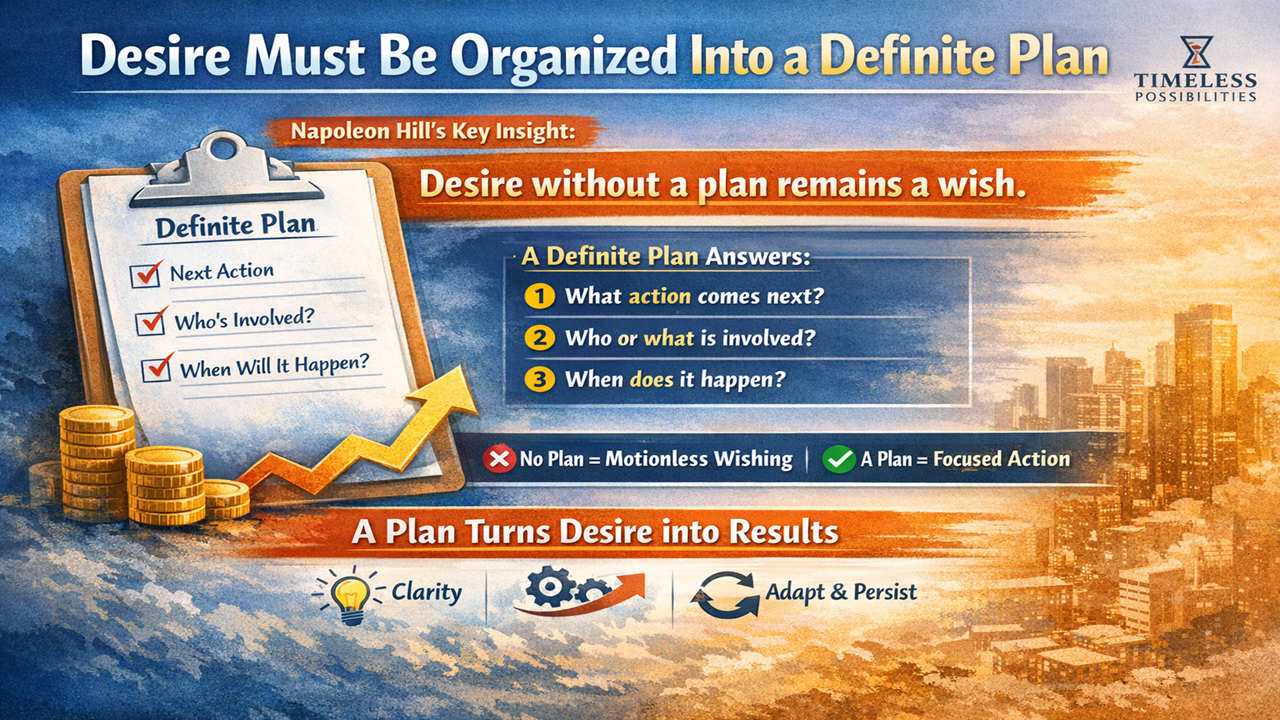
Most people don’t fail because they lack desire, they fail because their desire never learns how to move. Desire can burn fiercely and still go nowhere. Napoleon Hill saw this repeatedly in his interviews with successful men. They all had intense desire, but that alone did not separate them from dreamers. The difference was this: They gave their desire a body. That body was a definite plan. This brings us to the moment desire stops being emotional and starts becoming mechanical.
Hill is explicit: desire without a plan remains a wish. A plan is not about certainty. It is about direction. Hill does not require the first plan to be perfect. In fact, he assumes it won’t be. What he insists on is this: When one plan fails, replace it immediately with another and keep moving. The purpose of a plan is not to guarantee success. It is to prevent paralysis.
What Hill Really Means by a “Definite Plan”
Hill is not talking about complexity. A definite plan answers three questions clearly:
- What action comes next?
- Who or what is involved?
- When does it happen?
That’s it. A plan gives desire traction. Without a plan, the mind wanders. With a plan, the mind executes.
Why People Avoid Making Plans
Hill understood this resistance well. Plans expose uncertainty, risk failure, require action, and remove excuses. Many people stay in desire because desire feels inspiring. Plans feel vulnerable. But Hill is blunt: No plan means no progress, only motionless wanting.
How a Definite Plan Directly Supports Your $10K/Month Goal
An additional $10,000 per month is not created by intensity alone. It is created by organized action. Here’s how planning turns desire into income:
- A plan reduces overwhelm: Instead of “How do I make $10K?” You ask: “What is my next step today?” Clarity replaces anxiety.
- A plan converts effort into leverage: Random action exhausts. Planned action compounds. Each step builds on the last.
- A plan creates feedback: When something doesn’t work, you know what failed. This allows adjustment instead of abandonment.
- A plan sustains persistence: You don’t quit, you revise. Hill calls this flexibility in method, firmness in purpose.
Why Planning Collapses in Isolation
Left alone, planning becomes overthinking, perfectionism, delay, and endless preparation. The mind tries to eliminate risk before acting, which guarantees inaction. Hill knew this was deadly. That’s why he introduced organized planning alongside the Master Mind principle.
How a Master Mind Makes Planning Effective
A Master Mind transforms planning from a private struggle into a living system.
- The Group Forces Movement, Not Perfection: When plans are shared, overthinking is exposed. The group asks: “What are you doing next?” “When?” “Why not now?” Momentum replaces hesitation.
- Collective Intelligence Strengthens the Plan: Hill’s “third mind” principle applies fully here. Others see flaws you missed, shortcuts you didn’t consider, and leverage you overlooked. Plans improve faster in collaboration.
- The Group Normalizes Plan Failure:When plans fail in isolation, people quit. In a Master Mind failure is expected, feedback is extracted, and replacement plans are built quickly. Persistence is preserved.
- Accountability Keeps Plans Alive: A plan that must be reported on gets executed. Silence allows abandonment. Visibility creates follow-through.
- The Master Mind Keeps Purpose Firm While Methods Change:When discouragement appears, the group reminds, you the goal stays, the plan changes. This distinction prevents quitting.
Practical Action Steps (Hill-Aligned)
Here’s how to apply this point deliberately:
- Action 1: Reduce the Plan to One Page: Complex plans collapse. Simple plans move.
- Action 2: Identify the First Revenue-Creating Action: Not busywork. Not learning. Action tied to income.
- Action 3: Assign a Time and Date: A plan without timing becomes optional.
- Action 4: Share the Plan in the Master Mind: Clarity improves instantly when spoken.
- Action 5: Expect the First Plan to Fail: Hill assumes adjustment. Failure is feedback, not defeat.
- Action 6: Replace Plans Immediately: Never stop moving. Motion sustains belief.
- Action 7: Review Weekly: Ask: “What worked?” “What didn’t?” “What’s next?”
Why Hill Placed Planning Inside the Six Steps
Because desire alone inspires, excites, and motivates, but planning executes, corrects and compounds. Planning is where desire becomes physical reality.
Final Reflection
If desire is the fuel, and time is the pressure, what plan are you currently using to convert both into results, and who is helping you improve it instead of abandon it?
Hill’s principle remains clear: A burning desire backed by organized planning cannot be stopped, only redirected.
What If You Could Start Creating More Financial Momentum in Just 7 Days?
Reading about financial success can give you ideas. Taking action is what begins to create change.
That's why I created the FREE Money Momentum Starter Guide Workbook—a practical starting point for anyone who wants to make greater financial progress by managing their money more intentionally, exploring opportunities to create additional income, and developing habits that keep them moving forward.
Inside the FREE Starter Guide, you'll discover:
- Where you are financially today and where you'd like to make progress
- Opportunities to take greater control of the money already flowing through your life
- Skills, knowledge, and experience you may be able to turn into additional income
- Practical actions you can begin taking right away
- How to create your own 7-Day Money Momentum Action Plan
You don't need to have everything figured out. You don't need a perfect financial plan or a great business idea. You simply need a starting point and a willingness to take the next step.
Want Some Help Working Through It?
You can complete the Money Momentum Starter Guide entirely on your own for free, or for a one-time $5 upgrade, get 30 days of access to your own Money Momentum AI Assistant to help you work through the workbook.
Your AI Assistant can help you think through questions, explore possibilities when you're unsure what to write, dig deeper into your answers, and turn what you discover into practical next steps and your personalized 7-Day Money Momentum Action Plan.
Start Building Your Money Momentum Today. Download your FREE Money Momentum Starter Guide Workbook and take your first step toward greater financial progress.
