
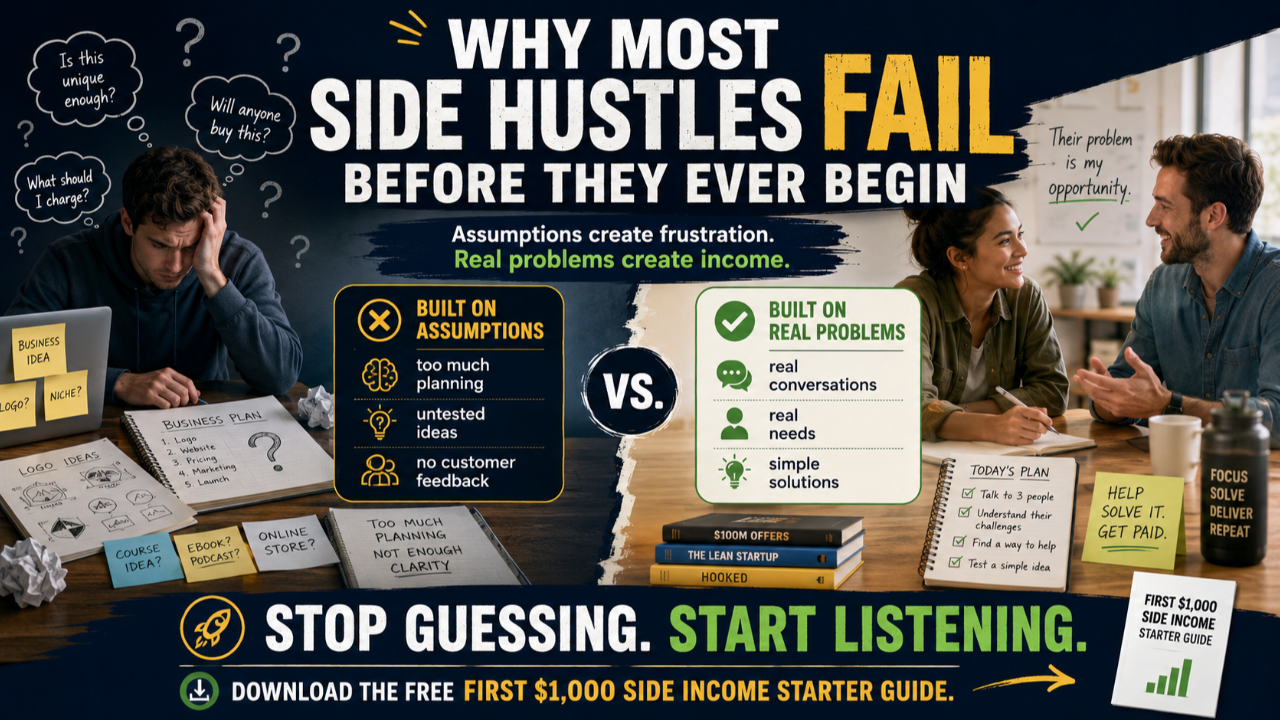
Why Most Side Hustles Fail Before They Ever Begin
Jun 30, 2026Most side hustles do not fail because people are lazy. They do not fail because people lack intelligence. They do not even fail because the idea is always bad. Many side hustles fail before they ever begin because they are built on assumptions instead of real problems.
Someone gets excited about an idea. They imagine how it could work. They picture people buying it. They start planning the name, the logo, the website, the social media page, and the offer.
Everything feels exciting in the beginning. But there is one important question they often forget to ask: "Does anyone actually want this?" That question can save months of frustration.
The Excitement of a New Idea
There is something powerful about a new idea.
At first, it feels full of possibility. You imagine the income it could create. You picture the freedom it could bring. You start thinking about how life might change if this idea works. That excitement is not wrong. In fact, excitement can be useful because it gives you energy to begin.
The problem comes when excitement replaces evidence. A person may feel strongly about an idea and assume that others will feel the same way. But the marketplace does not reward excitement. It rewards value. That is where many people get into trouble. They mistake their own enthusiasm for customer demand.
Assumptions Are Expensive
An assumption is something you believe to be true without enough proof. You may assume people have a problem. You may assume they want your solution. You may assume they will pay for it. You may assume your price is reasonable. You may assume your message is clear.
Sometimes those assumptions are correct. Many times, they are not. The danger is that assumptions feel real in your own mind. The more you think about an idea, the more convincing it can become. You begin building an entire plan around something that has never been tested.
That is why assumptions can be expensive. They cost time. They cost energy. They cost confidence. Sometimes they cost money. But the biggest cost is emotional. When someone spends weeks or months building something and then discovers nobody is interested, it can feel discouraging. They may conclude that they are not cut out for business, when the real problem was that they built before they listened.
People Do Not Buy What You Think They Should Want
This is one of the hardest lessons for new entrepreneurs. People do not buy what you think they should want. They buy what they believe they need, value, or desire.
You may think someone should care about your service. You may believe your idea could help them. You may be convinced that your offer is useful. But the customer decides what matters. That is why listening is so important.
If you want to create a side income, your job is not to convince people to want something. Your job is to understand what they already care about and then offer a solution that helps them move forward. This is the difference between guessing and serving.
Guessing starts with your idea. Serving starts with their problem.
A Side Hustle Should Begin With a Conversation
Many people begin their side hustle by building something. A better place to begin is with a conversation.
Talk to the kind of person you hope to help. Ask what they are struggling with. Ask what they have already tried. Ask what frustrates them most. Ask what result they wish they could create. Then listen. Do not rush to pitch your idea. Do not try to prove that your solution is perfect. Just listen.
Those conversations will often reveal more than hours of online research. You may discover that the problem is real, but your solution needs to change. You may discover that people care about a different problem than the one you expected. You may discover that the opportunity is stronger than you thought.
Either way, you learn and learning early is much better than learning after months of wasted effort.
The Wrong Question Can Mislead You
One common mistake is asking people, "Do you like my idea?" Most people are polite. They may say yes because they do not want to discourage you. They may tell you it sounds interesting, even if they would never pay for it. That kind of feedback can be misleading.
A better approach is to ask about their real experience. Instead of asking whether they like your idea, ask what they currently do about the problem. Ask how often the problem happens. Ask whether they have paid for help before. Ask what makes the problem frustrating. Real behavior tells you more than polite opinions.
If someone has already spent money trying to solve a problem, that is a strong signal. If someone has been complaining about the same problem for months and still has no solution, that may also be a signal. The goal is not to collect compliments. The goal is to discover truth.
The First Version Should Be Simple
Another reason side hustles fail early is that people make them too complicated. They want everything to look professional before they start. They want the full website, the perfect brand, the polished sales page, and the complete system. But for your first $1,000, simplicity is usually better.
A simple offer can be tested quickly. A simple service can be explained clearly. A simple conversation can produce useful feedback.
You do not need to build the final version of your business before you know whether people want it. You need the simplest version that allows you to learn. That may be one service. One conversation. One customer. One result. Start there.
Failure Often Happens Quietly
When people imagine business failure, they often picture a dramatic collapse. But many side hustles fail quietly.
They fail because the person never shares the offer. They fail because the idea stays in a notebook. They fail because the person keeps preparing but never talks to real people. They fail because fear disguises itself as planning.
That kind of failure is easy to miss because it feels safe. There is no rejection. No embarrassment. No public mistake. But there is also no progress. A side hustle cannot grow in private forever. At some point, it has to meet the marketplace.
The Marketplace Is Not Your Enemy
Many people are afraid to test their idea because they do not want to hear bad news. But the marketplace is not your enemy. The marketplace is your teacher.
It tells you what people value. It shows you what message is clear and what message is confusing. It reveals which problems matter enough for people to take action.
When people say no, you learn. When people ask questions, you learn. When people hesitate, you learn. When people say yes, you learn. Every response gives you information.
The people who succeed are not the ones who avoid feedback. They are the ones who use feedback to improve.
Confidence Comes From Testing
Many people wait to feel confident before they share their offer. But confidence rarely appears before action. Confidence grows when you test your idea, learn from the response, and realize you can improve.
The first conversation may feel uncomfortable. The first offer may feel awkward. The first rejection may sting. But each step gives you experience. Experience creates evidence. Evidence creates confidence.
That confidence becomes far more valuable than the comfort of waiting.
The First $1,000 Comes From Solving a Real Problem
Your first $1,000 will probably not come from having the most creative idea. It will come from helping people solve a problem they actually care about. That is why validation matters.
Before you spend months building, spend time listening. Before you perfect the offer, make sure the problem matters. Before you assume people will pay, look for evidence.
A real problem plus a simple solution plus consistent action can create income. But an untested idea, no matter how exciting it feels, can keep you stuck.
A Simple Challenge
Before you build anything new this week, have three conversations. Choose three people who might represent the kind of person you want to help. Ask them about the problem you are considering solving. Ask what they have tried. Ask what frustrates them. Ask what result they want.
Then pay attention. Do they seem interested? Do they describe the problem with emotion? Have they already tried to solve it? Would solving it make their life easier, faster, less stressful, or more productive?
Those answers can help you decide whether your idea is worth pursuing. You do not need perfect certainty. You need enough evidence to take the next step wisely.
Download Your Free First $1,000 Side Income Starter Guide
If this article helped you see why assumptions can be dangerous, your next step is to begin identifying and testing real income opportunities. That is why I created The First $1,000 Side Income Starter Guide.
This free guide will help you think through your skills, notice problems people may already be willing to pay to solve, and begin taking simple action toward your first $1,000 in extra income.
You do not need to build a complicated business. You do not need the perfect idea. You do not need to have everything figured out. You need a clear starting point and the willingness to take the next step.
Download your free First $1,000 Side Income Starter Guide today and begin turning real problems into realistic income opportunities.
And when you are ready for a step-by-step process, The First $1,000 Side Income Action Plan will walk you through the full 12-week journey of choosing one opportunity, creating a simple offer, taking consistent action, and building momentum toward your first $1,000.
What If You Could Start Creating More Financial Momentum in Just 7 Days?
Reading about financial success can give you ideas. Taking action is what begins to create change.
That's why I created the FREE Money Momentum Starter Guide Workbook—a practical starting point for anyone who wants to make greater financial progress by managing their money more intentionally, exploring opportunities to create additional income, and developing habits that keep them moving forward.
Inside the FREE Starter Guide, you'll discover:
- Where you are financially today and where you'd like to make progress
- Opportunities to take greater control of the money already flowing through your life
- Skills, knowledge, and experience you may be able to turn into additional income
- Practical actions you can begin taking right away
- How to create your own 7-Day Money Momentum Action Plan
You don't need to have everything figured out. You don't need a perfect financial plan or a great business idea. You simply need a starting point and a willingness to take the next step.
Want Some Help Working Through It?
You can complete the Money Momentum Starter Guide entirely on your own for free, or for a one-time $5 upgrade, get 30 days of access to your own Money Momentum AI Assistant to help you work through the workbook.
Your AI Assistant can help you think through questions, explore possibilities when you're unsure what to write, dig deeper into your answers, and turn what you discover into practical next steps and your personalized 7-Day Money Momentum Action Plan.
Start Building Your Money Momentum Today. Download your FREE Money Momentum Starter Guide Workbook and take your first step toward greater financial progress.
