
Why Most People Set Goals Too Low & How to Break the “Safe Goal” Trap
Jan 20, 2026Why Most People Set Goals Too Low and How to Break the “Safe Goal” Trap
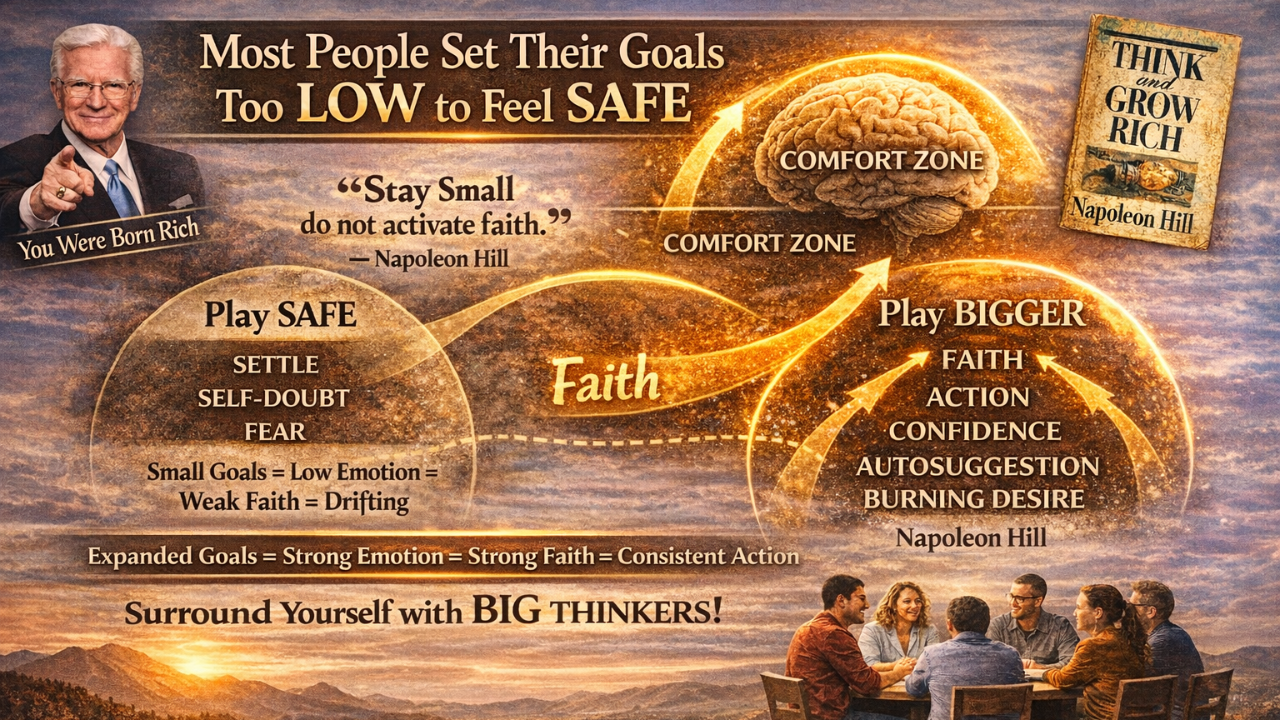
Most people don’t aim low because they lack ambition. They aim low because it feels safer. In You Were Born Rich, Bob Proctor reveals a truth that quietly explains why so many goals never transform into results: people choose goals they can emotionally survive, not goals that stretch who they must become. That’s why Napoleon Hill insists in Think and Grow Rich that desire must be strong enough to override fear. Because without emotional intensity, faith never activates… and without faith, action collapses. This is also why this stage is where many people stall and exactly why structured support matters.
If you’re noticing yourself negotiating your goals downward or choosing “reasonable” over meaningful, this is the work we focus on inside our Implementation Mastermind. It’s designed to help you move from safe goals to activated goals and from belief to consistent action.
Most People Set Their Goals Too Low to Feel Safe
What Bob Proctor Is Really Teaching: In You Were Born Rich, Bob Proctor explains that people don’t choose goals based on potential, they choose them based on emotional safety. A goal is often unconsciously filtered through questions like: Will this make me look foolish if I fail? Will people judge me? Can I justify this level of success? So instead of asking, “What do I truly want?”, people ask, “What can I want without discomfort?” This creates socially acceptable goals rather than authentic goals. Comfort becomes the invisible ceiling.
Low goals are rarely humility. They are usually fear wearing polite clothing.
How This Directly Relates to Think and Grow Rich
Napoleon Hill repeatedly emphasizes that desire must be intense enough to override fear. Hill’s Teaching on Faith & Autosuggestion: Hill defines faith as belief that is emotionally charged, repeated, and accepted by the subconscious. “Faith is the visualization of, and belief in, the attainment of desire.”
Here’s the critical connection: Small goals do not activate faith. Why? They don’t excite the imagination. They don’t stir emotion, and they don’t demand growth. As a result, autosuggestion is weak, repetition lacks feeling, and action becomes inconsistent. Hill warns that without emotional involvement, autosuggestion becomes empty words.
Proctor explains why this happens: The goal was chosen for safety, not desire.
The Hidden Danger of “Safe” Goals
Safe goals preserve identity, avoid responsibility, and minimize exposure to failure. But Hill calls this state drifting. Drifters don’t lack ambition, they lack permission. They have never given themselves permission to want more than feels reasonable.
Would a Mastermind Group Be Helpful?
Yes. This Is One of Its Greatest Functions
- A Mastermind Normalizes Big Thinking: When everyone around you sets conservative goals, conservative feels responsible. In a mastermind bigger numbers are spoken aloud. Expansion becomes normal and fear loses its disguise. Your comfort zone is social, not logical. Hearing others aim higher resets what feels “reasonable.”
- A Mastermind Activates Emotional Faith: Faith grows faster in a group than alone. Why? Emotion is contagious, confidence multiplies, and expectation rises collectively. Hill taught that faith must be emotionalized. A mastermind provides that emotional charge. Borrowed belief becomes internal belief.
- A Mastermind Prevents Quiet Goal Shrinkage: Without accountability, people unconsciously revise goals downward. A mastermind keeps goals visible, brings gentle pressure, and calls out retreat disguised as realism. Isolation breeds negotiation.
- A Mastermind Bridges Fear → Action: Hill is clear: faith must translate into action. A mastermind adds deadlines, encourages first steps, and converts belief into movement. Action reinforces belief, completing the loop.
People don’t aim low because they lack desire. They aim low because they’re protecting their comfort.”
Final Integration Summary
Proctor explains why goals are capped (fear + comfort). Hill explains how to break the cap (faith + autosuggestion). Mastermind supplies the environment where faith expands naturally.
- Safe goals → weak emotion → weak faith → inconsistent action
- Expanded goals → strong emotion → strong faith → sustained action
What If You Could Start Creating More Financial Momentum in Just 7 Days?
Reading about financial success can give you ideas. Taking action is what begins to create change.
That's why I created the FREE Money Momentum Starter Guide Workbook—a practical starting point for anyone who wants to make greater financial progress by managing their money more intentionally, exploring opportunities to create additional income, and developing habits that keep them moving forward.
Inside the FREE Starter Guide, you'll discover:
- Where you are financially today and where you'd like to make progress
- Opportunities to take greater control of the money already flowing through your life
- Skills, knowledge, and experience you may be able to turn into additional income
- Practical actions you can begin taking right away
- How to create your own 7-Day Money Momentum Action Plan
You don't need to have everything figured out. You don't need a perfect financial plan or a great business idea. You simply need a starting point and a willingness to take the next step.
Want Some Help Working Through It?
You can complete the Money Momentum Starter Guide entirely on your own for free, or for a one-time $5 upgrade, get 30 days of access to your own Money Momentum AI Assistant to help you work through the workbook.
Your AI Assistant can help you think through questions, explore possibilities when you're unsure what to write, dig deeper into your answers, and turn what you discover into practical next steps and your personalized 7-Day Money Momentum Action Plan.
Start Building Your Money Momentum Today. Download your FREE Money Momentum Starter Guide Workbook and take your first step toward greater financial progress.
