
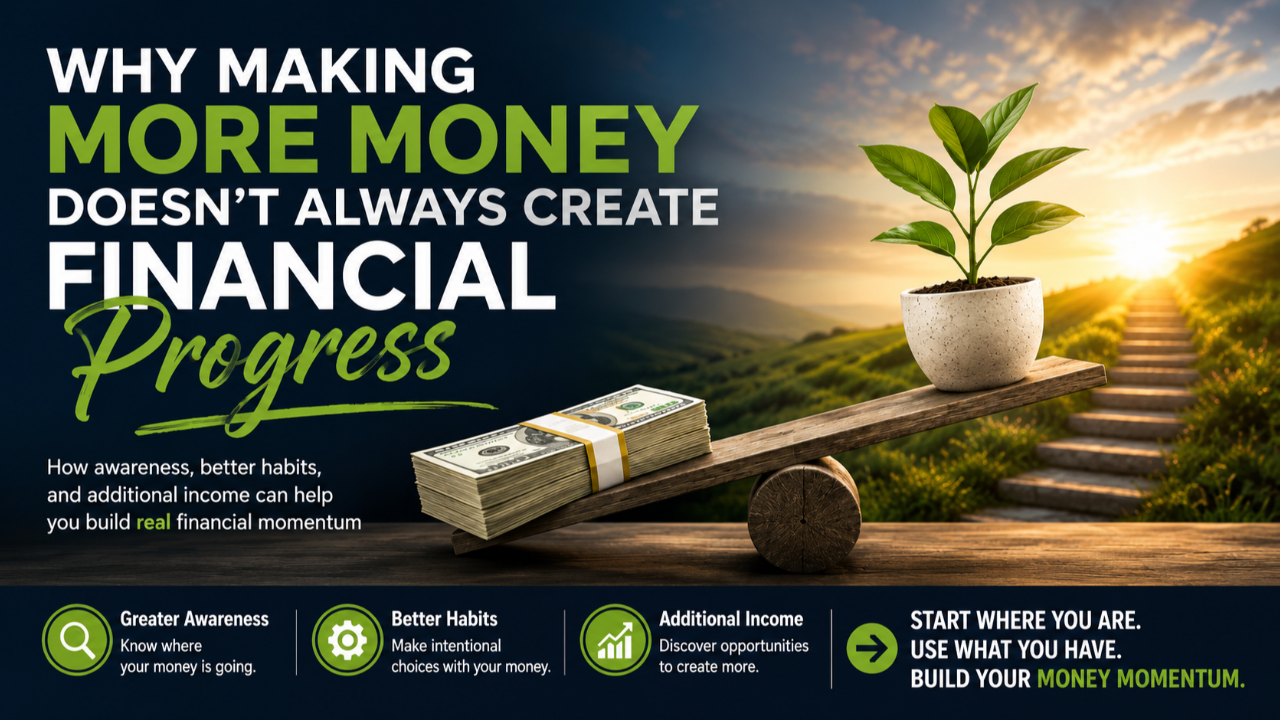
Why Making More Money Doesn't Always Create Financial Progress
Aug 18, 2026Have you ever looked at your income and wondered, "Why am I not further ahead?" You may be earning considerably more than you did five or ten years ago, yet somehow the additional financial breathing room you expected hasn't appeared. The bills continue to arrive, unexpected expenses still cause frustration, and saving or investing may seem more difficult than you think it should be.
It's easy to assume the solution is simply to make more money. Certainly, increasing your income can make a tremendous difference, and creating additional sources of income can be an important part of building greater financial freedom. But there's an important distinction we often overlook: earning more money and making financial progress are not necessarily the same thing.
Why More Income Doesn't Always Mean More Progress
Imagine someone earning $50,000 a year who believes life would become much easier if they could increase their income to $60,000. Eventually, they get the raise they've been hoping for, and for a while it feels as though they've finally turned a corner. There is more money coming in each month, and they naturally feel they can afford to relax a little.
Gradually, however, their lifestyle begins to change. Perhaps they replace their vehicle, eat out more often, take a better vacation, add a few subscriptions, or simply stop paying as much attention to smaller purchases. None of these decisions seems particularly significant on its own, but a year later much of the additional income has been absorbed into everyday life.
Now the person earning $60,000 begins thinking that perhaps $75,000 would finally make the difference.
There is nothing inherently wrong with improving your lifestyle as your income grows. The problem occurs when spending automatically expands to consume whatever additional money becomes available. Without an intentional plan for that increased income, making more can easily become spending more rather than progressing more.
Financial Progress Begins With Awareness
One of the most valuable financial habits you can develop is simply knowing what is happening with your money. Most of us know approximately what we earn and can probably identify our largest monthly expenses, but that doesn't necessarily mean we have a clear understanding of our overall cash flow.
Money has a way of disappearing through dozens of seemingly insignificant decisions. A few meals out, an online purchase, another monthly subscription, convenience purchases, entertainment, and other small expenses can quietly consume a surprising amount of income. Individually, these decisions may seem harmless, but collectively they can make the difference between moving forward financially and wondering where the money went.
This is why awareness matters so much. Financial awareness isn't about feeling guilty about what you've spent or eliminating everything you enjoy. It's about understanding your current patterns well enough to make intentional decisions about what you want your money to accomplish. You can't take greater control of something you aren't paying attention to.
Managing Money Is Only Half of the Equation
Traditional financial advice often concentrates heavily on reducing expenses. Spending less than you earn is certainly important, and finding unnecessary expenses can create money that can be redirected toward savings, investments, debt reduction, or other priorities. But there is a practical limit to how much most people can cut.
That's why I believe we should look at financial progress from both directions. We need to become better at managing the money already flowing through our lives while also asking how we might increase the amount coming in.
This changes the conversation. Instead of asking only, "What can I eliminate?" we can also begin asking, "What could I create?" Perhaps there is a skill you could offer, knowledge you could teach, a service you could provide, or a problem you know how to solve. Additional income doesn't necessarily require starting a complicated business; sometimes it begins by recognizing the value of something you already know how to do.
You May Already Have More Value Than You Realize
Most of us underestimate our own knowledge because we've become accustomed to it. Something you've done for twenty years may seem completely ordinary to you, while someone without your experience could find that knowledge extremely valuable.
Think about what you've learned through your career, hobbies, education, relationships, challenges, and life experiences. You've developed skills, solved problems, made mistakes, discovered better ways of doing things, and accumulated knowledge that someone else may not have. Somewhere within those experiences could be an opportunity to create additional value for someone else and additional income for yourself.
The starting question doesn't have to be, "What business should I start?" A better question may be, "What problem could I help someone solve with something I already know?" That is often a much simpler and less intimidating place to begin.
Small Improvements Can Create Significant Momentum
Financial progress doesn't always require a dramatic change. Imagine becoming more aware of your spending and discovering $150 each month that could be redirected toward something important to you. Now imagine finding a relatively simple way to create another $300 or $500 in monthly income.
Neither change alone is likely to completely transform your financial life. Together, however, they could improve your financial position by several hundred dollars every month. More importantly, they can begin changing the way you think about your finances.
Instead of continually telling yourself there isn't enough money, you begin looking for ways to use what you have more intentionally and create more when you need it. Instead of wondering where your money went, you begin deciding where you want it to go. Rather than feeling that your financial situation is something happening to you, you begin recognizing the influence your decisions and actions can have over it.
That's the idea behind Money Momentum.
Progress Is More Important Than Perfection
It's tempting to believe that financial progress begins once you finally have the perfect budget, eliminate every unnecessary expense, discover the perfect income opportunity, or earn a certain amount of money. That thinking can actually keep you from starting.
You don't need to transform everything at once. You need to understand where you are today, identify where you would like to improve, and take the next reasonable step. Greater awareness can lead to better decisions, better decisions can develop into stronger habits, and stronger habits can create more financial stability.
Additional income can provide more choices, and those choices can make it possible to save, invest, reduce debt, pursue opportunities, or simply create greater breathing room. Over time, what initially seemed like a few small changes can become meaningful financial progress.
Turn What You've Learned Into Action
One of the challenges with reading about money and personal development is that it's easy to agree with an idea without actually doing anything differently afterward. Information becomes valuable when we apply it to our own lives, and that usually begins with taking a closer look at where we are today.
Consider what you've discovered as you've read this article. Perhaps you've realized that earning more isn't the only answer, or you've started thinking differently about where your current income is going. Maybe you've even begun recognizing skills, knowledge, or experience that could create additional income.
The important thing is not to try to change everything at once. Choose one area where you could make progress and take one meaningful action. That might mean becoming more aware of your spending, intentionally redirecting some of your current income, exploring an additional-income idea, or simply making a decision you've been postponing.
Financial momentum is created when one useful action leads to another. As those actions become habits, you begin developing greater confidence in your ability to influence your financial future. You may not see dramatic results overnight, but you are no longer simply hoping things will improve—you are actively moving them in a better direction.
That's ultimately what Money Momentum is about: taking greater control of what you have, developing your ability to create more, and building the habits that help you continue moving toward greater financial freedom.
You don't need to wait until you're earning more money to begin.
Start where you are. Use what you have. Take the next step. Then keep building momentum.
What If You Could Start Creating More Financial Momentum in Just 7 Days?
Reading about financial success can give you ideas. Taking action is what begins to create change.
That's why I created the FREE Money Momentum Starter Guide Workbook—a practical starting point for anyone who wants to make greater financial progress by managing their money more intentionally, exploring opportunities to create additional income, and developing habits that keep them moving forward.
Inside the FREE Starter Guide, you'll discover:
- Where you are financially today and where you'd like to make progress
- Opportunities to take greater control of the money already flowing through your life
- Skills, knowledge, and experience you may be able to turn into additional income
- Practical actions you can begin taking right away
- How to create your own 7-Day Money Momentum Action Plan
You don't need to have everything figured out. You don't need a perfect financial plan or a great business idea. You simply need a starting point and a willingness to take the next step.
Want Some Help Working Through It?
You can complete the Money Momentum Starter Guide entirely on your own for free, or for a one-time $5 upgrade, get 30 days of access to your own Money Momentum AI Assistant to help you work through the workbook.
Your AI Assistant can help you think through questions, explore possibilities when you're unsure what to write, dig deeper into your answers, and turn what you discover into practical next steps and your personalized 7-Day Money Momentum Action Plan.
Start Building Your Money Momentum Today. Download your FREE Money Momentum Starter Guide Workbook and take your first step toward greater financial progress.
