
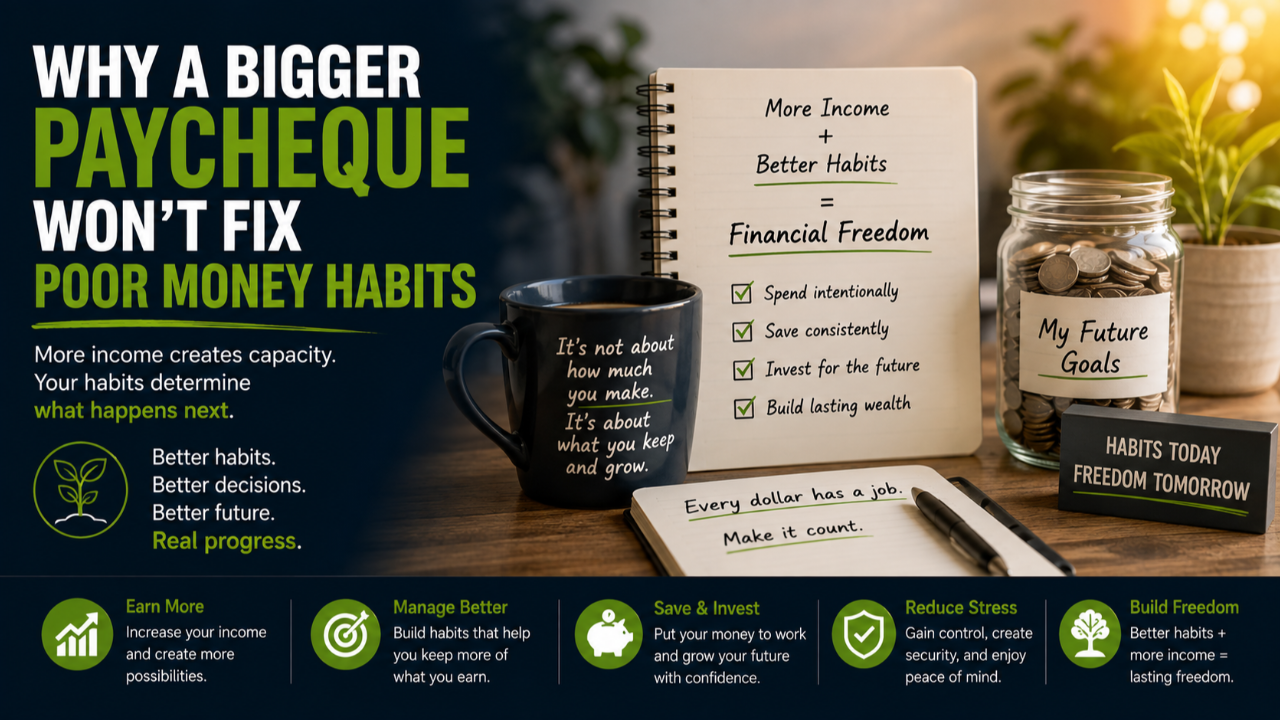
Why a Bigger Paycheque Won't Fix Poor Money Habits
Aug 21, 2026Have you ever thought about how much easier life would be if you simply earned more money? Perhaps you've imagined receiving a substantial raise, moving into a higher-paying position, growing your business, or creating an additional source of income. It seems reasonable to assume that once more money starts coming in, saving will become easier, financial stress will decrease, and you'll finally begin making the progress you've been hoping for.
More income can certainly help. There are situations where the fundamental problem really is that there isn't enough money coming in to cover reasonable living expenses and financial priorities. Increasing income can create breathing room, provide more choices, and make goals that once seemed impossible much more achievable.
But there's another side to the equation that is easy to overlook. If the habits that determine what you do with money remain unchanged, a larger paycheque may not create the financial improvement you expect. You can earn more and still find yourself wondering where the money went.
That's because more income gives you greater financial capacity, but your habits determine what happens to that capacity.
Why More Money Can Disappear So Quickly
Imagine receiving an extra $500 every month. Before the increase arrives, you might be convinced that most of it will go toward savings, investments, debt reduction, or another important financial goal. For the first month or two, perhaps that's exactly what happens.
Then life begins adjusting to the new income. You eat out a little more often because you can afford it. You replace something that you've wanted for a while. A more expensive monthly subscription doesn't seem significant anymore. Perhaps you upgrade your vehicle or take on another payment because the additional income makes it manageable.
None of these decisions necessarily seems irresponsible. In fact, most may be completely reasonable on their own. The problem is that several small lifestyle improvements can gradually consume the entire increase.
Before long, your new income level feels normal. The extra $500 no longer feels like extra money because your regular expenses have expanded to absorb it. What once seemed like a substantial raise has quietly become part of your everyday lifestyle.
This is often called lifestyle inflation, and it helps explain why people at very different income levels can experience remarkably similar financial pressure.
Your Lifestyle Can Grow as Quickly as Your Income
As our income increases, our definition of what is “normal” often changes with it. Things that once seemed like luxuries gradually become expectations. The older vehicle that was perfectly acceptable suddenly feels inadequate. Restaurants that once seemed expensive become regular choices. Vacations become more elaborate, technology gets upgraded more frequently, and homes sometimes become larger as soon as income makes the payments possible.
There is nothing wrong with enjoying the benefits of earning more. Money should improve our lives, and increasing your standard of living can be one of the rewards of creating greater income. The issue is not whether you should ever spend more; it's whether the decision is intentional.
If every increase in income automatically produces an equivalent increase in lifestyle, it becomes extremely difficult to create lasting financial progress. You may earn significantly more than you did ten years ago while still feeling as though there is never quite enough.
The numbers have changed, but the pattern hasn't.
Habits Often Matter More Than Individual Decisions
When people think about improving their finances, they often focus on individual purchases. They ask whether they should buy a particular item, eat at a particular restaurant, or spend money on a particular experience. Those decisions matter, but the habits behind them can matter even more.
A single restaurant meal probably won't determine your financial future. Eating out several times every week because it has become automatic may have a much larger effect. One impulse purchase isn't likely to cause a serious problem, but a habit of shopping whenever you're bored, stressed, or unhappy can gradually consume a significant amount of money.
Financial habits are powerful because they repeat. A decision you make once has one consequence. A behaviour you repeat every week or every month can influence your finances for years.
That's why changing financial results often requires looking beyond individual expenses and asking what behaviours are producing them. If the underlying habit remains unchanged, simply adding more money to the system may only give that habit more money to work with.
More Income Can Hide Problems for a While
A larger income can sometimes make poor financial habits less visible rather than correcting them. When more money is available, it becomes easier to absorb unnecessary spending, inefficient decisions, and recurring expenses without immediately feeling the consequences.
Someone earning a modest income may quickly notice an extra $200 leaving their account every month because it creates an obvious shortage. Someone earning considerably more may be able to carry that expense for years without questioning it. The financial impact is still real, but the higher income makes it easier to ignore.
This is why earning a good income doesn't automatically mean someone is financially secure. A person can have an impressive salary and still have very little savings, significant debt, large monthly obligations, and considerable financial stress.
Income tells you how much money is coming in. It doesn't tell you what happens after it arrives.
The Goal Isn't to Become Afraid of Spending
Discussions about money habits can easily turn into messages about restriction. Spend less. Stop buying coffee. Don't eat out. Cancel everything enjoyable and save every possible dollar.
I don't believe that's a particularly motivating or sustainable way to approach money.
The purpose of improving your financial habits isn't to make your life smaller. It's to make your decisions more intentional so your money can support both the life you enjoy today and the future you want to create.
There may be things you spend money on that bring enormous value to your life. Those expenses don't necessarily need to change. The opportunity may be hidden in spending that has become automatic, purchases you barely remember, or expenses that no longer reflect what matters to you.
A good financial habit isn't simply spending less. It's making conscious decisions about where your money can create the greatest value in your life.
Decide What an Increase Will Do Before It Arrives
One of the best times to decide what you'll do with additional income is before you receive it.
Imagine you're expecting a $500 monthly raise. Instead of allowing the entire amount to blend into your regular bank account and gradually become part of your lifestyle, you could decide in advance what you want that money to accomplish.
Perhaps you decide that a portion will improve your lifestyle today while another portion goes toward savings, investing, reducing debt, or building something for your future. You still enjoy the benefits of earning more, but you prevent the entire increase from disappearing into higher spending.
The exact percentages matter less than the habit of deciding intentionally. When you give additional income a purpose before lifestyle expansion has a chance to claim it, an increase in earnings can begin producing lasting financial progress.
This principle can apply to raises, bonuses, tax refunds, additional business income, side income, or any unexpected money that comes into your life.
Pay Attention to the Habits That Happen Automatically
One of the reasons money habits are difficult to change is that many of them don't feel like decisions anymore. They have become routines.
You may automatically stop somewhere for coffee on the way to work, browse online stores in the evening, order food when you're tired, or upgrade technology whenever a new version becomes available. None of these behaviours is necessarily a problem, but they deserve occasional examination because automatic decisions are rarely compared with your current priorities.
Ask yourself whether the habit still gives you enough value to justify its cost. Something you genuinely enjoy may easily pass that test. Something you barely notice may not.
This isn't about analyzing every purchase until spending becomes exhausting. It's about periodically bringing automatic behaviours back into conscious awareness. Once you're aware of a habit, you can decide whether it still deserves a place in your financial life.
Better Habits Give Additional Income More Power
This is where earning more becomes particularly valuable. When stronger financial habits and higher income work together, the results can be dramatically different.
Imagine two people each receive an additional $500 per month. The first person's lifestyle gradually expands until the entire increase is being spent. The second person enjoys some of the increase but consistently directs the rest toward building savings, investing, reducing debt, or another meaningful goal.
After one month, there may not be much difference between them. After several years, however, the difference could become substantial.
The additional income wasn't what created the difference because both people received the same amount. The difference came from what they repeatedly did with it.
That is the power of combining income growth with intentional habits. You aren't simply earning more; you're allowing more of what you earn to improve your financial position.
Creating More Income Still Matters
None of this means you should focus only on reducing spending. There is a point where cutting expenses further produces very little benefit, and continually trying to shrink your lifestyle isn't a particularly inspiring financial strategy.
Increasing income remains one of the most powerful ways to expand your financial possibilities. Additional income can help you reach goals faster, create greater security, invest more, experience more, and build greater freedom.
The important point is that earning more and managing better should work together.
If you focus only on managing money, you may become excellent at dividing a limited amount without ever expanding what's possible. If you focus only on earning more, you may continually increase your income without retaining enough of that increase to meaningfully change your financial future.
Money Momentum comes from working on both sides of that equation.
Your Habits Can Change
Sometimes people describe themselves in permanent terms when talking about money. They say things such as, “I'm just bad with money,” or “I've never been a saver.” When repeated often enough, those statements can begin to feel like part of someone's identity rather than descriptions of behaviours that can change.
But a habit is something you've learned through repetition, which means a different habit can also be developed through repetition. You don't have to transform your entire financial life in one weekend. In fact, trying to change everything at once can make it harder to sustain any change.
A better approach is to identify one behaviour that would make a meaningful difference and work on it consistently. Perhaps you begin reviewing your spending once a week, automatically moving money toward savings when you're paid, waiting before making unplanned purchases, or deciding in advance how additional income will be used.
Small actions may not feel significant at first, but repeated actions gradually become habits. Those habits can eventually influence financial results far more than one burst of motivation ever could.
Make Your Next Pay Increase Count
Think about the next time your income increases. It might come from a raise, a new job, additional customers, a side-income opportunity, a bonus, or something you haven't even anticipated yet.
What would happen to that money if your current habits remained exactly the same? Would it genuinely improve your financial position, or would your lifestyle gradually expand until the increase disappeared?
Now consider a different possibility. What if you developed the habits now that would allow your next income increase to create lasting progress? Instead of waiting until more money arrives to become intentional, you can begin practicing with the money already flowing through your life.
That's an important part of building Money Momentum. Greater financial freedom doesn't come only from earning more, and it doesn't come only from spending less. It develops when you become more intentional with what you have, expand your ability to create more, and develop habits that allow those improvements to build upon one another.
A bigger paycheque can open new possibilities. It can create breathing room, accelerate your goals, and give you choices you didn't previously have.
But the paycheque alone won't determine what happens next.
Your habits will.
What If You Could Start Creating More Financial Momentum in Just 7 Days?
Reading about financial success can give you ideas. Taking action is what begins to create change.
That's why I created the FREE Money Momentum Starter Guide Workbook—a practical starting point for anyone who wants to make greater financial progress by managing their money more intentionally, exploring opportunities to create additional income, and developing habits that keep them moving forward.
Inside the FREE Starter Guide, you'll discover:
- Where you are financially today and where you'd like to make progress
- Opportunities to take greater control of the money already flowing through your life
- Skills, knowledge, and experience you may be able to turn into additional income
- Practical actions you can begin taking right away
- How to create your own 7-Day Money Momentum Action Plan
You don't need to have everything figured out. You don't need a perfect financial plan or a great business idea. You simply need a starting point and a willingness to take the next step.
Want Some Help Working Through It?
You can complete the Money Momentum Starter Guide entirely on your own for free, or for a one-time $5 upgrade, get 30 days of access to your own Money Momentum AI Assistant to help you work through the workbook.
Your AI Assistant can help you think through questions, explore possibilities when you're unsure what to write, dig deeper into your answers, and turn what you discover into practical next steps and your personalized 7-Day Money Momentum Action Plan.
Start Building Your Money Momentum Today. Download your FREE Money Momentum Starter Guide Workbook and take your first step toward greater financial progress.
