
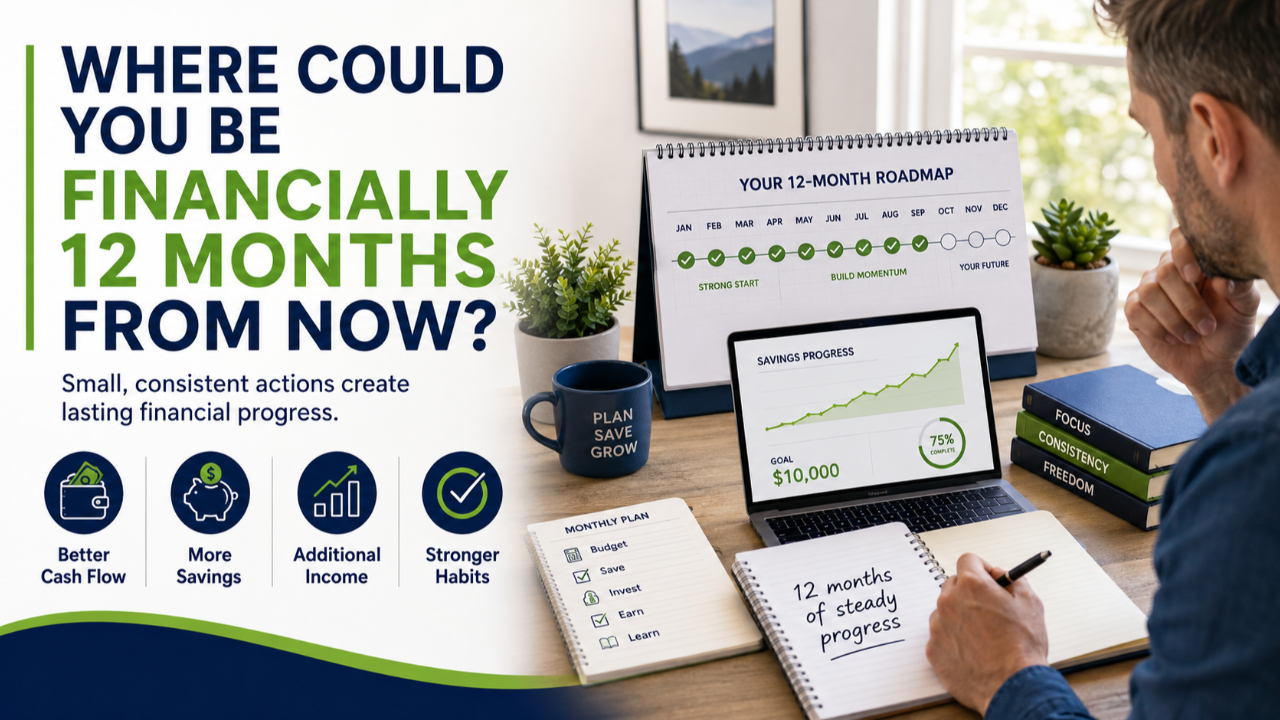
Where Could You Be Financially 12 Months From Now?
Sep 01, 2026Twelve months can feel like a long time when you look ahead, but surprisingly short when you look back. Think about where you were financially one year ago. Some things may have changed, while others may look almost exactly the same.
Now imagine reaching this point next year with more savings, less debt, better control of your spending, an additional source of income, and greater confidence in the way you manage money. None of those improvements necessarily requires one dramatic financial breakthrough. They can be created through relatively small decisions made consistently over the next 12 months.
The more useful question may not be, "How can I completely transform my finances?" It may simply be, "What could change if I started building financial momentum now?"
Small Monthly Improvements Can Become Significant
One of the reasons people underestimate what can happen in a year is that small monthly improvements don't look particularly impressive at first.
Suppose you review your spending and identify $150 a month that could be used more intentionally. Perhaps some subscriptions no longer provide much value, convenience spending has gradually increased, or purchases have simply become automatic. Redirecting $150 may not feel life-changing.
But over 12 months, that represents $1,800.
Now suppose you also begin creating an additional $250 a month using a skill, service, or small income opportunity. That adds another $3,000 over a year before expenses and taxes.
Together, those two relatively modest changes could create $4,800 of additional financial capacity over 12 months. You haven't doubled your salary or built a huge business. You simply improved both sides of your financial equation: managing what you have and creating more.
Better Cash-Flow Decisions Can Reduce Financial Pressure
Financial progress isn't only about accumulating more money. Sometimes the first noticeable improvement is simply feeling less pressure.
When you don't know where your money is going, each month can feel reactive. Bills arrive, purchases happen, unexpected expenses appear, and you deal with them as they come. Even someone earning a reasonable income can feel financially uncertain when there is little structure.
A year of paying closer attention can change that.
You may begin knowing what is coming in and where it is going. You might build a reserve for expenses that previously went onto a credit card. You may start giving some of your money a purpose before spending begins rather than hoping something will remain at the end of the month.
Those changes may not produce an exciting overnight transformation, but they can give you something extremely valuable: greater control.
And greater control often creates the confidence needed to make the next improvement.
What Could One Year of Additional Income Look Like?
Creating additional income is another area where people sometimes expect too much too quickly. They imagine replacing their salary, building a successful business, or creating thousands of dollars every month. When those results don't happen immediately, they assume the idea isn't working.
A more realistic first objective might simply be learning how to create money outside your primary income source.
Imagine you spend the next few months identifying a skill people value and eventually begin earning $100 a week from it. That might come from consulting, tutoring, providing a local service, completing project work, or helping someone solve a problem you already understand.
At $100 a week, you're creating roughly $400 a month. If that eventually becomes consistent, it represents approximately $4,800 over 12 months before expenses and taxes.
The amount matters, but something else matters too. You have developed the ability to create income. You have learned how to identify a problem, offer value, find someone who needs help, and get paid.
Those skills can continue developing long after the first year ends.
Stronger Money Habits Compound Too
We often think about compounding only in relation to investments, but habits can compound as well.
Saving $50 once is useful. Learning to save automatically every pay period is more powerful because the behaviour can continue for years. Reviewing your finances once can provide useful information, but developing a weekly money review can help you catch problems and make better decisions repeatedly.
The same is true for additional income. Contacting one potential customer may lead nowhere. Developing the habit of consistently reaching out, improving your offer, and following up can eventually produce opportunities.
After 12 months, the biggest change may not simply be the amount in your bank account. You may have become someone who pays attention to cash flow, saves consistently, makes more deliberate spending decisions, and actively looks for opportunities to create value.
That identity is considerably more powerful than a temporary burst of financial motivation.
Progress Rarely Comes From One Big Breakthrough
It's tempting to believe our financial situation will change when something big happens. Maybe we'll receive a substantial raise, make a successful investment, sell a business, inherit money, or finally discover the perfect side income opportunity.
Those things can happen, but building a financial plan around waiting for a breakthrough gives you very little control.
Momentum works differently.
You improve one spending habit. Then you begin saving consistently. You reduce one debt. You explore an additional income idea. You earn your first $100 outside your primary income. You learn from the experience and earn another $100.
None of those steps looks dramatic by itself. But after a year, they begin telling a very different financial story.
That's why consistency is often more powerful than intensity. A few productive actions repeated for 12 months can accomplish more than occasional bursts of enthusiasm followed by long periods of inactivity.
Don't Expect the Next 12 Months to Be Perfect
There will almost certainly be setbacks.
An unexpected expense may reduce your savings. An income idea may fail. You might overspend one month, miss a weekly review, or find yourself returning to an old money habit.
That doesn't erase your progress.
Financial momentum isn't created by doing everything perfectly. It comes from noticing when you've moved off course and beginning again rather than abandoning the plan entirely.
If you make 50 better financial decisions over the next year and 10 poor ones, the poor decisions don't necessarily cancel the other 50. What matters is the direction in which your habits are moving.
A year gives you enough time to experiment, adjust, learn, and keep improving.
Your Money Momentum Action Step
Picture yourself 12 months from today and imagine that you are genuinely pleased with the financial progress you've made. What would be different?
Perhaps you've built a $3,000 emergency reserve, eliminated a credit card balance, invested consistently, created $500 a month of additional income, or simply gained much greater control over where your money goes.
Choose one result that would meaningfully improve your financial life. Then bring your attention back to today and ask: What is the first action that would begin moving me toward that result?
It might be reviewing last month's spending, setting up an automatic savings transfer, making an additional debt payment, identifying a skill you could turn into income, or contacting your first potential customer.
This is what Money Momentum is really about. Financial progress is rarely created by one dramatic moment. It develops as you manage what you have more intentionally, increase your ability to create more, and build habits that keep you moving forward.
Twelve months from now is going to arrive whether you change anything or not.
You don't need to know exactly where the entire journey will lead. Decide where you would like to be a year from now, choose one useful action that moves you in that direction, and begin building momentum today.
What If You Could Start Creating More Financial Momentum in Just 7 Days?
Reading about financial success can give you ideas. Taking action is what begins to create change.
That's why I created the FREE Money Momentum Starter Guide Workbook—a practical starting point for anyone who wants to make greater financial progress by managing their money more intentionally, exploring opportunities to create additional income, and developing habits that keep them moving forward.
Inside the FREE Starter Guide, you'll discover:
- Where you are financially today and where you'd like to make progress
- Opportunities to take greater control of the money already flowing through your life
- Skills, knowledge, and experience you may be able to turn into additional income
- Practical actions you can begin taking right away
- How to create your own 7-Day Money Momentum Action Plan
You don't need to have everything figured out. You don't need a perfect financial plan or a great business idea. You simply need a starting point and a willingness to take the next step.
Want Some Help Working Through It?
You can complete the Money Momentum Starter Guide entirely on your own for free, or for a one-time $5 upgrade, get 30 days of access to your own Money Momentum AI Assistant to help you work through the workbook.
Your AI Assistant can help you think through questions, explore possibilities when you're unsure what to write, dig deeper into your answers, and turn what you discover into practical next steps and your personalized 7-Day Money Momentum Action Plan.
Start Building Your Money Momentum Today. Download your FREE Money Momentum Starter Guide Workbook and take your first step toward greater financial progress.
