
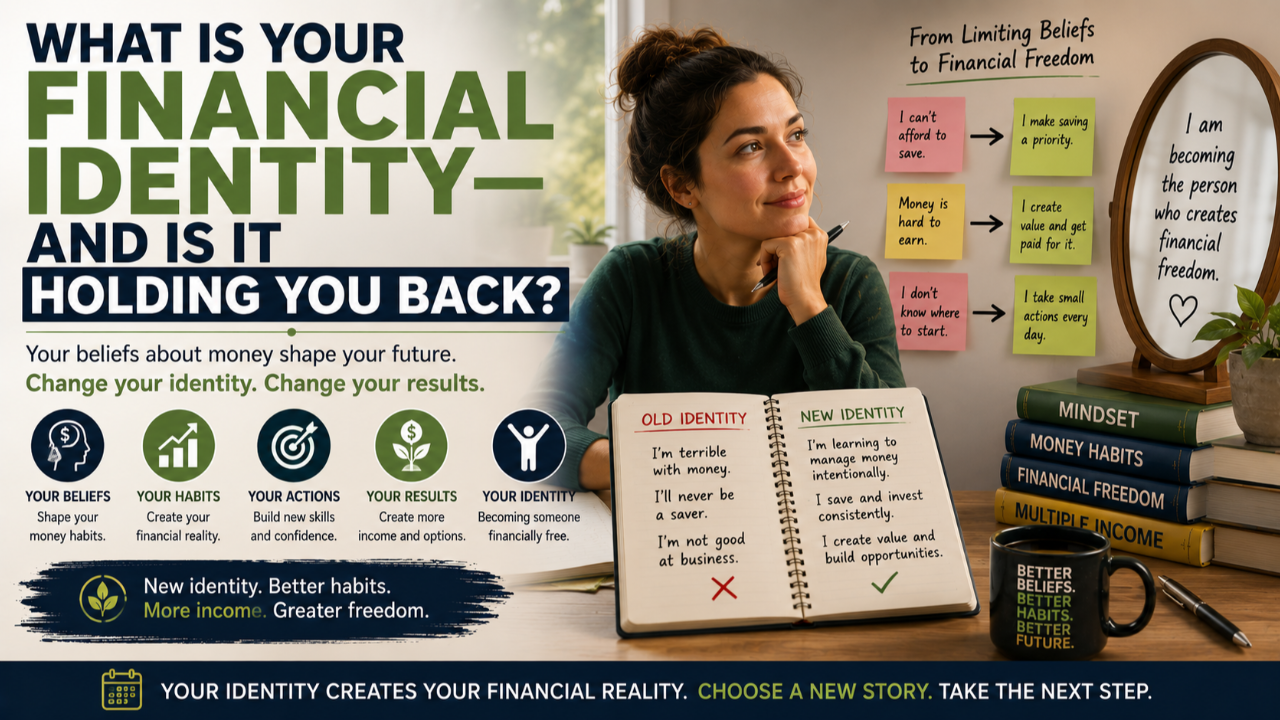
What Is Your Financial Identity and Is It Holding You Back?
Aug 29, 2026Have you ever heard yourself say something like, "I'm terrible with money," "I've never been a saver," or "I'm just not good at business"? These statements can seem harmless because they appear to describe past experience. But when repeated often enough, they can become something more powerful: a description of who we believe we are.
That's where financial identity becomes important. Your financial identity is the collection of beliefs you hold about yourself in relation to money, earning, saving, spending, investing, and creating opportunities. Those beliefs don't completely determine your financial future, but they can quietly influence the decisions you make—and the decisions you avoid.
What Is a Financial Identity?
Your financial identity isn't simply how much money you have. Two people with similar incomes can see themselves very differently.
One person might think, "I'm someone who manages my money carefully and figures things out." Another might think, "Money has always been a problem for me." Those beliefs can influence how each person responds to exactly the same financial situation.
Our financial identity develops over time. It can be influenced by family experiences, previous successes and failures, education, work, relationships, and messages we've heard about money. A difficult financial period can eventually become a permanent label if we're not careful.
Someone who made several poor financial decisions in their twenties might still describe themselves as "bad with money" at 45, even though they now have decades of additional knowledge and experience. The description survives long after the circumstances that created it.
Pay Attention to the Labels You Give Yourself
The language we use about ourselves matters because labels can turn temporary behaviour into permanent identity.
Consider the difference between saying, "I haven't managed my money very well," and saying, "I'm terrible with money." The first describes behaviour that can change. The second describes a person.
The same thing happens with income. Someone might say, "I'm not a salesperson," and immediately dismiss an opportunity that requires explaining the value of a service. Another person might say, "I've never been good at business," and therefore never investigate whether their experience could be turned into additional income.
These statements can feel like facts when they're often conclusions based on limited experience.
You may not currently understand investing. That doesn't mean you're "not an investor." You may have struggled to save consistently. That doesn't mean you're "not a saver." You may never have earned money outside your regular employment. That doesn't mean you're incapable of creating additional income.
Adding the word yet can sometimes completely change the meaning of the story you're telling yourself.
Your Identity Can Influence Your Money Habits
Imagine someone who believes, "Whenever I get money, I spend it." Each time that person makes an unnecessary purchase, the behaviour confirms the belief. "See? That's just what I do."
Eventually, the identity and behaviour begin reinforcing each other.
But consider what happens if that person decides to automatically transfer $50 from every paycheque into savings. At first, $50 may not seem financially significant. After 20 pay periods, however, they have accumulated $1,000.
Something else has happened at the same time. They now have evidence that challenges their previous identity. Instead of saying, "I can't save money," they can truthfully say, "I've saved $1,000."
The money matters, but so does the evidence.
Small financial actions can gradually create a new story about who you are. You don't have to convince yourself that you're fantastic with money before changing your behaviour. Sometimes the behaviour needs to come first.
The Same Principle Applies to Creating Additional Income
Financial identity can become particularly limiting when people think about earning more.
Many of us have spent decades operating within a familiar structure: work for an employer, receive a paycheque, and occasionally receive a raise or promotion. If that's all you've known, the idea of creating income independently can feel foreign.
You might think, "I'm not entrepreneurial," "I don't know how to sell," or "Nobody would pay me for that."
But creating additional income doesn't necessarily require becoming a completely different person. It may simply require using something you already know to solve a problem someone else has.
Suppose you're experienced with spreadsheets and help a small business organize a reporting system for $150. You haven't suddenly become a business expert. You've simply used an existing skill to create value, and someone paid you for that value.
That $150 may be financially modest, but psychologically it can be significant. You now have evidence that you're capable of creating income outside your normal paycheque.
One experience can begin changing what you believe is possible.
You Don't Need to Pretend to Be Someone You're Not
Changing your financial identity doesn't mean standing in front of a mirror and claiming you're wealthy while ignoring the reality of your finances. Sustainable change requires something more practical.
Begin with an identity that represents the direction you're moving.
Instead of declaring, "I'm brilliant with money," when you don't believe it, you might begin thinking, "I'm learning to manage my money more intentionally." Instead of "I'm a successful entrepreneur," try, "I'm learning how to create value people will pay for."
These statements leave room for growth while encouraging action.
Then look for behaviours that support the new identity. Someone becoming more intentional with money might review their spending once a week. Someone becoming a saver might automate a small transfer. Someone learning to create additional income might spend an hour identifying problems their skills could solve.
Repeated action makes the new identity increasingly credible because you're no longer simply saying something different. You're behaving differently.
Build Evidence for the Person You Want to Become
One of the most useful ways to change financial identity is to stop waiting for a dramatic transformation and start collecting small pieces of evidence.
If you review your finances this week, that's evidence that you're taking greater responsibility for your money. If you save $25, that's evidence that you can save. If you reduce an unnecessary expense, that's evidence that you can make intentional financial choices.
If you talk to one potential customer about a service you could provide, that's evidence that you're willing to explore additional income. If someone eventually pays you $50, $100, or $500, you have even stronger evidence that you can create value outside your primary income source.
None of these actions individually transforms your financial life. Together, however, they can begin changing both your circumstances and the person you believe yourself to be.
This is why small wins matter so much. They create progress while simultaneously challenging the beliefs that may have been holding you back.
Who Are You Becoming Financially?
Your past financial behaviour deserves to be understood, but it doesn't need to become your permanent identity. A history of overspending doesn't require a future of overspending. Never having created additional income doesn't mean you can't learn how.
Money Momentum is ultimately about movement. You become more intentional about managing what you already have, develop your ability to create more, and build habits that support continued financial progress. As those actions accumulate, your financial identity can begin changing with them.
Pay attention the next time you hear yourself saying, "I'm terrible with money," "I'm not good at that," or "I'm just not the kind of person who can do this." Instead of accepting the statement automatically, ask whether you're describing an unchangeable fact or simply repeating an old story.
Then choose one small action that provides evidence for a better story.
You don't have to become a completely different person before your financial life can change. Start changing what you do, and you may discover that what you believe about yourself begins changing too.
What If You Could Start Creating More Financial Momentum in Just 7 Days?
Reading about financial success can give you ideas. Taking action is what begins to create change.
That's why I created the FREE Money Momentum Starter Guide Workbook—a practical starting point for anyone who wants to make greater financial progress by managing their money more intentionally, exploring opportunities to create additional income, and developing habits that keep them moving forward.
Inside the FREE Starter Guide, you'll discover:
- Where you are financially today and where you'd like to make progress
- Opportunities to take greater control of the money already flowing through your life
- Skills, knowledge, and experience you may be able to turn into additional income
- Practical actions you can begin taking right away
- How to create your own 7-Day Money Momentum Action Plan
You don't need to have everything figured out. You don't need a perfect financial plan or a great business idea. You simply need a starting point and a willingness to take the next step.
Want Some Help Working Through It?
You can complete the Money Momentum Starter Guide entirely on your own for free, or for a one-time $5 upgrade, get 30 days of access to your own Money Momentum AI Assistant to help you work through the workbook.
Your AI Assistant can help you think through questions, explore possibilities when you're unsure what to write, dig deeper into your answers, and turn what you discover into practical next steps and your personalized 7-Day Money Momentum Action Plan.
Start Building Your Money Momentum Today. Download your FREE Money Momentum Starter Guide Workbook and take your first step toward greater financial progress.
