
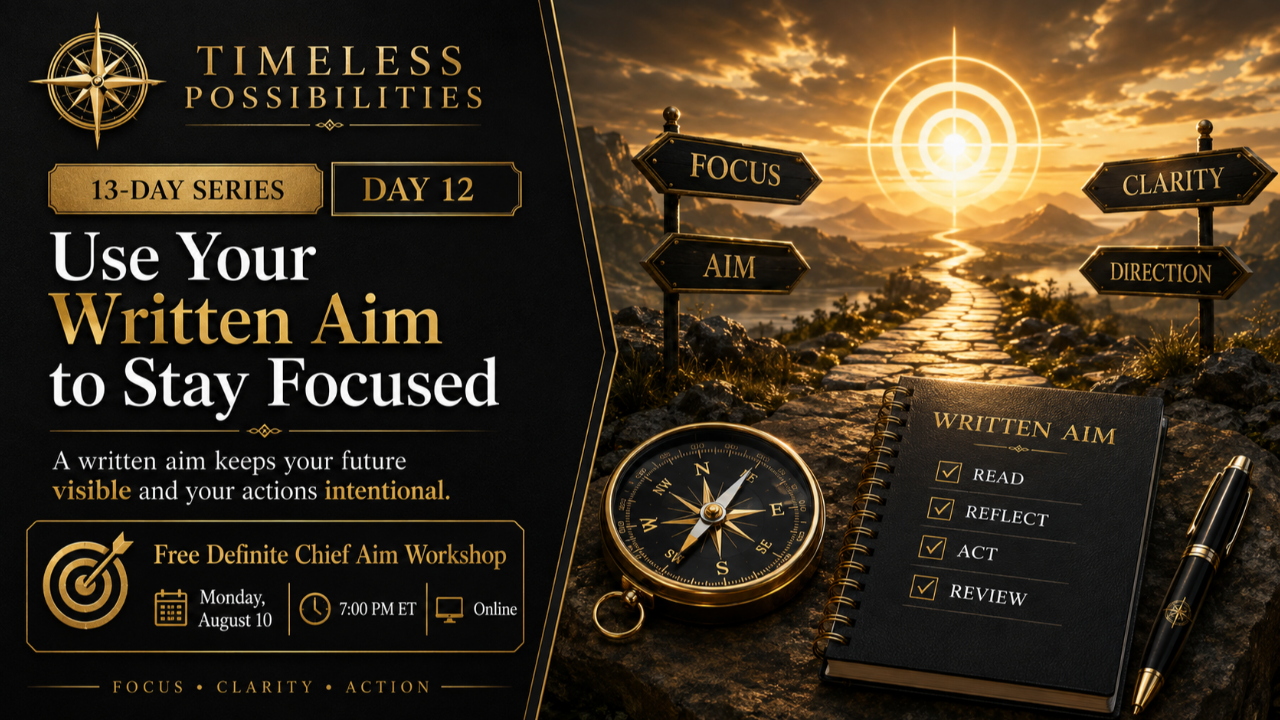
Use Your Written Aim to Stay Focused
Aug 08, 2026In the last post, we talked about becoming the kind of person your goal requires. A meaningful goal often asks you to strengthen your discipline, your consistency, your confidence, and your ability to follow through. Today, I want to focus on one of the simplest ways to support that growth: using your written Definite Chief Aim as a daily reminder of what you have chosen.
Writing your aim once is useful, but returning to it consistently is what helps keep it active in your thinking. Life has a way of filling your attention with urgent tasks, other people’s priorities, unexpected problems, and endless distractions. Without a clear reminder of your direction, even a meaningful goal can slowly move into the background.
Your written aim gives you something to come back to.
A Written Goal Keeps the Future Visible
One of the biggest challenges with long-term goals is that the future can feel distant while today’s responsibilities feel immediate. The bills, emails, errands, meetings, and problems in front of you naturally demand attention, while the future you want to create can seem less urgent.
A written Definite Chief Aim helps correct that imbalance because it keeps the goal visible. When you read it regularly, you are reminding yourself that your future deserves attention too. You are bringing a long-term intention back into the present moment.
That matters because what stays visible tends to influence your choices. When your aim is fresh in your mind, it becomes easier to notice whether the way you are spending your time actually supports the direction you have chosen.
Focus Is Easier When You Know What Matters
A clear written aim helps reduce decision fatigue because it gives you a reference point. Instead of treating every opportunity, task, or idea as equally important, you can evaluate it in relation to the goal you have already chosen.
This does not mean your entire life revolves around one objective. You still have family responsibilities, work, relationships, health, and many other priorities. What the written aim does is help ensure that your chosen goal does not disappear underneath everything else.
When you know what matters, focus becomes less about trying to do more and more about doing the right things more consistently.
Repetition Helps Reinforce the Decision
There is a reason Napoleon Hill emphasized repeatedly reading a written statement of purpose. The value is not in the words alone. The value comes from repeatedly directing your attention back toward the result you have chosen.
Every time you read your Definite Chief Aim, you are renewing the decision. You are reminding yourself what you want, why it matters, what you are willing to give in return, and what kind of action the goal requires.
That repetition can become especially useful on days when motivation is low. You may not feel excited every morning, and you may not feel confident every evening. But your written aim can still remind you of the commitment you made when your emotions are changing.
Consistency of direction matters more than consistency of mood.
A Written Aim Can Help You Catch Drift Early
One of the benefits of revisiting your aim regularly is that you can notice when you are starting to drift.
Maybe you have spent several days reacting instead of acting. Perhaps you have become distracted by a new idea that has very little connection to your goal. Maybe you have been avoiding one uncomfortable step and replacing it with easier activity.
When the aim is visible, those patterns become easier to recognize.
You can ask yourself whether your recent actions still match the direction you chose. If they do not, you do not need to criticize yourself. You simply need to return to the aim and make the next better decision.
That ability to correct course is one of the practical reasons to keep your goal in front of you.
Your Aim Should Be Specific Enough to Guide You
A written aim is only useful if it is clear.
If your statement says something vague such as “I want to be more successful,” it may not give you much direction when you read it. But if it clearly describes what you intend to achieve, by when, and what you are willing to give in return, it becomes much more useful.
Specificity gives the statement weight.
When you read a clear goal, you can immediately compare your current actions against it. You can ask whether you are doing the kind of work that supports the result, whether your current plan still makes sense, and whether you need to adjust your focus.
The clearer the statement, the more practical it becomes.
Connect the Aim to Your Daily Behaviour
Reading your Definite Chief Aim should not become a passive ritual.
The real value comes when the statement influences what you do next.
After reading it, ask yourself what one action would best support the goal today. That question keeps the written aim connected to behaviour instead of allowing it to remain inspirational language.
The action does not need to be large. It may be a follow-up, a conversation, a focused block of work, or a decision you have been postponing. What matters is that the aim creates movement.
A useful written goal should help you move from intention into action.
Use the Aim to Protect Your Attention
Attention is one of your most valuable resources.
Every day, countless things compete for it. Notifications, news, new opportunities, problems, entertainment, and other people’s priorities can consume hours without you realizing how much focus has been lost.
Your Definite Chief Aim can help protect your attention because it reminds you what deserves priority.
When a new idea appears, you can compare it against the goal. When a distraction pulls you away, you have something concrete to return to. When you are unsure what to work on, the aim can help you remember the direction.
The goal is not to become rigid. The goal is to become intentional.
Reflection Makes the Aim More Useful
Your written aim can also become a useful tool for reflection.
At the end of the week, take a few minutes and ask whether your actions matched the goal you have written. Look at what moved you forward, what pulled you off course, and what needs to change in the coming week.
This is not about judging yourself.
It is about using the aim as a standard for learning.
If you discover that your plan is not working, you can adjust it. If you notice that distractions are becoming a pattern, you can create stronger boundaries. If you see that one activity is producing better results, you can give it more attention.
The written aim helps make reflection more objective.
Your Aim Can Strengthen Identity Too
There is also a connection between your written goal and the identity we discussed in the last post.
When you repeatedly read your aim and then act in alignment with it, you reinforce the kind of person you are becoming. The statement reminds you of the future you have chosen, while your behaviour provides the evidence.
Over time, the two begin to support each other.
You are not only saying, “This is what I want.” You are also proving through your actions that you are willing to live in a way that supports it.
That is where a written goal starts to become part of your identity rather than simply a sentence on a page.
Keep the Aim Where You Will See It
A Definite Chief Aim is much less useful if you write it once and then forget where you put it.
Keep it somewhere you will see it regularly. That may be in a notebook, on your desk, in a planner, or somewhere private that is easy to access.
The exact location matters less than the habit of returning to it.
The purpose is not to create another item to check off a list. The purpose is to create a consistent reminder of the direction you have chosen.
When the aim stays visible, the goal stays mentally active.
Let the Written Goal Bring You Back
There will be days when you get distracted.
There will be weeks when your focus slips.
That is normal.
The important thing is having a way to return.
Your written Definite Chief Aim can become that return point. It reminds you what you decided, why you decided it, and what kind of action the goal still requires.
You do not need perfect focus.
You need the ability to notice when you have drifted and bring yourself back to the direction you chose.
Join the Free Definite Chief Aim Workshop
On Monday, August 10, at 7:00 p.m. Eastern Time, I will be hosting a free online Definite Chief Aim Workshop where we will work through how to create a written aim that is clear enough to guide your decisions and practical enough to influence your daily actions.
We will focus on defining what you really want, choosing a definite date, deciding what you are willing to give in return, creating a simple starting plan, and putting the entire aim into a written statement you can use after the workshop is over. The goal is not simply to write something inspiring. The goal is to create a statement that helps you stay focused when life becomes busy and distractions begin competing for your attention.
If you have a goal but find yourself losing focus, changing direction too often, or allowing daily responsibilities to push your future into the background, this workshop can help you create a stronger point of reference. The workshop is completely free, it will be held online, and we will meet on Monday, August 10 at 7:00 p.m. Eastern Time.

A written aim gives your future a place in the present. When you return to it consistently and connect it to your daily actions, it becomes more than a goal on paper; it becomes a practical tool for staying focused on the direction you have chosen.
What If You Could Start Creating More Financial Momentum in Just 7 Days?
Reading about financial success can give you ideas. Taking action is what begins to create change.
That's why I created the FREE Money Momentum Starter Guide Workbook—a practical starting point for anyone who wants to make greater financial progress by managing their money more intentionally, exploring opportunities to create additional income, and developing habits that keep them moving forward.
Inside the FREE Starter Guide, you'll discover:
- Where you are financially today and where you'd like to make progress
- Opportunities to take greater control of the money already flowing through your life
- Skills, knowledge, and experience you may be able to turn into additional income
- Practical actions you can begin taking right away
- How to create your own 7-Day Money Momentum Action Plan
You don't need to have everything figured out. You don't need a perfect financial plan or a great business idea. You simply need a starting point and a willingness to take the next step.
Want Some Help Working Through It?
You can complete the Money Momentum Starter Guide entirely on your own for free, or for a one-time $5 upgrade, get 30 days of access to your own Money Momentum AI Assistant to help you work through the workbook.
Your AI Assistant can help you think through questions, explore possibilities when you're unsure what to write, dig deeper into your answers, and turn what you discover into practical next steps and your personalized 7-Day Money Momentum Action Plan.
Start Building Your Money Momentum Today. Download your FREE Money Momentum Starter Guide Workbook and take your first step toward greater financial progress.
