
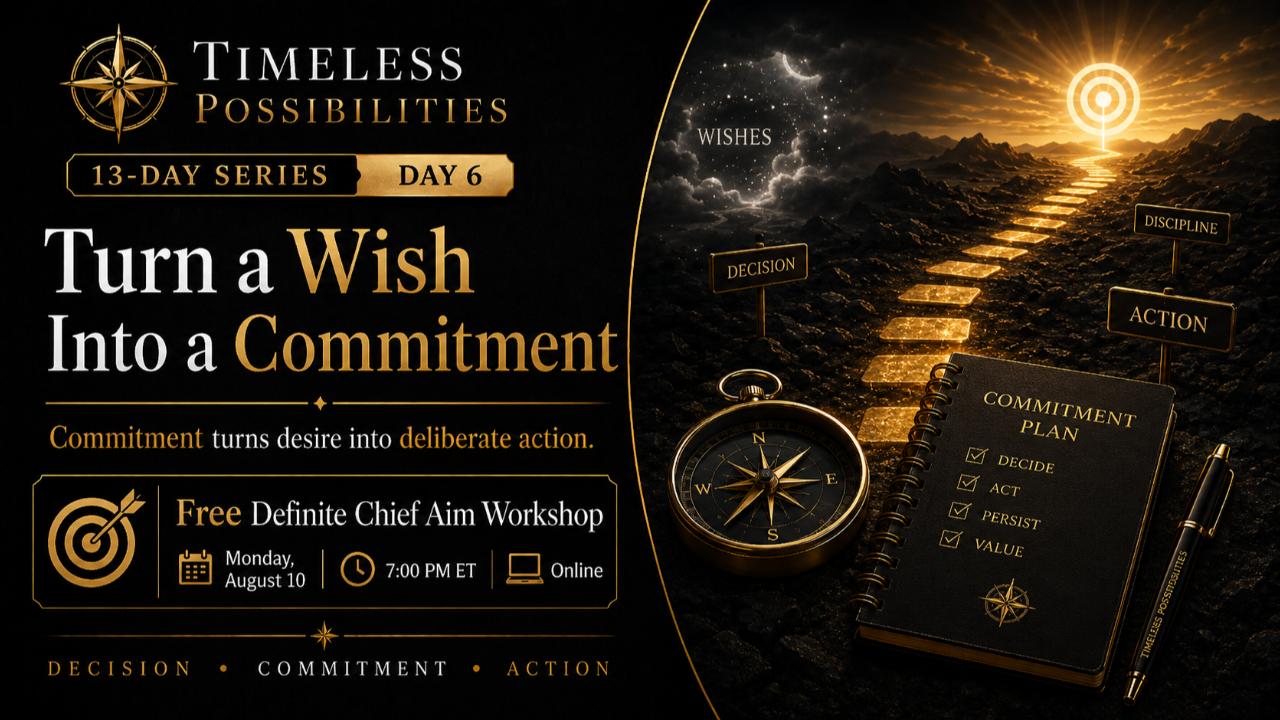
Turn a Wish Into a Commitment
Aug 02, 2026Over the past several days, we have talked about stopping the drift, getting clear about what you really want, making your goal specific, giving your daily actions a purpose, and using your aim to make better decisions. Today, I want to focus on the point where a goal begins to become much more serious: the moment you stop merely wishing for something and decide to commit to it.
A wish says, “I hope this happens.” A commitment says, “I have decided to pursue this.”
That difference may sound small, but it changes the way you think, the way you act, and the way you respond when things become difficult. Most people have plenty of wishes. They would like to earn more money, create greater freedom, improve their circumstances, build something meaningful, or change an area of their life. But wishing does not require much from us. Commitment does.
A Wish Can Stay Comfortable
Wishing is easy because it allows you to keep the goal at a safe distance. You can think about what you would like to accomplish without having to change very much today. You can imagine a different future without making a firm decision about what you are willing to do to create it.
That is why wishes can remain with us for years.
Someone may say they want to start a business, create additional income, write a book, improve their finances, or develop a new skill. They may genuinely mean it. But if the desire never becomes a commitment, there is always a reason to wait.
The timing is not right. There is too much going on. They need more information. They want to feel more confident. They will start when things settle down.
Eventually, “someday” becomes a habit.
Commitment breaks that pattern because it forces you to move from possibility to decision.
Commitment Changes the Question
When something is only a wish, you tend to ask, “Wouldn’t it be nice if this happened?”
When you make a commitment, the question becomes, “What do I need to do next?”
That is a very different way of thinking.
Suppose you have been saying for months that you would like to create an additional source of income. As long as it remains a wish, you can keep thinking about ideas without taking meaningful action.
But once you decide that you are going to create an additional $1,000 per month within a specific timeframe, your mind begins to approach the situation differently. Now you need to identify a skill, a problem you can solve, an offer you can make, and people you can speak with.
Commitment gives the desire consequences.
It requires action.
Commitment Does Not Mean You Know Exactly How
One reason people hesitate to commit is that they believe commitment requires certainty.
It does not.
You can make a serious commitment without knowing exactly how the goal will be achieved. In fact, most meaningful goals begin before the entire path is visible.
When you choose a destination for a long trip, you may not know every turn, delay, or detour you will encounter. That does not prevent you from deciding where you are going.
Your goal works the same way.
Commitment means you have decided that the result matters enough to pursue. You can still adjust the route. You can learn new information. You can improve your plan. You can even discover that some of your original assumptions were wrong.
None of that makes the commitment meaningless.
The commitment gives you a reason to keep searching for the next step.
Your Actions Reveal the Strength of the Commitment
One of the most useful questions you can ask yourself is whether your behaviour matches what you say you want.
If you say a goal is important but it never receives time, attention, or action, then it may still be more of a wish than a commitment.
That does not mean you need to completely rearrange your life overnight. Commitment can begin with something very small. It may mean setting aside thirty minutes each day. It may mean making the phone call you have been avoiding. It may mean finally writing the offer, creating the budget, registering for the course, or having the conversation.
What matters is that the decision begins producing visible behaviour.
You should be able to point to something and say, “Because I have committed to this goal, I now do this.”
That is when the goal begins to move from your imagination into your life.
Commitment Becomes Especially Important When Motivation Fades
Almost every meaningful goal feels exciting in the beginning.
You imagine the result. You feel hopeful. You may even experience a burst of energy and enthusiasm.
But motivation changes.
There will be days when the goal feels less exciting. There will be setbacks. Some actions will feel uncomfortable. You may receive disappointing feedback or wonder whether you are making enough progress.
If your goal is based only on how motivated you feel, those moments can quickly pull you off course.
Commitment gives you something more stable.
It allows you to say, “I may not feel as excited today, but I still made the decision.”
That does not mean stubbornly continuing with a strategy that clearly is not working. You can adapt the plan while remaining committed to the result.
The route can change without abandoning the destination.
Commitment Requires an Exchange
Napoleon Hill’s approach to a Definite Chief Aim included an important idea that is often overlooked: deciding what you are willing to give in return for the result you want.
That matters because commitment is not just about what you want to receive.
If you want more income, what value are you prepared to create? If you want greater opportunity, what skills will you develop? If you want more freedom, what discipline are you willing to practise now? If you want a different future, what habits may need to change?
This is where a goal becomes grounded in reality.
You stop asking only, “What do I want?” and begin asking, “What am I willing to contribute?”
That second question can reveal how serious the commitment really is.
Put Your Commitment Into Writing
There is power in taking a decision out of your head and putting it onto paper.
Writing forces you to become more precise. It gives the goal a form. It creates something you can return to when you become distracted or discouraged.
A written statement can remind you what you chose, why it matters, what you intend to accomplish, and what you have agreed to give in return.
That does not mean the words themselves will create the result. The value comes from using the written statement to reinforce your decision and guide your behaviour.
The goal is not to write something impressive.
The goal is to write something you intend to live.
Ask Yourself Whether You Have Decided
Think about one goal that matters to you right now.
Ask yourself whether you are still hoping it happens or whether you have actually decided to pursue it.
If you are uncertain, look at your recent behaviour. Has the goal received regular attention? Have you made choices because of it? Have you taken actions that felt uncomfortable? Have you sacrificed some time, convenience, or distraction in order to move forward?
Your actions will usually give you an honest answer.
If you discover that the goal has remained mostly a wish, you do not need to criticize yourself.
You can make a new decision today.
Join the Free Definite Chief Aim Workshop
On Monday, August 10, at 7:00 p.m. Eastern Time, I will be leading a free online Definite Chief Aim Workshop.
The purpose of the workshop is to help you move beyond vague hopes and begin turning a meaningful desire into a clear commitment. We will work through what you want, how to make the goal specific, when you intend to achieve it, what you are prepared to give in return, and how to create a simple plan you can begin using.
You will also have the opportunity to put your Definite Chief Aim into writing so that you leave with something more concrete than an idea in your head.
If there is something you have been thinking about, postponing, or telling yourself you will pursue “someday,” this workshop can help you turn that desire into a clearer decision.
The workshop is free, it is online, and it takes place on Monday, August 10 at 7:00 p.m. Eastern Time.

A wish describes something you would like to happen.
A commitment begins changing what you are willing to do.
The future starts to move when you stop merely hoping for a different result and decide that you are going to participate in creating it.
What If You Could Start Creating More Financial Momentum in Just 7 Days?
Reading about financial success can give you ideas. Taking action is what begins to create change.
That's why I created the FREE Money Momentum Starter Guide Workbook—a practical starting point for anyone who wants to make greater financial progress by managing their money more intentionally, exploring opportunities to create additional income, and developing habits that keep them moving forward.
Inside the FREE Starter Guide, you'll discover:
- Where you are financially today and where you'd like to make progress
- Opportunities to take greater control of the money already flowing through your life
- Skills, knowledge, and experience you may be able to turn into additional income
- Practical actions you can begin taking right away
- How to create your own 7-Day Money Momentum Action Plan
You don't need to have everything figured out. You don't need a perfect financial plan or a great business idea. You simply need a starting point and a willingness to take the next step.
Want Some Help Working Through It?
You can complete the Money Momentum Starter Guide entirely on your own for free, or for a one-time $5 upgrade, get 30 days of access to your own Money Momentum AI Assistant to help you work through the workbook.
Your AI Assistant can help you think through questions, explore possibilities when you're unsure what to write, dig deeper into your answers, and turn what you discover into practical next steps and your personalized 7-Day Money Momentum Action Plan.
Start Building Your Money Momentum Today. Download your FREE Money Momentum Starter Guide Workbook and take your first step toward greater financial progress.
