
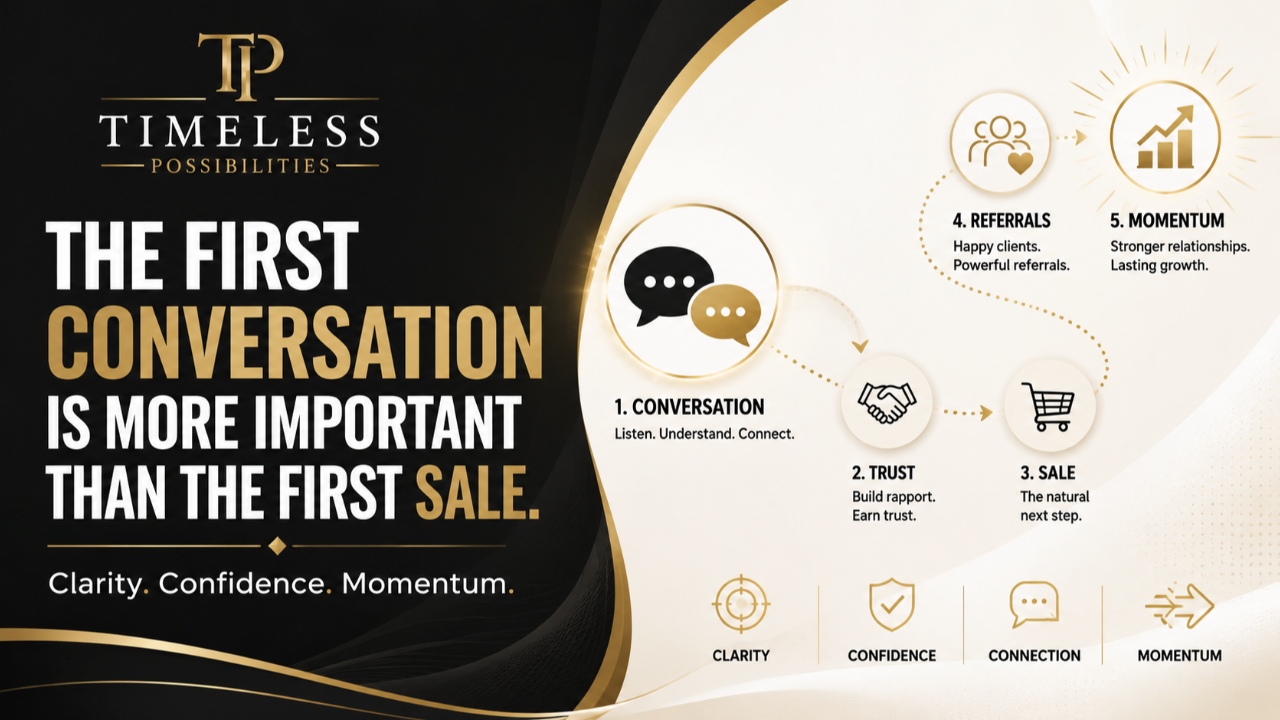
The First Conversation Is More Important Than the First Sale
Jul 10, 2026When people start building a side income, they often put too much pressure on the first sale.
They think the first conversation has to turn into a customer. They worry that if someone does not buy, the idea failed. They treat every conversation like a test they must pass instead of an opportunity to learn.
That kind of pressure can make starting feel much harder than it needs to be.
Yes, sales matter. If you want to earn your first $1,000 in extra income, eventually someone has to pay you for the value you provide. But before the first sale comes the first conversation. And for many people, that first conversation is actually the more important breakthrough.
Why? Because conversations create clarity, confidence, feedback, referrals, and momentum. Even when a conversation does not lead to money right away, it can still move you forward.
Conversations Help You Get Out of Your Head
Many side income ideas stay stuck in private thinking. You think about the offer. You imagine what people might say. You wonder whether the price is right. You keep adjusting the wording, but nothing really changes because the idea is still only being tested in your mind.
A real conversation changes that.
When you explain your offer to another person, you immediately learn something. You hear how it sounds out loud. You notice whether the other person understands it. You see what questions they ask. You discover whether the problem makes sense to them.
That feedback is much more useful than guessing in private.
The first conversation helps your offer leave your head and enter the real world.
A Conversation Can Produce More Than a Sale
One mistake beginners make is thinking a conversation only counts if it creates a customer. That is too narrow. A conversation can create several valuable outcomes.
It may lead to a sale. It may lead to a referral. It may help you realize your message is unclear. It may reveal a better problem to solve. It may show you that your ideal customer is slightly different than you thought. It may simply give you practice explaining what you do.
All of those outcomes matter.
When you stop judging every conversation only by whether someone buys, you become more willing to start. That willingness creates more conversations. More conversations create more learning. More learning creates better offers.
And better offers eventually create more customers.
The First Conversation Builds Confidence
Confidence does not usually appear before action. It grows through action.
The first time you tell someone about your side income offer, it may feel awkward. You may stumble over your words. You may explain too much. You may feel nervous when they ask a question.
That is normal.
You are practicing a new skill.
But after you have the first conversation, something changes. You realize you survived it. You realize the other person did not laugh at you. You realize you can explain your offer and improve it. The next conversation becomes a little easier, and the one after that becomes easier again.
That is how confidence is built. Not by waiting until you feel ready, but by taking small actions before you feel fully ready.
Listen More Than You Talk
The goal of the first conversation is not to deliver a perfect sales pitch. The goal is to understand.
Ask questions. Listen carefully. Pay attention to the words the other person uses. Notice what they care about, what frustrates them, and what they have already tried.
If you are offering tutoring, ask what the student is struggling with and how it is affecting their confidence. If you are offering bookkeeping help, ask what feels disorganized and what would make the business owner feel more in control. If you are offering home organization, ask which area feels most stressful and why it matters.
The better you listen, the better your offer becomes.
Selling becomes much easier when you are responding to a real problem instead of forcing a memorized pitch.
Do Not Rush the Sale
When someone shows interest, it can be tempting to rush toward the sale. You may feel excited and want to explain every detail, every benefit, and every option. But too much information too quickly can overwhelm the other person.
A better approach is to keep the next step simple.
You might say, “Would it make sense to talk for ten minutes so I can understand what you need?” Or, “Would you like me to take a look and suggest a simple next step?” Or, “Would it help if I explained how I usually work with someone in that situation?”
These simple next steps keep the conversation moving without pressure.
The goal is not to force someone into a decision. The goal is to help them clearly see whether your offer is a good fit.
Rejection Is Still Useful Information
Not every conversation will turn into a customer, and that is okay. A “no” does not always mean your idea is bad. Sometimes the person does not have the problem. Sometimes they are not ready to solve it. Sometimes the timing is wrong. Sometimes they are not the right customer.
Instead of taking every “no” personally, look for what you can learn.
Did they understand the offer? Did they ask any questions? Did they mention someone else who might need it? Did they hesitate because of the price, the timing, or the result? Did the conversation reveal something you could explain more clearly next time?
Every conversation gives feedback if you are willing to pay attention.
That feedback helps you improve.
One Conversation Can Open Another Door
Sometimes the first person you talk to will not buy, but they will know someone who might. This is why conversations are so powerful. You are not only speaking to one potential customer. You are also giving that person a clear way to refer you.
If your offer is simple, they may remember it. If they remember it, they may mention it to someone else. That means one conversation can lead to another conversation, and that second conversation may lead to your first customer.
This is why clarity matters. People cannot refer what they do not understand. When you can clearly explain who you help and what problem you solve, you make it easier for others to help you find the right people.
A Simple Challenge for This Week
This week, choose one person and start one conversation about your offer.
Do not make it complicated. Do not try to close a sale immediately. Simply explain what problem you are helping solve and ask whether they know anyone who might need that kind of help.
You might say, “I am starting to help busy homeowners keep their yards looking cared for so they can enjoy their weekends. Do you know anyone who might need help with that?”
Or, “I am helping small business owners organize simple records so they feel less stressed and more prepared. Do you know anyone who struggles with that?”
After the conversation, write down what you learned. Did your offer sound clear? Did they ask a question? Did they suggest someone else? Did you feel more confident after saying it out loud?
That is progress.
Momentum Starts With One Conversation
Your first $1,000 will not appear because you thought about your offer long enough. It will come from sharing your offer, listening to real people, and learning through action.
The first sale matters, but the first conversation often matters more because it breaks the silence. It moves your idea out of private planning and into the marketplace. It gives you feedback, builds confidence, and helps you discover what people actually need.
Do not wait until you feel completely ready. Start with one conversation.
One conversation can create clarity.
One conversation can create confidence.
One conversation can create a referral.
And one conversation may be the first step toward your first $1,000.
Download Your Free First $1,000 Side Income Starter Guide
If this article helped you see why the first conversation matters, your next step is to begin putting that idea into action. That is why I created The First $1,000 Side Income Starter Guide.
This free guide will help you think through your skills, identify real problems, clarify your offer, and begin taking practical steps toward your first $1,000 in extra income.
You do not need to wait for the perfect moment. You need a clear offer, a real conversation, and the willingness to learn as you go.
Download your free First $1,000 Side Income Starter Guide today and start building momentum one conversation at a time.
And when you are ready for a complete step-by-step process, The First $1,000 Side Income Action Plan will guide you through the full 12-week journey of choosing one opportunity, creating a simple offer, taking consistent action, and earning your first $1,000.
What If You Could Start Creating More Financial Momentum in Just 7 Days?
Reading about financial success can give you ideas. Taking action is what begins to create change.
That's why I created the FREE Money Momentum Starter Guide Workbook—a practical starting point for anyone who wants to make greater financial progress by managing their money more intentionally, exploring opportunities to create additional income, and developing habits that keep them moving forward.
Inside the FREE Starter Guide, you'll discover:
- Where you are financially today and where you'd like to make progress
- Opportunities to take greater control of the money already flowing through your life
- Skills, knowledge, and experience you may be able to turn into additional income
- Practical actions you can begin taking right away
- How to create your own 7-Day Money Momentum Action Plan
You don't need to have everything figured out. You don't need a perfect financial plan or a great business idea. You simply need a starting point and a willingness to take the next step.
Want Some Help Working Through It?
You can complete the Money Momentum Starter Guide entirely on your own for free, or for a one-time $5 upgrade, get 30 days of access to your own Money Momentum AI Assistant to help you work through the workbook.
Your AI Assistant can help you think through questions, explore possibilities when you're unsure what to write, dig deeper into your answers, and turn what you discover into practical next steps and your personalized 7-Day Money Momentum Action Plan.
Start Building Your Money Momentum Today. Download your FREE Money Momentum Starter Guide Workbook and take your first step toward greater financial progress.
