
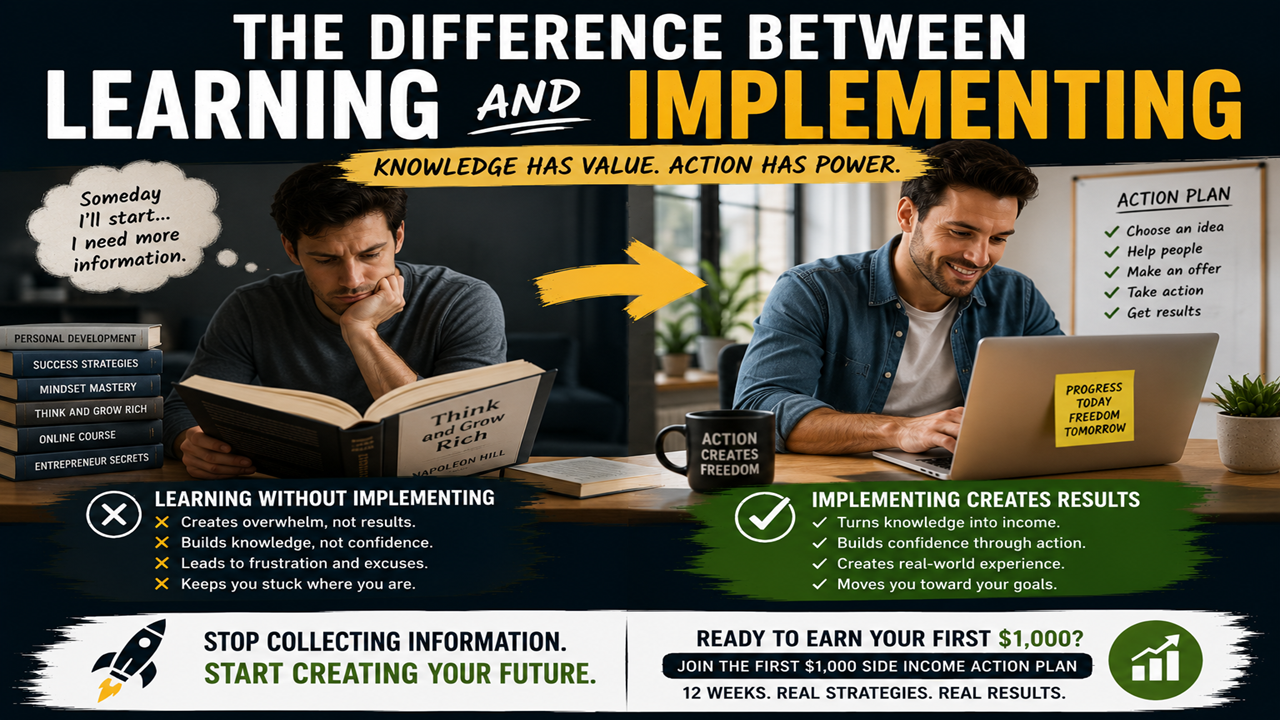
The Difference Between Learning and Implementing
Jun 24, 2026Have you ever noticed that two people can read the same book, attend the same seminar, or complete the same course and get completely different results?
One person takes what they learned and transforms their life. They start a business, improve their finances, or achieve goals they once thought were impossible. The other person feels inspired for a few days, talks about what they learned, and then slowly returns to their old habits.
The information was the same. The opportunity was the same. Yet the results were dramatically different. Why? Because there is a massive difference between learning and implementing.
Unfortunately, most people spend far more time learning than implementing. We live in a culture that celebrates information. New books are published every day. Thousands of videos are uploaded every hour. Courses, podcasts, webinars, and social media posts provide an endless stream of knowledge. Learning has never been easier. Implementation, however, remains rare.
Many people confuse learning with progress. They finish a book and feel productive. They watch a training video and feel like they are moving forward. They listen to a podcast and believe they are improving their situation. While learning is valuable, it is only the beginning.
Knowledge without action creates very little change. Imagine someone who spends six months studying fitness. They read every nutrition book they can find. They watch exercise videos. They follow experts online. They know exactly what they should eat and how they should train.
At the end of those six months, they may possess a tremendous amount of knowledge. But if they never exercise, nothing changes. Their body doesn't respond to what they know. It responds to what they do.
The same principle applies to money, business, relationships, and personal growth. Results are produced by implementation, not information. One of the reasons people stay stuck in learning mode is because learning feels safe.
When you're learning, there is very little risk. Nobody can reject you. Nobody can criticize your offer. Nobody can tell you your idea won't work. You remain protected inside your comfort zone.
Implementation is different. Implementation requires exposure. It requires uncertainty. It requires the willingness to discover whether your ideas actually work in the real world. That can feel uncomfortable. Yet that discomfort is often where growth begins.
Many successful entrepreneurs will tell you that their greatest lessons didn't come from books. They came from customers. They came from mistakes. They came from conversations. They came from trying something, discovering it didn't work, and adjusting.
The marketplace is a far better teacher than theory alone. When you implement, you receive feedback. Feedback reveals what works. Feedback reveals what doesn't work. Feedback reveals opportunities you would never have discovered by simply studying.
This is why implementation creates clarity. Many people wait until they have everything figured out before they begin. They want certainty. They want guarantees. They want confidence. But confidence often arrives after implementation, not before.
Think about learning to drive a car. You can study the rules of the road for months. You can memorize every traffic sign. You can understand every safety procedure. Yet the real learning begins when you sit behind the wheel.
At first, it feels awkward. You make mistakes. You overthink every movement. Then something interesting happens. Experience begins to replace uncertainty. The actions that once felt difficult become natural. Confidence grows because you have evidence.
Implementation creates that evidence. One of the biggest differences between high achievers and everyone else is not intelligence. It is speed of implementation.
Successful people tend to act on ideas more quickly. They don't wait until they know everything. They learn enough to take the next step. Then they learn from that step. Then they take another. This cycle continues over and over.
Meanwhile, many people remain trapped in preparation. They continue gathering information. Continue researching. Continue planning. Continue waiting. They tell themselves they're being responsible. In reality, they are often avoiding action.
There is a phrase that says, "You can learn your way into action, or you can act your way into learning." The second approach is usually faster.
Action reveals lessons that information cannot. Action reveals strengths you didn't know you had. Action reveals opportunities hiding in plain sight. Action reveals what customers actually want.
This is one reason earning your first $1,000 is such an important milestone.
The money matters. But the experience matters more. The process forces you to implement. You must talk to people. You must solve problems. You must create value. You must take action. And through those actions, you gain something incredibly valuable.
Proof. Proof that you can create opportunities. Proof that you can learn new skills. Proof that you can generate income beyond your job. That proof changes how you see yourself. And when your identity begins to change, your results often follow.
Napoleon Hill understood this principle well.
Throughout Think and Grow Rich, he emphasized organized planning, decision, persistence, and taking initiative. Those are not learning principles. Those are implementation principles.
Hill knew that knowledge only becomes powerful when it is translated into action. Many people love personal development because it feels inspiring. Implementation is often less glamorous. It involves uncomfortable conversations, mistakes, rejection, adjustment, and persistence, but implementation is where transformation occurs.
If you've been consuming information for months without seeing the results you want, perhaps it's time to ask yourself a simple question: "What do I already know that I haven't applied?"
That question can be surprisingly revealing. Most people already know enough to take their next step. What they need is the courage to take it. The goal is not to stop learning. Learning will always be important. The goal is to create balance.
For every hour spent learning, spend time implementing. For every idea you discover, take action on one. For every lesson you study, find a way to apply it, because learning can inspire you. Implementation can change your life.
Ready to Move From Learning to Implementing?
The First $1,000 Side Income Action Plan was designed for people who are ready to stop consuming information and start creating results. Download your FREE The First $1000 Side Income Starter Guidebook.
What If You Could Start Creating More Financial Momentum in Just 7 Days?
Reading about financial success can give you ideas. Taking action is what begins to create change.
That's why I created the FREE Money Momentum Starter Guide Workbook—a practical starting point for anyone who wants to make greater financial progress by managing their money more intentionally, exploring opportunities to create additional income, and developing habits that keep them moving forward.
Inside the FREE Starter Guide, you'll discover:
- Where you are financially today and where you'd like to make progress
- Opportunities to take greater control of the money already flowing through your life
- Skills, knowledge, and experience you may be able to turn into additional income
- Practical actions you can begin taking right away
- How to create your own 7-Day Money Momentum Action Plan
You don't need to have everything figured out. You don't need a perfect financial plan or a great business idea. You simply need a starting point and a willingness to take the next step.
Want Some Help Working Through It?
You can complete the Money Momentum Starter Guide entirely on your own for free, or for a one-time $5 upgrade, get 30 days of access to your own Money Momentum AI Assistant to help you work through the workbook.
Your AI Assistant can help you think through questions, explore possibilities when you're unsure what to write, dig deeper into your answers, and turn what you discover into practical next steps and your personalized 7-Day Money Momentum Action Plan.
Start Building Your Money Momentum Today. Download your FREE Money Momentum Starter Guide Workbook and take your first step toward greater financial progress.
