
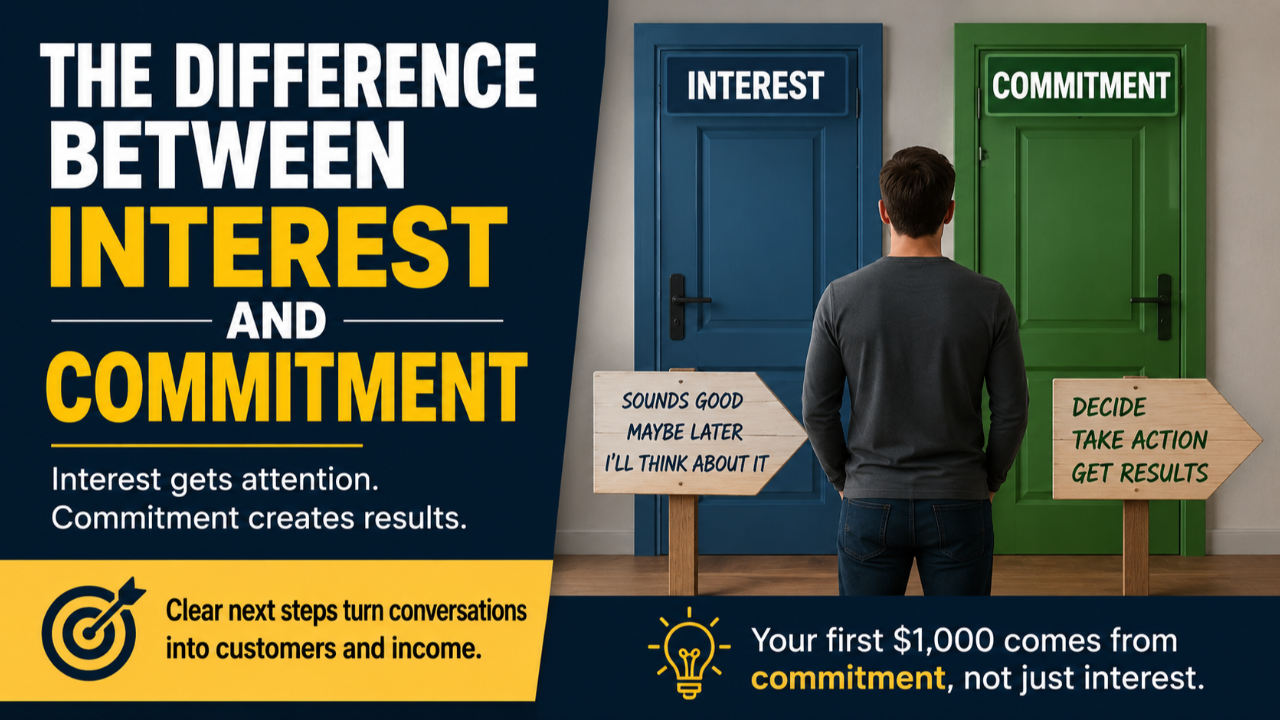
The Difference Between Interest and Commitment
Jul 13, 2026One of the most encouraging moments when building a side income is when someone shows interest in your offer.
They might say, “That sounds interesting,” or “I may need something like that,” or “Send me more information.” For a moment, it feels like momentum is building. You start thinking this could become your first customer, your first sale, or another step toward your first $1,000 in extra income.
But then nothing happens.
They do not book. They do not pay. They do not follow up. The conversation fades, and you are left wondering what went wrong.
This is a common experience, especially when you are just starting out. The problem is not always your offer. Often, the problem is that interest was never turned into commitment.
Interest is a good sign, but commitment is what creates action.
Interest Is the Beginning, Not the Decision
When someone shows interest, it usually means your offer has caught their attention. They may recognize the problem. They may like the result you are describing. They may even believe your offer could help.
But interest alone does not mean they have decided.
A person can be interested and still be unsure. They can be interested and still be busy. They can be interested and still need more clarity. They can be interested and still avoid making a decision because the next step feels unclear.
That is why you cannot treat interest as the finish line. It is only the beginning of a possible buying conversation.
Commitment Requires a Clear Next Step
One of the biggest reasons interested people do not move forward is that the next step is too vague.
If you end a conversation with, “Let me know what you think,” you may believe you have invited them to respond. But to the other person, that can feel unclear. What exactly should they do next? Should they ask questions? Should they book a time? Should they decide now? Should they wait?
A clear next step makes commitment easier.
Instead of saying, “Let me know what you think,” you could say, “Would it make sense to schedule a ten-minute call this week so I can understand what you need?” Or, “Would you like me to send you the details and a simple option to get started?” Or, “If this sounds helpful, the next step would be to choose a time for me to take a look.”
Commitment usually does not happen by accident. It happens when the next step is simple and clear.
Do Not Confuse Encouragement With a Sale
When you are excited about your side income idea, encouraging words can feel like proof that someone is ready to buy. But not every positive response means someone is prepared to take action.
Someone may genuinely like your idea but not need it. They may think your offer sounds useful but not have the problem themselves. They may want to be supportive, even though they are not a real prospect.
This is why you need to pay attention to behavior, not just words.
A person who is committed will usually take a next step. They will book a call, answer questions, send information, agree to a time, make a payment, or ask what happens next. Interest sounds positive. Commitment moves.
Questions Can Signal Real Interest
Not all interest is equal. When someone starts asking specific questions, that can be a stronger sign that they are considering action.
They might ask how the process works, what is included, how long it takes, what it costs, when you are available, or whether your offer can help with their specific situation. These questions show that they are imagining the offer in their own life.
When this happens, do not rush or overwhelm them. Answer clearly and then guide them toward the next step. For example, you might say, “Based on what you described, I think the simplest next step would be a short call so I can understand the details and recommend the best option.”
That keeps the conversation moving without pressure.
Commitment Often Needs Clarity
Sometimes people hesitate because they do not fully understand what they are saying yes to. They may wonder what is included, what result they can expect, how much effort is required, how long it will take, or what happens after they agree.
This is why clarity matters so much. A confused person may be interested, but they will often delay commitment.
Your job is not to pressure them. Your job is to remove unnecessary confusion. Explain the problem you help solve, the result you are working toward, what the first step looks like, and what they can expect next.
The clearer the path, the easier it becomes for the right person to say yes.
Give People a Simple Choice
Too many options can slow commitment. If you give someone five packages, three payment options, a long explanation, and several possible starting points, they may feel overwhelmed. When people feel overwhelmed, they often delay.
A simple choice is usually better when you are starting out.
You might say, “I have one starter option that focuses on solving this specific problem first.” Or, “The simplest way to begin is with a one-hour session to organize the main issue.” Or, “I usually start with a small first step so we can make progress without overcomplicating it.”
This keeps the decision manageable. Your first customer does not need your entire future business model. They need one clear way to get help.
Respect the Difference Between No, Maybe, and Not Yet
When someone does not commit, it does not always mean they are rejecting you. Sometimes it is a no. Sometimes it is a maybe. Sometimes it is simply not yet.
A no means they are not the right fit right now. A maybe may mean they need more clarity or time. A not yet may mean the timing is wrong, but the problem still matters.
Your follow-up should respect that difference. You can ask, “Does this feel like something you want to move forward with now, or would it be better to revisit later?” That question gives the person room to answer honestly and gives you useful information.
It also prevents you from chasing someone who is not ready while still keeping the door open for future opportunities.
Your First $1,000 Requires Decisions
Your first $1,000 will not come from vague interest alone. It will come from helping the right people make clear decisions.
If your offer is $100, you need ten decisions. If your offer is $250, you need four decisions. If your offer is $500, you need two decisions. That makes the process more practical.
You are not trying to collect compliments about your idea. You are trying to create enough clarity and trust that the right people can decide whether your offer is a fit.
That does not mean forcing people. It means guiding the conversation from interest to a clear next step.
A Simple Challenge for This Week
This week, look back at the people who have shown interest in your offer. Make a short list of anyone who said they might need help, asked a question, requested more information, or responded positively.
Then choose two or three people and follow up with a clear next step.
You might say, “You mentioned that this might be helpful. Would it make sense to schedule a ten-minute conversation this week so I can understand what you need and suggest a simple next step?”
Or, “I wanted to follow up and see if this is something you want to move forward with now, or if it would be better to revisit later.”
The goal is not to pressure anyone. The goal is to stop leaving conversations floating in uncertainty.
Commitment Creates Momentum
Interest feels good, but commitment creates movement. When someone takes the next step, the offer becomes real. You gain experience, feedback, confidence, and the opportunity to deliver value.
This is an important part of earning your first $1,000. You are learning how to move from casual conversations to clear decisions. You are learning how to guide people respectfully. You are learning how to make your offer easier to understand and easier to act on.
Do not be discouraged by people who are only interested. Interest is still useful. It tells you that something about your offer may be connecting.
But do not stop there.
Help the right people take the next step.
That is how conversations turn into customers, and customers turn into momentum.
Download Your Free First $1,000 Side Income Starter Guide
If this article helped you understand the difference between interest and commitment, your next step is to put that clarity into action. That is why I created The First $1,000 Side Income Starter Guide.
This free guide will help you think through your skills, identify real problems, clarify your offer, and begin taking practical steps toward your first $1,000 in extra income.
You do not need to chase people or pressure them into buying. You need a clear offer, a simple next step, and the confidence to guide interested people toward a decision.
Download your free First $1,000 Side Income Starter Guide today and start turning conversations into real momentum.
And when you are ready for a complete step-by-step process, The First $1,000 Side Income Action Plan will guide you through the full 12-week journey of choosing one opportunity, creating a simple offer, taking consistent action, and earning your first $1,000.
What If You Could Start Creating More Financial Momentum in Just 7 Days?
Reading about financial success can give you ideas. Taking action is what begins to create change.
That's why I created the FREE Money Momentum Starter Guide Workbook—a practical starting point for anyone who wants to make greater financial progress by managing their money more intentionally, exploring opportunities to create additional income, and developing habits that keep them moving forward.
Inside the FREE Starter Guide, you'll discover:
- Where you are financially today and where you'd like to make progress
- Opportunities to take greater control of the money already flowing through your life
- Skills, knowledge, and experience you may be able to turn into additional income
- Practical actions you can begin taking right away
- How to create your own 7-Day Money Momentum Action Plan
You don't need to have everything figured out. You don't need a perfect financial plan or a great business idea. You simply need a starting point and a willingness to take the next step.
Want Some Help Working Through It?
You can complete the Money Momentum Starter Guide entirely on your own for free, or for a one-time $5 upgrade, get 30 days of access to your own Money Momentum AI Assistant to help you work through the workbook.
Your AI Assistant can help you think through questions, explore possibilities when you're unsure what to write, dig deeper into your answers, and turn what you discover into practical next steps and your personalized 7-Day Money Momentum Action Plan.
Start Building Your Money Momentum Today. Download your FREE Money Momentum Starter Guide Workbook and take your first step toward greater financial progress.
