
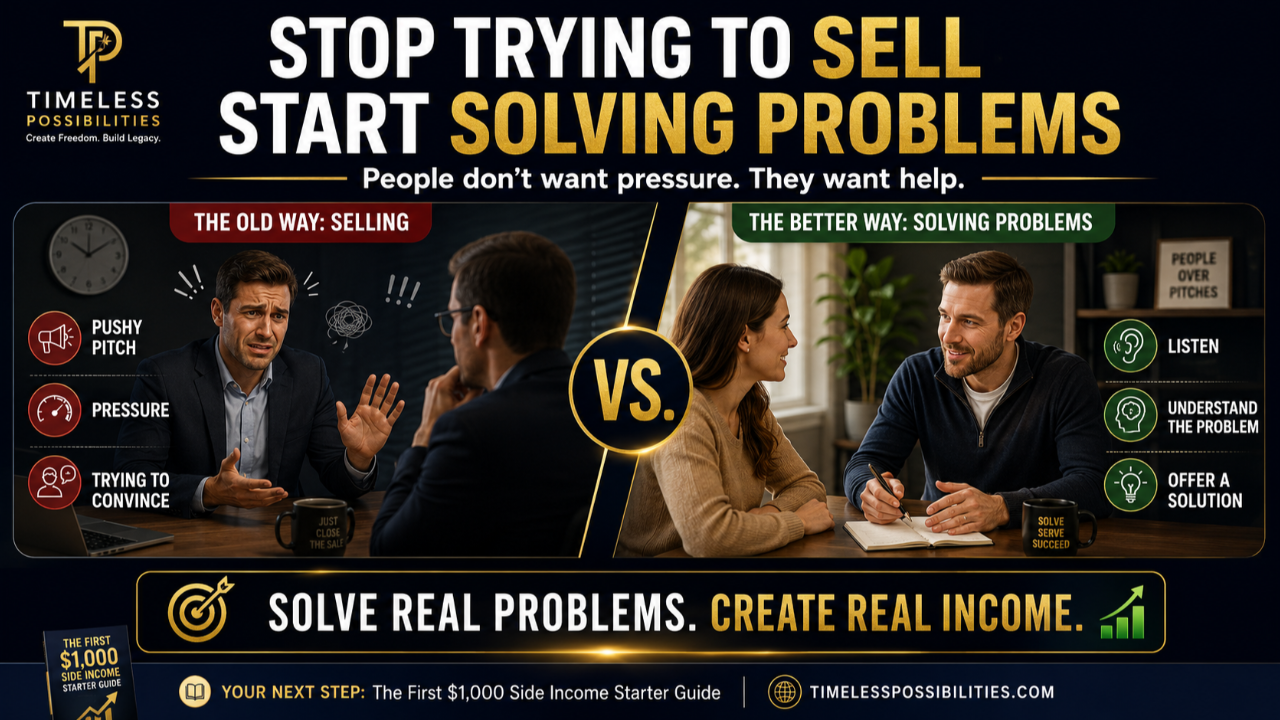
Stop Trying to Sell and Start Solving Problems
Jul 02, 2026
For many people, the word “selling” creates an uncomfortable feeling. They imagine pressure. They imagine awkward conversations. They imagine trying to convince someone to buy something they may not want.
Because of that, many people avoid selling altogether. They may have a good idea, a useful skill, or a real opportunity to help someone, but they hesitate because they do not want to feel pushy.
This is one of the biggest reasons people struggle to earn their first $1,000 in extra income. They think they need to become great at selling. But in reality, they need to become great at solving problems. That one shift can change everything.
Selling Feels Hard When You Start With Yourself
Selling feels uncomfortable when the focus is on you.
You start thinking about how you sound, whether people will judge you, what they will think of your offer, whether they will say no, and whether you are qualified enough. Suddenly the whole conversation feels personal.
That kind of pressure makes people freeze. They overthink the message. They delay sharing the offer. They convince themselves they need more confidence, more experience, or a better presentation. But the real issue is not always confidence.
Sometimes the issue is focus. When the focus is on you, selling feels heavy. When the focus is on the other person’s problem, the conversation becomes much easier.
People Do Not Want to Be Sold
Most people do not enjoy feeling sold to. They do not want to feel pressured. They do not want to feel manipulated. They do not want to feel like someone is trying to push them into a decision.
But people do want help. They want relief from frustration. They want solutions to problems. They want someone to understand what they are dealing with. They want a better result. That is why problem-solving is so powerful.
When you stop trying to convince people and start trying to understand them, the entire conversation changes. You are no longer trying to “get a sale.” You are trying to discover whether you can genuinely help.
The Best Selling Begins With Listening
Many people think selling begins with talking. They believe they need the perfect pitch, the perfect script, or the perfect explanation. But strong selling often begins with listening.
When you listen well, you learn what the person actually cares about. You learn what frustrates them. You learn what they have already tried. You learn what outcome they want. You learn what would make their life easier.
That information is valuable because it helps you determine whether your offer is a good fit. If it is, you can explain how you may be able to help. If it is not, you do not need to force the conversation. That is a much more honest and comfortable way to approach selling.
A Simple Example
Imagine someone is thinking about offering lawn care services. They could walk up to a homeowner and say, “I mow lawns. Do you want to hire me?” That may work sometimes, but it can feel abrupt.
A better approach might begin with observation and conversation. Maybe the homeowner has mentioned they are too busy to keep up with yard work. Maybe they have complained about not having time after work. Maybe they have said their weekends are already full.
Now the conversation is different. You are not pushing a random service. You are responding to a real problem. You might say, “I know you mentioned that keeping up with the yard has been difficult lately. I am offering lawn care help in the neighborhood. Would it be useful if I took that off your plate?”
That does not feel like pressure. It feels like help.
Solving Problems Makes Your Offer Clearer
A lot of people struggle to explain what they do because they describe the service instead of the problem. They say, “I do social media management.” Or, “I do tutoring.” Or, “I offer virtual assistance.”
Those statements may be accurate, but they do not always create interest. A stronger message connects the service to the problem it solves.
Instead of saying, “I do social media management,” you might say, “I help busy small business owners stay consistent online without spending hours trying to create posts.”
Instead of saying, “I do tutoring,” you might say, “I help students who are falling behind in math rebuild confidence and improve their grades.”
Instead of saying, “I offer virtual assistance,” you might say, “I help overwhelmed business owners get administrative tasks off their plate so they can focus on serving customers.”
The service matters. But the result matters more.
People Pay for Relief, Results, and Progress
When someone buys a service, they are usually buying more than the task itself. They are buying relief from stress. They are buying time back. They are buying confidence. They are buying progress. They are buying a result they do not want to create alone.
This is why your offer should be built around the outcome. If you can clearly show how your help solves a real problem, the conversation becomes much more natural.
You are not begging someone to buy. You are showing them a possible path from frustration to improvement.
Selling Becomes Easier When You Believe in the Help
Many people feel uncomfortable selling because deep down they are not sure their offer is valuable. That uncertainty is normal at the beginning. But confidence grows when you focus on helping one person solve one real problem.
You do not need to help everyone. You do not need to solve every problem. You do not need to be perfect. You simply need to help the right person with the right problem.
When you know your offer can make someone’s life easier, selling feels less like pressure and more like service.
Do Not Sell to Everyone
One mistake beginners often make is believing everyone should want their offer. That is not true. Your offer is not for everyone. Some people will not need it. Some people will not value it. Some people will not be ready. Some people will not be willing to pay for help.
That is okay. Your job is not to convince everyone. Your job is to find the people who already have the problem you solve and are open to help. This takes pressure off the conversation.
A “no” does not mean you failed. It may simply mean the person was not the right fit.
The First $1,000 Comes From Service
Your first $1,000 in extra income will probably not come from a fancy sales strategy. It will likely come from helping real people solve real problems.
One person needs help. You offer a solution. You do good work. They tell someone else. You improve your offer. You keep going.
That is how momentum begins. Not with pressure. Not with manipulation. Not with trying to sound impressive. Momentum begins when people experience real value.
What Napoleon Hill Would Remind Us
Napoleon Hill often taught that success comes through rendering useful service. That principle still applies today. Money follows value. Income follows service.
Opportunities grow when people trust that you can help them achieve a result. If you are trying to earn extra income, do not begin by asking, “How can I sell more?” Begin by asking, “How can I serve better?”
That question will lead you in a much stronger direction.
A Simple Challenge for This Week
Think about one service, skill, or idea you could offer. Now rewrite it as a problem-solving statement. Do not just describe what you do. Describe who you help, what problem they have, and what result you help them create.
For example: “I help busy homeowners keep their yards looking good without losing their weekends.” “I help small business owners stay organized with simple spreadsheet systems.” “I help parents support their children in math by making difficult concepts easier to understand.”
Then share that statement with one real person and pay attention to their response. You may be surprised how much clearer your offer becomes when it is built around solving a problem.
Stop Selling. Start Helping. Selling does not have to feel uncomfortable. It becomes uncomfortable when you try to push people toward something they do not want. But when you listen, understand, and offer real help, selling becomes much more natural.
You are not trying to pressure someone. You are trying to serve someone. You are helping them move from a problem to a result. And that is the foundation of a real side income.
Download Your Free First $1,000 Side Income Starter Guide
If this article helped you see selling in a new way, your next step is to begin identifying the problems you may be able to solve for other people. That is why I created The First $1,000 Side Income Starter Guide.
This free guide will help you think through your skills, notice real problems, and begin taking simple steps toward creating extra income. You do not need to be a pushy salesperson.
You do not need the perfect business idea. You do not need to have everything figured out. You simply need to find a real problem, offer a helpful solution, and take the next step.
Download your free First $1,000 Side Income Starter Guide today and begin discovering how your skills, experience, and everyday observations could become the foundation for your first $1,000 in extra income.
When you are ready for a step-by-step process, The First $1,000 Side Income Action Plan will walk you through the full 12-week journey of choosing one opportunity, creating a simple offer, taking consistent action, and building momentum toward your first $1,000.
What If You Could Start Creating More Financial Momentum in Just 7 Days?
Reading about financial success can give you ideas. Taking action is what begins to create change.
That's why I created the FREE Money Momentum Starter Guide Workbook—a practical starting point for anyone who wants to make greater financial progress by managing their money more intentionally, exploring opportunities to create additional income, and developing habits that keep them moving forward.
Inside the FREE Starter Guide, you'll discover:
- Where you are financially today and where you'd like to make progress
- Opportunities to take greater control of the money already flowing through your life
- Skills, knowledge, and experience you may be able to turn into additional income
- Practical actions you can begin taking right away
- How to create your own 7-Day Money Momentum Action Plan
You don't need to have everything figured out. You don't need a perfect financial plan or a great business idea. You simply need a starting point and a willingness to take the next step.
Want Some Help Working Through It?
You can complete the Money Momentum Starter Guide entirely on your own for free, or for a one-time $5 upgrade, get 30 days of access to your own Money Momentum AI Assistant to help you work through the workbook.
Your AI Assistant can help you think through questions, explore possibilities when you're unsure what to write, dig deeper into your answers, and turn what you discover into practical next steps and your personalized 7-Day Money Momentum Action Plan.
Start Building Your Money Momentum Today. Download your FREE Money Momentum Starter Guide Workbook and take your first step toward greater financial progress.
