
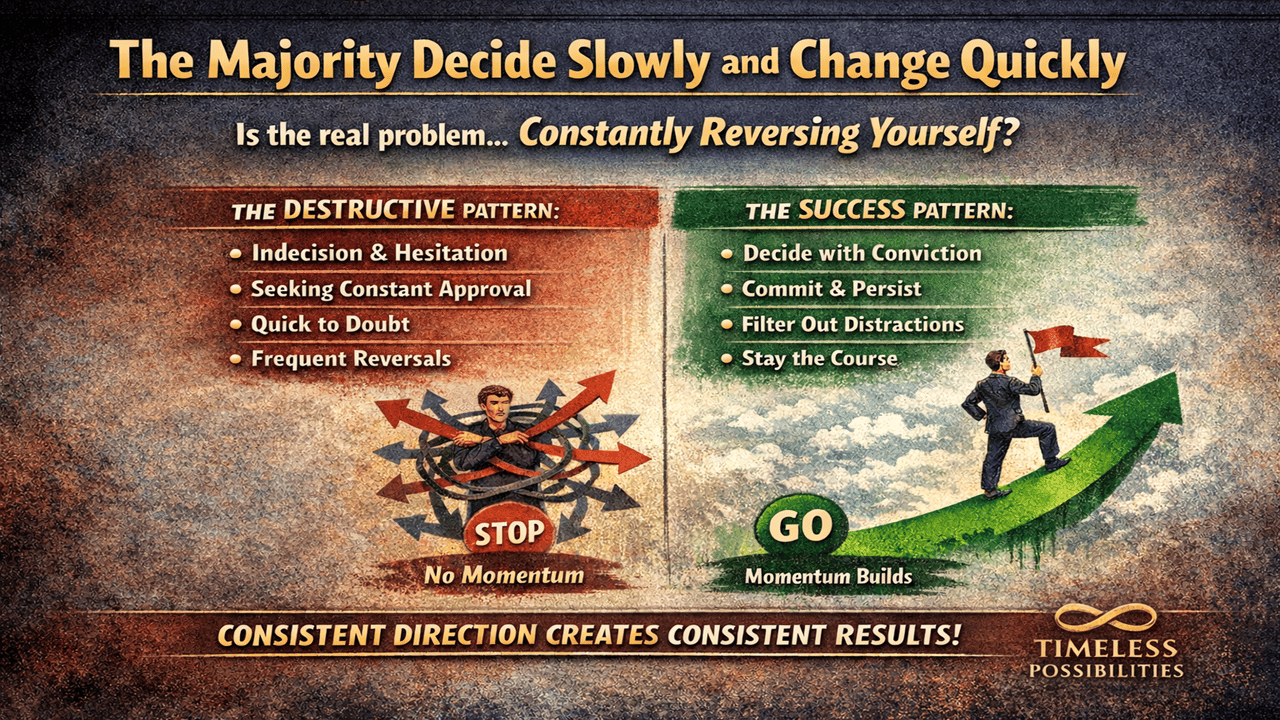
Stop Second-Guessing: Why Changing Direction Kills Success
Apr 16, 2026What if the real reason most people never gain momentum… is not because they lack talent but because they can’t stop reversing themselves?”
Napoleon Hill did something most authors don’t do. He didn’t just study successful people. He studied those who failed. And he found a disturbing pattern. The majority decided slowly, hesitated endlessly, sought excessive approval, and once they finally committed… they reversed themselves quickly and often.
Hill wrote: “People who fail to accumulate money, without exception, have the habit of reaching decisions, if at all, very slowly, and of changing these decisions quickly and often.” That sentence is not casual. It is clinical.
The Majority Decide Slowly and Change Quickly
Hill observed that indecision creates instability. When someone debates endlessly, delays commitment, weighs every possibility, and finally chooses under pressure. Their decision is fragile. The first sign of difficulty feels like proof they were wrong. So they pivot. Then pivot again. Then pivot again. Each reversal resets momentum.
What Hill Is Really Teaching
Hill is warning against a subtle but devastating habit: Constant course correction driven by emotion. Slow decision-making often signals fear of criticism, fear of failure, and fear of responsibility. Quick reversals signal lack of conviction, emotional instability, and external influence. When direction changes constantly, confidence erodes, trust weakens, effort scatters, and results stall. Stability, not speed alone, builds progress.
How This Helps You Reach $10,000/Month
An additional $10,000 per month requires repetition, refinement, consistent messaging, stable positioning, and focused execution. If you change offers every month, alter strategy weekly, and question direction daily, you never allow your efforts to compound.
Income does not reward fluctuation. It rewards persistence in direction. Here’s what changes when you stop reversing decisions:
- Your message strengthens: Consistency builds authority.
- Your skill improves: Repetition creates mastery.
- Your confidence grows: You stop second-guessing.
- Your systems stabilize: Process becomes predictable.
- Income compounds: Momentum builds naturally.
Hill’s lesson is sobering: The habit of frequent decision changes, destroys the power of effort.
Why People Reverse Decisions So Easily
Hill understood that external opinions destabilize weak commitments. When friends question your path, family expresses doubt, or social media offers conflicting advice, you begin to reconsider. Slow deciders seek reassurance. Reassurance makes decisions fragile.
How a Master Mind Prevents Instability
A true Master Mind does not encourage impulsive pivots. It does something more powerful: It strengthens conviction while refining strategy.
- Decisions Are Tested Before Commitment: You think thoroughly, once.
- Emotional Reactions Are Filtered: The group stabilizes your perspective.
- Feedback Replaces Panic: Adjustments become strategic, not emotional.
- Accountability Discourages Reversal: Public commitment reduces impulsive change.
- Direction Becomes Anchored: Momentum compounds instead of resetting.
Practical Action Steps (Hill-Aligned)
Here’s how to eliminate unstable decision patterns:
- Action 1: Decide Within a Set Timeframe: Avoid endless analysis.
- Action 2: Write the Reason for Your Decision: Clarity strengthens commitment.
- Action 3: Limit Outside Opinions: Too many voices dilute direction.
- Action 4: Commit to a 90-Day Stability Rule: No major directional changes without evidence.
- Action 5: Review Progress Objectively: Use data, not emotion.
- Action 6: Discuss Adjustments in Your Master Mind: Revisions should be thoughtful, not reactive.
- Action 7: Protect the Core Goal: Refine tactics, not purpose.
Why Hill Includes This Point
Because most people don’t fail from bad ideas. They fail from inconsistent direction, emotional reversals, and unstable commitment. Hill wanted readers to understand: Success demands decisiveness followed by disciplined consistency.
Final Reflection
Where in your life are you mistaking emotional reaction for strategic adjustment?
Hill’s message is direct: Decide firmly. Adjust intelligently. Do not reverse yourself lightly. Consistency is power.
What If You Could Start Creating More Financial Momentum in Just 7 Days?
Reading about financial success can give you ideas. Taking action is what begins to create change.
That's why I created the FREE Money Momentum Starter Guide Workbook—a practical starting point for anyone who wants to make greater financial progress by managing their money more intentionally, exploring opportunities to create additional income, and developing habits that keep them moving forward.
Inside the FREE Starter Guide, you'll discover:
- Where you are financially today and where you'd like to make progress
- Opportunities to take greater control of the money already flowing through your life
- Skills, knowledge, and experience you may be able to turn into additional income
- Practical actions you can begin taking right away
- How to create your own 7-Day Money Momentum Action Plan
You don't need to have everything figured out. You don't need a perfect financial plan or a great business idea. You simply need a starting point and a willingness to take the next step.
Want Some Help Working Through It?
You can complete the Money Momentum Starter Guide entirely on your own for free, or for a one-time $5 upgrade, get 30 days of access to your own Money Momentum AI Assistant to help you work through the workbook.
Your AI Assistant can help you think through questions, explore possibilities when you're unsure what to write, dig deeper into your answers, and turn what you discover into practical next steps and your personalized 7-Day Money Momentum Action Plan.
Start Building Your Money Momentum Today. Download your FREE Money Momentum Starter Guide Workbook and take your first step toward greater financial progress.
