
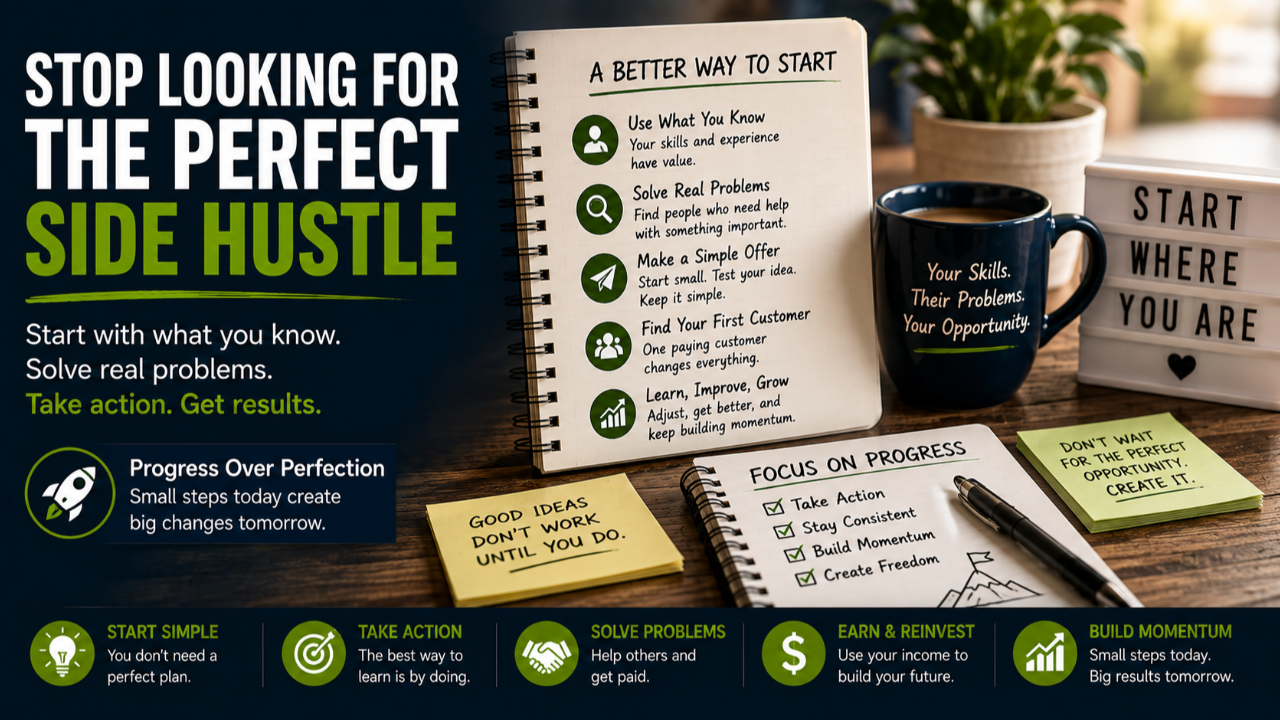
Stop Looking for the Perfect Side Hustle
Aug 23, 2026If you've ever searched online for ways to create additional income, you already know how overwhelming it can become. One article recommends freelancing, another tells you to start an online store, and someone on social media insists that digital products are the answer. Before long, you've encountered dozens of possibilities involving consulting, coaching, affiliate marketing, delivery services, content creation, online courses, reselling, tutoring, and businesses you didn't even know existed.
Having choices should make it easier to get started. Strangely, the opposite often happens. The more opportunities you discover, the more difficult it becomes to choose one.
You start wondering which opportunity has the greatest earning potential, which is growing fastest, which requires the least money to start, and which one will still be profitable several years from now. Eventually, you can spend more time researching ways to create additional income than you would have spent testing one.
The problem may not be that you haven't found the right opportunity yet. The problem may be that you're looking for something that doesn't exist: the perfect side hustle.
The Perfect Opportunity Is Difficult to Recognize in Advance
It's natural to want certainty before investing your time and effort. Nobody wants to spend months pursuing an idea only to discover that it isn't right for them. As a result, we often try to eliminate uncertainty by doing more research.
Research is useful, but there comes a point where additional information stops helping you make a decision. You can compare opportunities endlessly because every option has advantages and disadvantages. One may have low startup costs but require significant time. Another may offer greater income potential but take longer to develop. Something that works extremely well for one person may be completely unsuitable for someone else.
The difficulty is that you often can't know whether an opportunity fits you until you've actually tried some version of it.
You may think you would enjoy coaching until you work with your first few clients. You may believe selling products online sounds exciting until you experience the logistics involved. You may dismiss a simple local service because it doesn't sound impressive, only to discover that people are willing to pay well for it.
Real-world experience provides information that research cannot.
Start With Yourself Before Looking at Trends
When people search for side hustles, they often begin by asking what's popular. A better starting point may be asking what makes sense for you.
Your experience, skills, interests, available time, financial needs, personality, relationships, and current responsibilities are different from everyone else's. An opportunity that is ideal for someone with twenty free hours each week may be completely unrealistic for someone with five. A person who loves talking with customers may thrive in an opportunity that someone else finds exhausting.
This is why lists of “best side hustles” can only take you so far. They can introduce possibilities, but they can't tell you which opportunity fits your life.
As we discussed in an earlier article, you may already have useful skills and experience that could create additional income. Before learning something entirely new because it's currently popular, consider whether there is a simpler way to use something you already know.
Starting from your existing abilities can reduce the amount of time between having an idea and discovering whether someone will actually pay you for it.
Look for a Problem Before You Look for a Business
One of the simplest ways to reduce the confusion around side income is to stop thinking about businesses for a moment and start thinking about problems.
People spend money because they want something. Sometimes they want a physical product, but often they want a result. They want something repaired, cleaned, organized, designed, explained, delivered, improved, created, or made easier.
If you can help produce that result, you may have the foundation of an income opportunity.
Suppose you're good at organizing information. Instead of trying to decide whether you should “start a consulting business,” you could look for someone who has a specific organizational problem. Perhaps a small business owner has customer information scattered across spreadsheets and needs help creating a simple system.
Now you're not trying to invent a business. You're solving a problem.
That distinction matters because people don't usually wake up wanting to buy a side hustle. They want their problem solved. Your opportunity exists at the intersection between something someone needs and something you're capable of helping them accomplish.
Simple Opportunities Are Easy to Underestimate
We are naturally attracted to exciting possibilities. A sophisticated online business can sound more appealing than helping someone with an ordinary problem in your local community. Creating a digital product may seem more scalable than providing a straightforward service.
But when you're trying to create your first additional income, simple can be an advantage.
A simple service may require almost no startup capital. You don't necessarily need inventory, complicated technology, or months of preparation. In some cases, all you need is a person with a problem, the ability to solve it, and the confidence to make an offer.
Imagine someone who knows how to set up computers and smartphones for people who aren't comfortable with technology. That may not sound like the next billion-dollar business, but it doesn't need to be. If people are willing to pay for the help, it can create additional income.
The first objective isn't necessarily to build something enormous. It's to prove that you can create value for someone and receive money in return.
Once you've done that, you have something real to improve.
Don't Build the Entire Business Before Testing the Idea
One of the easiest ways to postpone creating income is to spend too much time preparing the business.
You decide on an idea and immediately start thinking about the business name. Then you need a logo. You begin building a website, creating social media accounts, designing marketing materials, choosing software, and perhaps purchasing equipment.
Weeks or months can pass before you've asked the most important question: Will anyone actually pay me for this?
There is a better order.
First, identify a problem you believe you can solve. Then find people who experience that problem and talk to them. Learn how they're dealing with it now, what frustrates them, and what result they would actually value.
If the conversations confirm that the problem matters, create the simplest reasonable offer you can and test it.
The website can come later.
A paying customer is much stronger evidence than a beautiful logo.
Your First Attempt Is Supposed to Teach You Something
Perfectionism becomes particularly dangerous when people believe their first offer needs to be their permanent offer.
It doesn't.
Your first side-income experiment is partly about earning money, but it's also about learning. You are discovering what people want, what they're willing to pay for, what you enjoy doing, what you're good at, and what you might change.
Suppose you offer a service and discover that customers keep asking for something slightly different. That's useful information. Perhaps the service takes twice as long as you expected, which tells you that the price needs to change. Maybe you discover that you enjoy one part of the work and dislike another.
None of those discoveries means you failed. They mean the market is teaching you.
The person who spends six months researching the perfect idea may still have no customers and very little real-world information. The person who spends one month testing an imperfect idea may already know what to improve.
Give an Idea Enough Time to Produce Useful Feedback
There is another side to this. While some people wait too long to begin, others switch ideas too quickly.
They try something for a week, don't immediately earn much money, and move on to another opportunity. A month later, they're testing something completely different. They stay busy but never remain with one idea long enough to develop skill, confidence, or meaningful feedback.
Creating additional income often requires repetition.
Your first conversation may feel awkward. Your first offer may not be clear. Your first price may be wrong. You may need to talk with several people before someone says yes.
That's normal.
The goal is not to stubbornly continue with an idea that clearly isn't working. The goal is to distinguish between an idea that needs improvement and an idea that genuinely has no potential.
Give yourself enough time to learn before deciding.
Choose Progress Over Potential
A common trap is continually comparing the opportunity you're pursuing with another opportunity that appears to have greater potential.
Perhaps you're making your first $200 from a simple service when you see someone online claiming to make thousands from a completely different business model. Suddenly, your idea feels inadequate.
Be careful with that comparison.
You are comparing your real beginning with someone else's advertised result. You may know very little about how long they've been doing it, how much they've invested, what skills they possess, or whether their claims represent typical results.
An opportunity that can realistically produce your first $100, $500, or $1,000 may be far more valuable to you right now than an opportunity that theoretically could produce $100,000 someday but keeps you stuck in preparation.
Momentum comes from progress, not potential.
You Can Improve an Opportunity After You Start
One of the reasons people search for the perfect idea is that they assume the opportunity they choose today determines everything that follows.
It doesn't.
Businesses evolve. Services change. Customers teach you what they need. Skills improve. Prices increase. New opportunities emerge from existing ones.
A person might begin by helping local businesses with basic social media posts and later discover that clients are willing to pay more for video creation. Someone might start tutoring individuals and eventually develop group workshops. A person providing a simple local service might later hire someone else to help deliver it.
You don't need to see the entire path from the starting line.
You need enough of a path to take the next step.
A Better Way to Evaluate Your Options
When considering an income opportunity, try moving away from the question, “Is this the perfect side hustle?” Instead, evaluate whether it is practical enough to test.
Consider whether you already possess enough skill to provide some value, whether you can identify people who might need what you're offering, and whether you can begin without risking money you can't afford to lose. Think about whether the opportunity fits realistically around your current responsibilities and whether you would be willing to work at it long enough to improve.
You don't need certainty on every point. You simply need enough evidence to justify a small experiment.
The objective is to reduce the size of the decision. You're not deciding what you'll do for the next twenty years. You're deciding what you're willing to test next.
That is a much easier decision to make.
Your First Side Hustle Doesn't Have to Be Your Last
There's a tendency to treat choosing an additional-income opportunity like choosing a career. We imagine that once we've committed to something, we're locked into it.
You're not.
Your first opportunity can simply be the vehicle that teaches you how to create value, make an offer, communicate with customers, price your work, receive feedback, and earn income outside your normal source.
Those skills can transfer to whatever you do next.
Even an opportunity you eventually leave behind may have been valuable if it taught you how to create income for yourself.
This is one of the most powerful changes that can happen when someone earns money independently for the first time. The lesson isn't only, “I made $100.” The deeper lesson is, “I discovered that I'm capable of creating income.”
That belief can open possibilities you couldn't see before.
Stop Searching and Start Testing
There will always be another side-hustle article to read, another video to watch, another business model to investigate, and another person telling you that they've discovered the best opportunity.
At some point, more information won't move you forward.
Action will.
Choose something that uses abilities you already possess, solves a problem you believe people care about, and can be tested without putting yourself at unreasonable financial risk. Then make the experiment small enough that you can actually begin.
Talk to someone. Make an offer. Help one customer. Learn from the experience and improve what you do next.
That's how Money Momentum is created. You don't need to predict the perfect financial opportunity in advance. You need to become more intentional about your finances, recognize your ability to create value, and take actions that give you something real to build upon.
Your first idea may work exactly as you hoped. It may need to change. It may even lead you toward an opportunity you haven't considered yet.
You won't know by continuing to search.
Stop looking for the perfect side hustle and start testing a useful idea. Your next opportunity may become clear only after you begin.
What If You Could Start Creating More Financial Momentum in Just 7 Days?
Reading about financial success can give you ideas. Taking action is what begins to create change.
That's why I created the FREE Money Momentum Starter Guide Workbook—a practical starting point for anyone who wants to make greater financial progress by managing their money more intentionally, exploring opportunities to create additional income, and developing habits that keep them moving forward.
Inside the FREE Starter Guide, you'll discover:
- Where you are financially today and where you'd like to make progress
- Opportunities to take greater control of the money already flowing through your life
- Skills, knowledge, and experience you may be able to turn into additional income
- Practical actions you can begin taking right away
- How to create your own 7-Day Money Momentum Action Plan
You don't need to have everything figured out. You don't need a perfect financial plan or a great business idea. You simply need a starting point and a willingness to take the next step.
Want Some Help Working Through It?
You can complete the Money Momentum Starter Guide entirely on your own for free, or for a one-time $5 upgrade, get 30 days of access to your own Money Momentum AI Assistant to help you work through the workbook.
Your AI Assistant can help you think through questions, explore possibilities when you're unsure what to write, dig deeper into your answers, and turn what you discover into practical next steps and your personalized 7-Day Money Momentum Action Plan.
Start Building Your Money Momentum Today. Download your FREE Money Momentum Starter Guide Workbook and take your first step toward greater financial progress.
