
Stop Learning, Start Losing: Why Growth Never Pauses
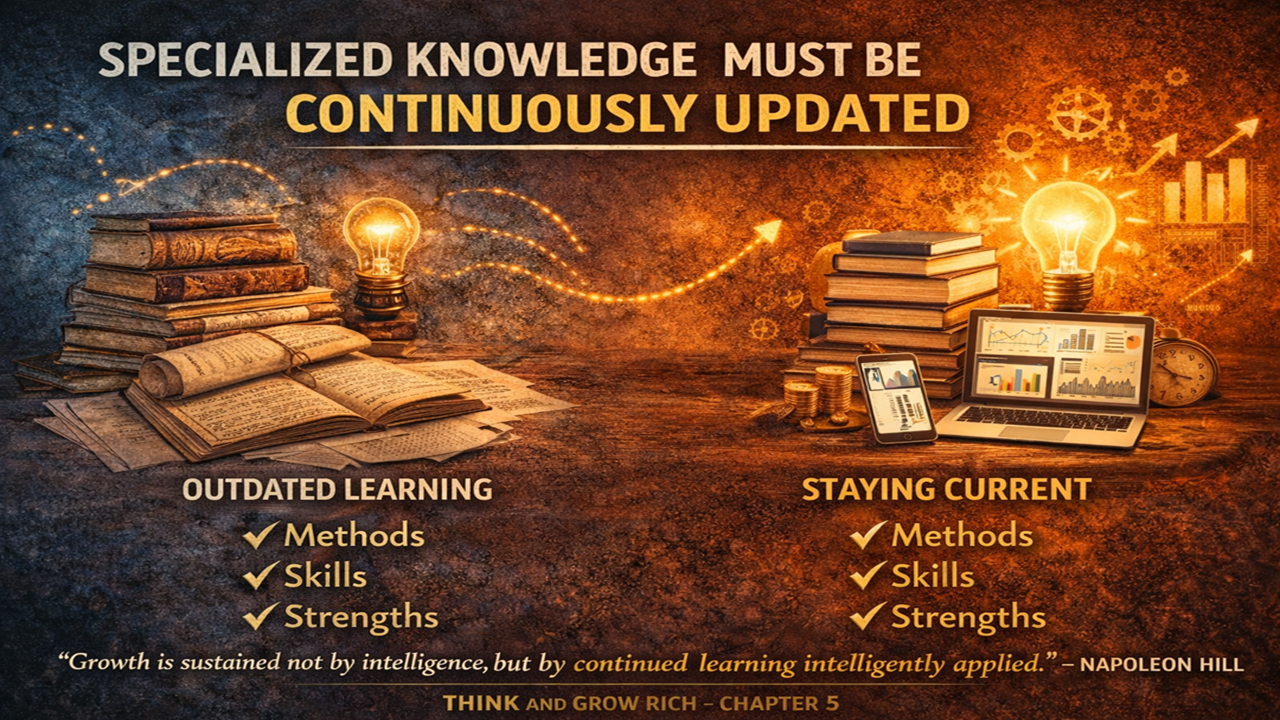
Mar 29, 2026Specialized Knowledge Must Be Continuously Updated
“What if the reason people lose momentum isn’t failure, but the quiet moment they stop learning?”
Napoleon Hill noticed something unsettling in his research. Many people reach a level of success, then plateau, not because they lack talent, effort, or opportunity, but because they unconsciously decide: “I know enough now.” Hill understood that this moment is not neutral. It is the beginning of decline. That realization brings us to Point 6 of Chapter 5, the principle that separates temporary success from lasting growth. Specialized knowledge
Acquiring specialized knowledge is not a one-time event. It is an ongoing process. Markets evolve. Methods change. People adapt. Knowledge that once created advantage eventually becomes baseline. Hill’s implication is clear: Those who stop learning do not stay still, they fall behind.
What Hill Really Means by “Continuous Learning”
Hill is not advocating endless study. He is advocating responsive learning. Continuous learning means staying alert to change, upgrading skills as conditions shift, refining methods based on feedback, and discarding what no longer works. This kind of learning is strategic, not academic. It is driven by purpose, not curiosity alone.
Why Stagnation Feels Invisible at First
Hill observed that stagnation rarely announces itself. It shows up quietly as diminishing results, increased effort for the same outcome, resistance from the market, and confusion about “what changed.” People assume the problem is motivation. Hill knew better. The problem is often outdated knowledge applied faithfully. Effort increases, results shrink.
How Continuous Learning Protects and Grows Your $10K/Month Goal
An additional $10,000 per month is not a static target. What works today may not work six months from now. Continuous learning ensures that your offer remains relevant, your skills stay competitive, your approach adapts to feedback, and your confidence is reinforced by competence. Here’s how this principle directly supports income stability:
- It keeps your value aligned with the market: You solve today’s problems, not yesterday’s.
- It prevents income decay: You evolve before results decline.
- It strengthens confidence: You trust yourself because your skills are current.
- It sharpens decision-making: You choose based on updated understanding, not habit.
- It compounds advantage: Each refinement builds on the last. Income follows relevance.
Why Continuous Learning Is Difficult Alone
Left alone, people tend to rely on what used to work, resist changing familiar methods, dismiss new feedback, and learn reactively instead of proactively. Hill understood this resistance. The mind grows comfortable with certainty, even when certainty becomes outdated. That’s why association becomes essential.
How a Master Mind Keeps Knowledge Alive
A Master Mind acts as a living feedback system.
- Change Is Detected Early: Others notice shifts before you do: audience response, market behavior, and emerging opportunities. Awareness prevents surprise.
- Learning Becomes Shared, Not Isolated: Instead of each person relearning the same lesson, insights are pooled. Learning accelerates.
- Old Assumptions Are Challenged: Group discussion exposes habits that no longer serve the goal. Blind spots shrink
- Experimentation Is Encouraged: New ideas are tested safely, refined collectively, and scaled intelligently. Risk is reduced.
- Growth Becomes Normalized: Learning never feels like failure, it feels like evolution. Identity stays flexible.
Practical Action Steps (Hill-Aligned)
Here’s how to practice continuous learning without overwhelm:
- Action 1: Tie Learning to Current Results: Ask weekly: “What skill would improve my outcome right now?”
- Action 2: Learn Only What Improves Performance: Avoid learning for novelty. Purpose filters information.
- Action 3: Replace One Outdated Habit at a Time: Progress beats reinvention.
- Action 4: Apply and Test Immediately: Learning that isn’t tested remains theoretical.
- Action 5: Share Insights in the Master Mind: Teaching reinforces mastery.
- Action 6: Invite Feedback Actively: Feedback accelerates correction.
- Action 7: Schedule Learning as Maintenance: Not inspiration, maintenance.
Why Hill Includes This Point
Because success is not protected by past effort. It is protected by adaptability. Hill’s deeper message is sobering and empowering: The world does not reward what you once learned. It rewards what you are learning now.
Final Reflection
If your current income depended on how relevant your knowledge is today, what would need to be updated first?
Hill’s insight remains exact: Growth is sustained not by intelligence, but by continued learning intelligently applied.
What If You Could Start Creating More Financial Momentum in Just 7 Days?
Reading about financial success can give you ideas. Taking action is what begins to create change.
That's why I created the FREE Money Momentum Starter Guide Workbook—a practical starting point for anyone who wants to make greater financial progress by managing their money more intentionally, exploring opportunities to create additional income, and developing habits that keep them moving forward.
Inside the FREE Starter Guide, you'll discover:
- Where you are financially today and where you'd like to make progress
- Opportunities to take greater control of the money already flowing through your life
- Skills, knowledge, and experience you may be able to turn into additional income
- Practical actions you can begin taking right away
- How to create your own 7-Day Money Momentum Action Plan
You don't need to have everything figured out. You don't need a perfect financial plan or a great business idea. You simply need a starting point and a willingness to take the next step.
Want Some Help Working Through It?
You can complete the Money Momentum Starter Guide entirely on your own for free, or for a one-time $5 upgrade, get 30 days of access to your own Money Momentum AI Assistant to help you work through the workbook.
Your AI Assistant can help you think through questions, explore possibilities when you're unsure what to write, dig deeper into your answers, and turn what you discover into practical next steps and your personalized 7-Day Money Momentum Action Plan.
Start Building Your Money Momentum Today. Download your FREE Money Momentum Starter Guide Workbook and take your first step toward greater financial progress.
