
Silent Habits Killing Your Persistence (And How to Fix Them)
Apr 26, 2026What if your biggest obstacle isn’t lack of ability… but the quiet habits that weaken your persistence?
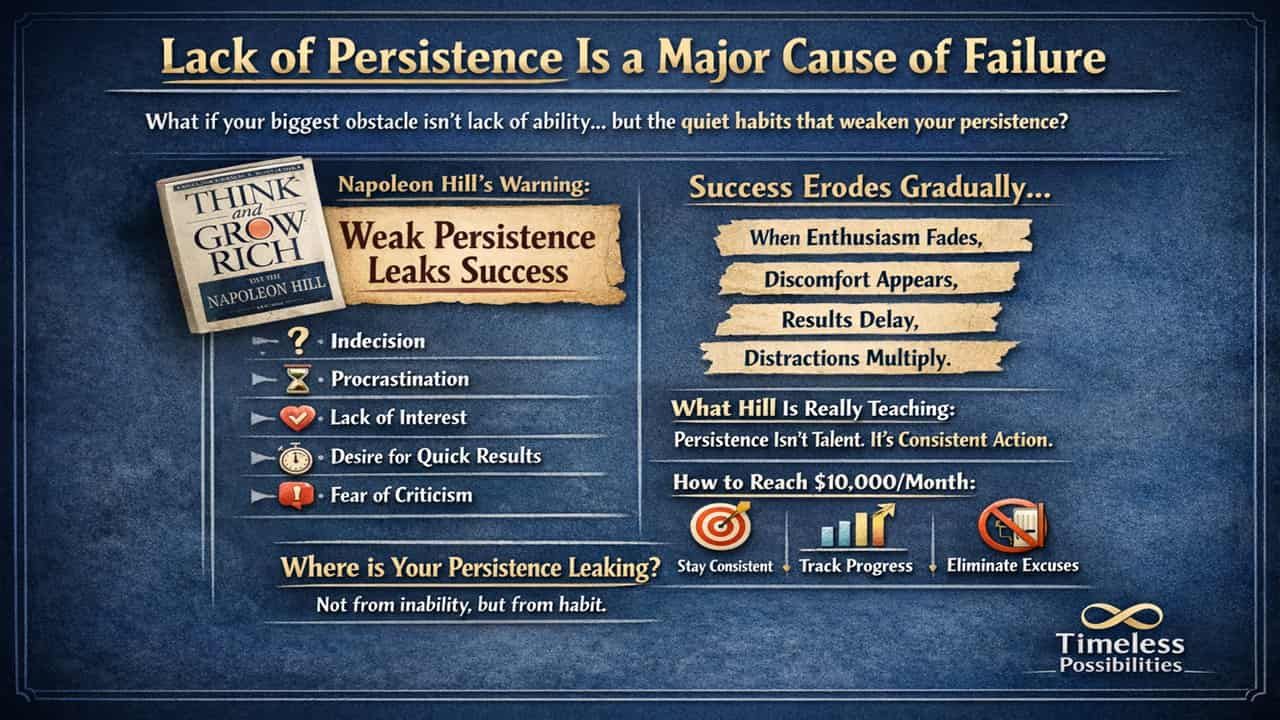
Napoleon Hill didn’t just praise persistence. He studied why it collapses. He identified patterns, subtle behaviors that slowly erode endurance. In Think and Grow Rich, Hill lists symptoms of weak persistence, including indecision, procrastination, lack of interest, desire for quick results, and fear of criticism. These are not dramatic failures. They are quiet leaks in discipline. This is the heart of Point 6 in Chapter 9.
Lack of Persistence Is a Major Cause of Failure
Hill implies something bold: Most failures are not caused by lack of intelligence. They are caused by quitting too soon. Persistence weakens when enthusiasm fades, discomfort appears, results delay, and distractions multiply. It doesn’t collapse overnight. It erodes gradually. Hill understood that success requires sustained effort long enough for compounding to occur. Without persistence, even strong plans dissolve.
What Hill Is Really Teaching
Hill is shifting responsibility inward. Instead of asking: “Why didn’t this work?” He encourages asking: “Where did my persistence weaken?” Persistence is not emotional intensity. It is disciplined repetition when motivation drops, doubt rises, and results stall. When persistence breaks, momentum resets. And momentum is the engine of achievement.
How This Helps You Reach $10,000/Month
An additional $10,000 per month does not require perfection. It requires consistency. If you stop promoting when engagement dips, abandon outreach when response slows, or change strategy when discomfort rises, income never stabilizes. But if you maintain steady effort your messaging improves, your systems refine, your audience grows, and your results compound.
Weak persistence causes inconsistent revenue. Strong persistence creates predictable growth. Hill’s message is direct: The person who stays long enough eventually outpaces the person who quits early.
Why Persistence Weakens Alone
Isolation magnifies weakness. Without reinforcement procrastination feels harmless, indecision feels reasonable, and delay feels safe. There is no mirror. No challenge. No accountability. Hill understood that environment shapes endurance.
How a Master Mind Strengthens Persistence
A Master Mind acts as a stabilizer.
- It Makes Inconsistency Visible: Patterns are exposed.
- It Normalizes Discipline: Effort becomes expected.
- It Challenges Excuses: Comfort is confronted.
- It Reinforces Standards: Consistency becomes identity.
- It Protects Momentum: Group rhythm sustains individual effort.
Persistence strengthens when effort is observed.
Practical Action Steps (Hill-Aligned)
Here’s how to reinforce persistence intentionally:
- Action 1: Identify Your Weak Points: Where do you typically slow down?
- Action 2: Set a Minimum Weekly Output: Non-negotiable standards prevent erosion.
- Action 3: Track Consistency, Not Just Wins: Momentum precedes payoff.
- Action 4: Report Weekly Activity in Your Master Mind: Accountability compresses drift.
- Action 5: Eliminate “Quick Result” Thinking: Compounding takes time.
- Action 6: Remove Emotional Exit Doors: Commit before results arrive.
- Action 7: Strengthen Environment: Surround yourself with persistent people.
Why Hill Emphasizes This Point
Because most people underestimate how slowly persistence erodes. They don’t collapse dramatically. They drift quietly. Hill wanted readers to understand: Success requires sustained effort, not temporary enthusiasm.
Final Reflection
Where is your persistence leaking, not from inability, but from habit?
Hill’s lesson is steady: Persistence is not talent. It is trained endurance. Endurance determines achievement.
What If You Could Start Creating More Financial Momentum in Just 7 Days?
Reading about financial success can give you ideas. Taking action is what begins to create change.
That's why I created the FREE Money Momentum Starter Guide Workbook—a practical starting point for anyone who wants to make greater financial progress by managing their money more intentionally, exploring opportunities to create additional income, and developing habits that keep them moving forward.
Inside the FREE Starter Guide, you'll discover:
- Where you are financially today and where you'd like to make progress
- Opportunities to take greater control of the money already flowing through your life
- Skills, knowledge, and experience you may be able to turn into additional income
- Practical actions you can begin taking right away
- How to create your own 7-Day Money Momentum Action Plan
You don't need to have everything figured out. You don't need a perfect financial plan or a great business idea. You simply need a starting point and a willingness to take the next step.
Want Some Help Working Through It?
You can complete the Money Momentum Starter Guide entirely on your own for free, or for a one-time $5 upgrade, get 30 days of access to your own Money Momentum AI Assistant to help you work through the workbook.
Your AI Assistant can help you think through questions, explore possibilities when you're unsure what to write, dig deeper into your answers, and turn what you discover into practical next steps and your personalized 7-Day Money Momentum Action Plan.
Start Building Your Money Momentum Today. Download your FREE Money Momentum Starter Guide Workbook and take your first step toward greater financial progress.
