
See It First: Visualization Makes Auto-Suggestion Work
Mar 21, 2026Visualization Amplifies Auto-Suggestion
Why does the mind act faster on what it can see than on what it merely hears? Because the subconscious mind believes experience, even imagined experience, more readily than instruction. Napoleon Hill understood this intuitively. He observed that people do not move toward goals they merely state; they move toward goals they have already experienced mentally. That realization brings us to Point 5 of Chapter 4 the moment auto-suggestion becomes experiential, not theoretical.
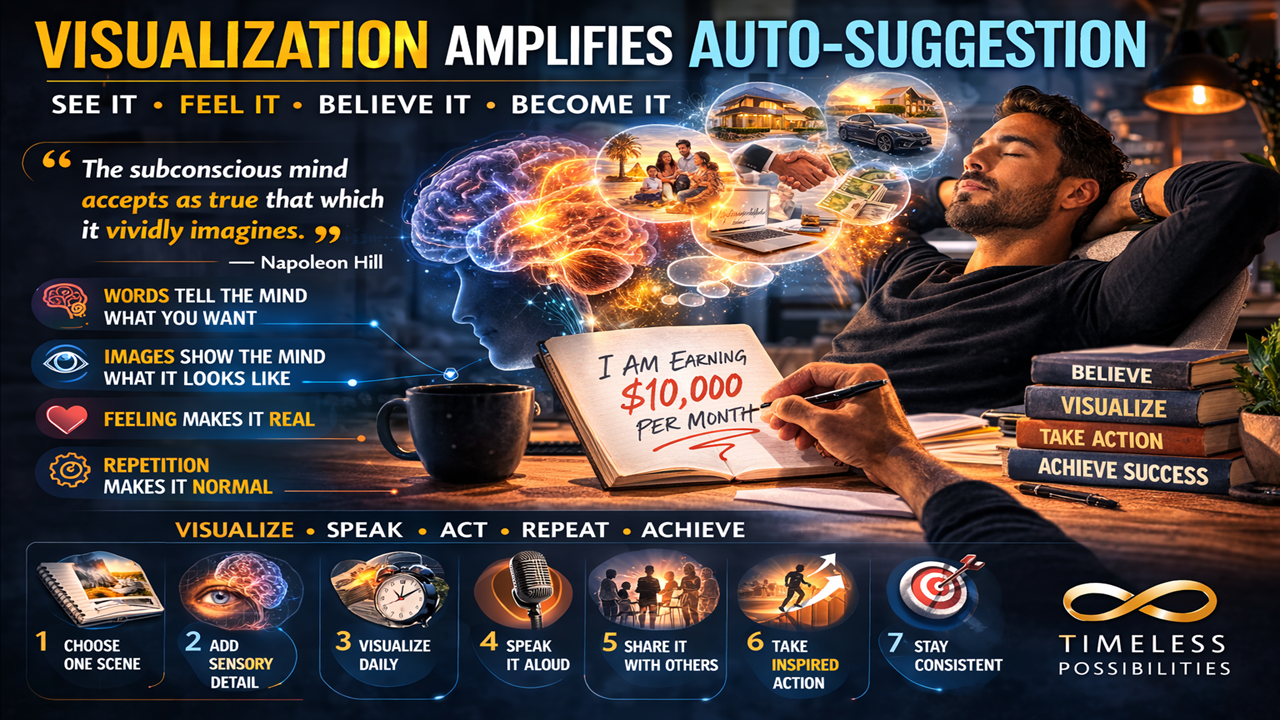
Hill teaches that the subconscious mind responds more powerfully to mental images than to words alone. Why? Because images simulate reality. The subconscious mind does not distinguish between something vividly imagined and something physically experienced. When you consistently visualize an outcome with feeling, the subconscious accepts it as already underway. Words tell the mind what you want. Images show the mind what it looks like to have it. That difference is everything.
What Hill Really Means by Visualization
Hill is not encouraging fantasy. He is describing mental rehearsal. Visualization allows you to experience possession before evidence, feel confidence before results, and practice success before performance. The subconscious responds by reducing resistance, increasing familiarity, aligning behavior, and sharpening intuition. Visualization turns belief from abstract into felt reality.
Why Auto-Suggestion Without Visualization Is Weak
Many people repeat statements daily yet feel unchanged. Hill explains why: Without imagery, words lack substance. The subconscious asks: “Where is the experience?” Visualization provides the experience. This is why fear installs quickly (it creates vivid images), confidence installs slowly (unless visualized), and doubt feels real (it is imagined repeatedly). Images imprint deeper than language.
How Visualization Directly Supports Your $10K/Month Goal
An additional $10,000 per month requires you to behave like someone who expects value exchange, speaks calmly about money, tolerates rejection, and persists without panic. Visualization trains that behavior in advance. Here’s how it affects income creation:
- Visualization reduces fear of action: What feels familiar feels safe. Mental rehearsal removes hesitation.
- Visualization stabilizes confidence: Confidence grows from familiarity, not evidence.
- Visualization aligns decision-making: You begin choosing actions consistent with the future you’ve rehearsed.
- Visualization accelerates identity shift: You stop acting like someone “trying” and start acting like someone operating. Income follows identity.
Why Visualization Fades in Isolation
Left alone, visualization is often rushed, inconsistent, and emotionally flat. Daily distractions interrupt imagery. Hill knew visualization must be reinforced, not assumed. That’s why association matters.
How a Master Mind Strengthens Visualization
A Master Mind transforms private imagery into shared expectation.
- Shared Language Reinforces Mental Images: When others describe progress, outcomes, and success, your mental pictures sharpen. Belief becomes social.
- Group Visualization Normalizes Success: When everyone visualizes growth ambition feels reasonable, success feels expected, and doubt feels out of place. Environment trains imagination.
- Verbalizing Images Deepens Imprint: Describing your visualization aloud engages speech, hearing, and imagination. The subconscious records it as real.
- Accountability Keeps Visualization Consistent: Scheduled meetings prevent drift. Consistency beats intensity.
- Borrowed Vision Carries You Through Weak Days: On low-clarity days, others remind you what you are building. Hill expected belief to be shared.
Practical Action Steps (Hill-Aligned)
Here’s how to use visualization deliberately:
- Action 1: Choose One Clear Scene: Not many images. One. Example: You reviewing a monthly income statement showing an additional $10K. Clarity strengthens impact.
- Action 2: Add Sensory Detail: What do you see? How do you feel? What changes? Emotion locks the image.
- Action 3: Visualize While Reading Your Auto-Suggestion: Words + image = stronger impression. Hill emphasized this pairing.
- Action 4: Practice Twice Daily: Morning and night. Brief but vivid. Repetition installs belief.
- Action 5: Describe the Scene in the Master Mind: Speaking imagery aloud accelerates acceptance.
- Action 6: Act Immediately After Visualizing: Action reinforces belief. The subconscious learns to expect follow-through.
- Action 7: Stay With It Past Skepticism: Skepticism fades after conditioning takes hold. Stay.
Why Hill Included Visualization Here
Because belief requires experience. Visualization creates that experience before results exist. It allows the subconscious to accept success as normal, not hypothetical.
Final Reflection
If your subconscious believes what it experiences, what future are you allowing it to experience repeatedly each day?
Hill’s insight remains exact: The subconscious mind accepts as true that which it vividly imagines.
What If You Could Start Creating More Financial Momentum in Just 7 Days?
Reading about financial success can give you ideas. Taking action is what begins to create change.
That's why I created the FREE Money Momentum Starter Guide Workbook—a practical starting point for anyone who wants to make greater financial progress by managing their money more intentionally, exploring opportunities to create additional income, and developing habits that keep them moving forward.
Inside the FREE Starter Guide, you'll discover:
- Where you are financially today and where you'd like to make progress
- Opportunities to take greater control of the money already flowing through your life
- Skills, knowledge, and experience you may be able to turn into additional income
- Practical actions you can begin taking right away
- How to create your own 7-Day Money Momentum Action Plan
You don't need to have everything figured out. You don't need a perfect financial plan or a great business idea. You simply need a starting point and a willingness to take the next step.
Want Some Help Working Through It?
You can complete the Money Momentum Starter Guide entirely on your own for free, or for a one-time $5 upgrade, get 30 days of access to your own Money Momentum AI Assistant to help you work through the workbook.
Your AI Assistant can help you think through questions, explore possibilities when you're unsure what to write, dig deeper into your answers, and turn what you discover into practical next steps and your personalized 7-Day Money Momentum Action Plan.
Start Building Your Money Momentum Today. Download your FREE Money Momentum Starter Guide Workbook and take your first step toward greater financial progress.
