
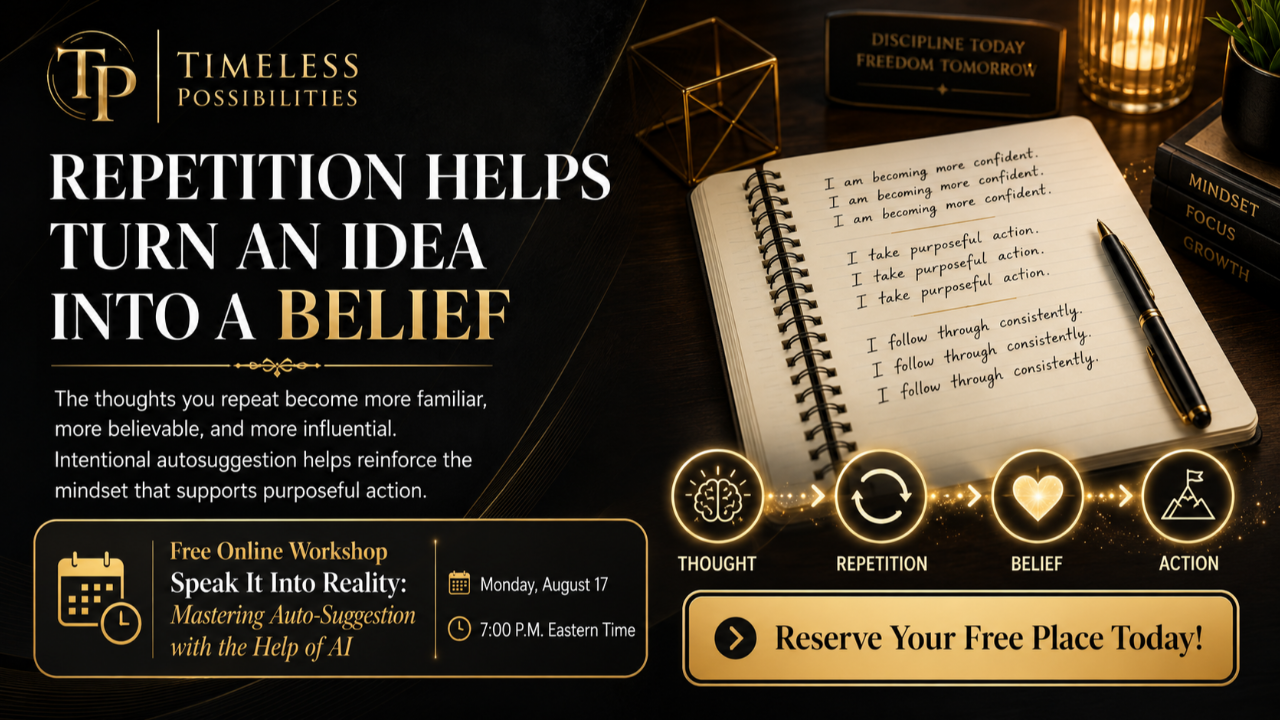
Repetition Helps Turn an Idea Into a Belief
Aug 14, 2026What if the reason a new goal feels difficult is not because the goal is wrong, but because the old message has simply been repeated more often?
Most of us have thoughts we have rehearsed for years. Some of them are useful, while others quietly limit what we expect from ourselves. If you have repeatedly told yourself that you are not confident, not disciplined, not good with money, or not the kind of person who follows through, those ideas can begin to feel true simply because they are familiar.
That is one of the reasons repetition matters so much in autosuggestion. A new thought usually does not become powerful because you say it once. It becomes more influential when you return to it often enough that it begins competing with the old message.
Familiar Thoughts Often Feel True
The mind tends to become comfortable with what it hears repeatedly.
That does not mean every repeated thought automatically becomes reality, but repetition can influence what feels normal, expected, and believable. If you keep telling yourself that something is impossible, you may begin approaching opportunities as though failure is already decided. If you repeatedly reinforce the idea that you can learn, improve, and take purposeful action, you are more likely to behave in ways that support growth.
This is where autosuggestion becomes practical. You are not trying to fool yourself into believing something unrealistic. You are deliberately giving more attention to a thought that supports the person you are trying to become.
The goal is to make the useful message more familiar.
One Repetition Is Usually Not Enough
People sometimes create an affirmation, repeat it a few times, and then decide that it did not work.
But think about how long the old belief may have been developing. If you have spent ten years reinforcing the idea that you are not confident, one morning of saying something different is unlikely to erase that pattern.
This is why consistency matters.
A new autosuggestion needs repetition because repetition gives the mind another message to work with. Over time, that message can become easier to recall, easier to act on, and more natural to use when challenges appear.
The process is gradual.
You are not replacing years of thinking overnight. You are building a new pattern one repetition at a time.
Repetition Works Better When the Statement Means Something
Not all repetition is equally useful.
If you repeat words that feel empty, generic, or disconnected from your life, the statement may have very little emotional impact. A useful autosuggestion should be personal enough that you understand why it matters and specific enough that you can connect it to real behaviour.
For example, “I am successful” may be too broad to influence much. A statement such as, “I am becoming more consistent by completing the actions I commit to each day,” gives you a much clearer direction.
Now the repetition points toward something you can actually do.
That makes the statement easier to reinforce with evidence.
Emotion Gives Repetition More Weight
Words tend to have more impact when they are connected to meaning.
If you read your autosuggestion mechanically while thinking about something else, it may become little more than background noise. But if you pause long enough to connect the words with why the goal matters to you, the repetition becomes more intentional.
Think about the result you are working toward and what it would change. Consider who would benefit, what opportunities might open, or how you would feel if you became more consistent, confident, or focused.
That emotional connection gives the words more relevance.
You are not simply repeating a sentence. You are reminding yourself of a future that matters enough to work toward.
Repetition Should Lead Back to Action
Autosuggestion is most useful when it supports behaviour.
Suppose you repeat, “I am becoming more confident in speaking about the value I provide.” The statement becomes more believable when you then have a real conversation, make an offer, or explain your work more clearly.
Each action gives the repetition something concrete to attach to.
This creates a useful cycle. The words remind you of the direction, the action provides evidence, and the evidence makes the words easier to believe the next time you repeat them.
That is much more powerful than repetition by itself.
The aim is not to use autosuggestion instead of action. It is to use autosuggestion to make aligned action easier to return to.
Old Thoughts May Still Show Up
Even when you begin using a new autosuggestion consistently, the old message may still appear.
That is normal.
If you have spent years thinking one way, the old pattern may surface automatically when you are tired, discouraged, or under pressure. The goal is not to panic when that happens.
Instead, recognize the old thought for what it is: a familiar pattern.
Then return to the message you have chosen deliberately.
This is where repetition becomes especially important. You are training yourself to come back to the new direction again and again, even when the old one still feels familiar.
Make Repetition Part of Your Routine
One of the easiest ways to make autosuggestion more effective is to connect it to moments that already exist in your day.
You might read your statement in the morning before you begin work, review it again in the evening, or keep it somewhere you naturally see it. The exact routine matters less than the consistency.
What matters is that the statement does not disappear after you write it.
The more regularly you return to it, the more likely it is to stay active in your thinking.
And the more active it becomes, the easier it may be to notice when your behaviour supports or contradicts it.
Let the Words Become Familiar
Think about one statement you want to strengthen over the next week.
Keep it clear, personal, and connected to action. Make sure it reflects the person you are becoming rather than making a claim that feels completely disconnected from your experience.
Then repeat it consistently.
Do not judge the process after one day. Give the new message time to become familiar.
The point is not to force belief.
The point is to keep reinforcing a useful idea long enough that it begins to feel more natural to think, say, and act from it.
Join the Free Mastering Auto-Suggestion Workshop
On Monday, August 17, at 7:00 p.m. Eastern Time, I will be hosting the free online workshop Speak It Into Reality: Mastering Auto-Suggestion with the Help of AI.
During the workshop, we will look at why repetition matters, how to create autosuggestions that feel personal and believable, and how to connect those statements to the goals and identity you are developing. We will also explore how AI can help you refine the wording so your autosuggestion becomes more specific, emotionally meaningful, and practical enough to use consistently.
If you have tried affirmations before but found that they felt generic or disconnected from real life, this workshop will help you approach the process differently. The goal is to create language you can repeat with intention and then support with action.
The workshop is completely free, it will be held online, and we will meet on Monday, August 17 at 7:00 p.m. Eastern Time.

The thoughts you have repeated for years may feel familiar, but familiar does not have to mean permanent. When you choose a better message, repeat it consistently, and support it with action, that new idea has the opportunity to become part of the way you think and the way you live.
What If You Could Start Creating More Financial Momentum in Just 7 Days?
Reading about financial success can give you ideas. Taking action is what begins to create change.
That's why I created the FREE Money Momentum Starter Guide Workbook—a practical starting point for anyone who wants to make greater financial progress by managing their money more intentionally, exploring opportunities to create additional income, and developing habits that keep them moving forward.
Inside the FREE Starter Guide, you'll discover:
- Where you are financially today and where you'd like to make progress
- Opportunities to take greater control of the money already flowing through your life
- Skills, knowledge, and experience you may be able to turn into additional income
- Practical actions you can begin taking right away
- How to create your own 7-Day Money Momentum Action Plan
You don't need to have everything figured out. You don't need a perfect financial plan or a great business idea. You simply need a starting point and a willingness to take the next step.
Want Some Help Working Through It?
You can complete the Money Momentum Starter Guide entirely on your own for free, or for a one-time $5 upgrade, get 30 days of access to your own Money Momentum AI Assistant to help you work through the workbook.
Your AI Assistant can help you think through questions, explore possibilities when you're unsure what to write, dig deeper into your answers, and turn what you discover into practical next steps and your personalized 7-Day Money Momentum Action Plan.
Start Building Your Money Momentum Today. Download your FREE Money Momentum Starter Guide Workbook and take your first step toward greater financial progress.
