
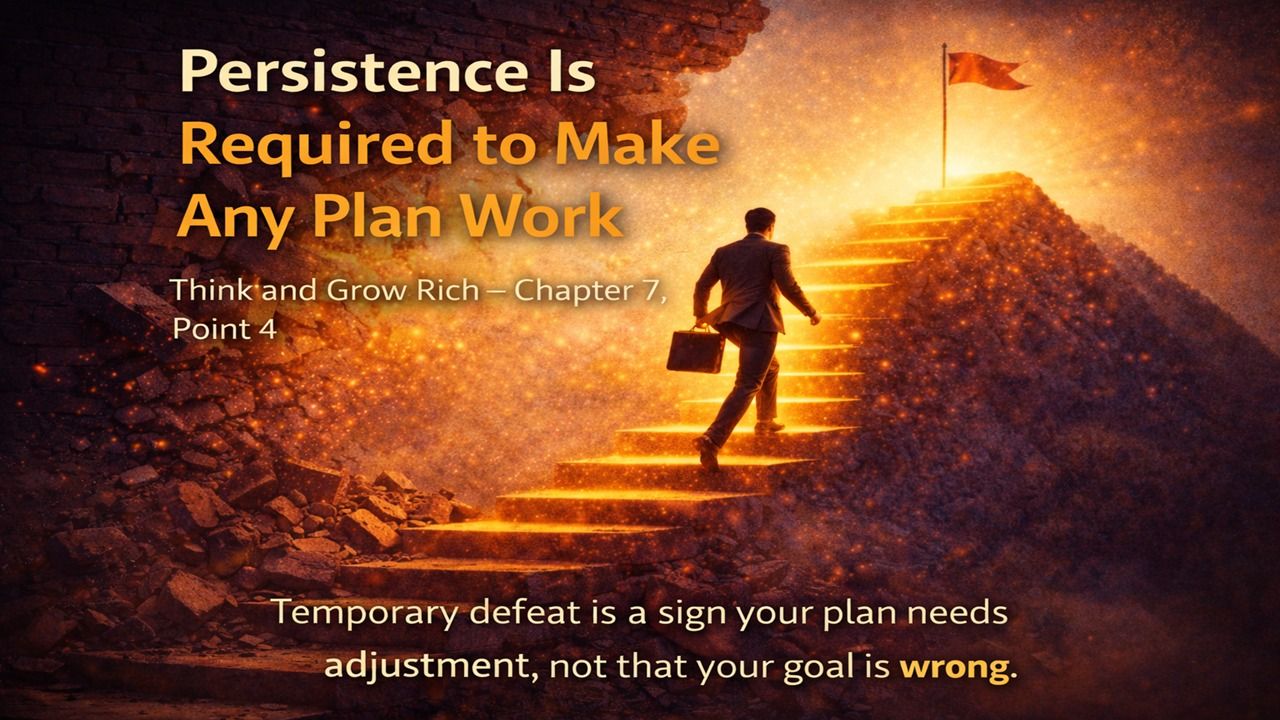
Plans Don’t Work Without Persistence, Here’s Why
Apr 10, 2026What if the real purpose of a plan isn’t to make things easy… but to give persistence something to work with?
Napoleon Hill understood something most people miss. A plan does not eliminate difficulty. A plan does not prevent resistance. A plan does not guarantee immediate success. What a plan does is give persistence a direction. That insight brings us to Point 4 of Chapter 7 in Think and Grow Rich.
Persistence Is Required to Make Any Plan Work
Hill makes this unmistakably clear throughout the chapter: Temporary defeat should be accepted as proof that the plan is not yet sound, not that the goal is wrong. In other words plans fail, people stumble, progress slows, and none of that means you should stop.
Hill separates achievers from drifters with one distinction: the achiever persists long enough to revise the plan instead of abandoning it.
What Hill Is Really Teaching
Hill is dismantling a false belief: If the plan were right, it wouldn’t require this much effort. In reality effort reveals weaknesses, resistance exposes gaps, and difficulty forces refinement. Hill understood that no plan becomes effective without persistence, because persistence is what keeps you engaged long enough to learn. It allows feedback to surface and creates the repetition necessary for mastery. Plans don’t succeed because they’re brilliant. They succeed because someone refuses to stop adjusting them.
Why Persistence and Planning Are Inseparable
Hill saw planning and persistence as partners. A plan without persistence collapses at the first obstacle. Persistence without a plan wastes energy. Together, they create sustained momentum, intelligent adjustment, and progressive improvement. Persistence keeps the plan alive long enough to become effective.
How This Principle Helps You Reach $10,000/Month
An additional $10,000 per month is rarely achieved by a single attempt. It is built by refining offers, adjusting messaging, improving systems, learning from rejection, and continuing despite slow starts. Every income stream requires time under pressure. Here’s how this principle directly supports income creation:
- You stop quitting too early: Most breakthroughs happen after the discomfort phase.
- Your skill compounds: Repetition turns effort into efficiency.
- Your plan improves with each cycle: Persistence exposes what works.
- Your confidence becomes earned: You trust yourself because you’ve endured.
- Income stabilizes: Consistency produces predictable results.
Hill’s lesson is simple but demanding: Plans only work when someone stays with them.
Why Persistence Is Hard to Maintain Alone
Left alone, people mistake resistance for failure, lose emotional momentum, personalize setbacks, and drift toward easier options. Hill knew that persistence weakens in isolation. That’s why he emphasized cooperation and association.
How a Master Mind Sustains Persistence
A Master Mind does something individual willpower struggles to do: It keeps you in the game when quitting feels reasonable.
- Perspective Is Restored: Others remind you what stage you’re actually in.
- Emotional Load Is Shared: Discouragement dissipates through discussion.
- Accountability Prevents Drift: Commitments spoken aloud hold weight.
- Adjustments Are Made Faster: The group helps revise the plan intelligently.
- Persistence Becomes Normal: Effort is expected, not questioned.
Practical Action Steps (Hill-Aligned)
Here’s how to apply persistence intelligently to your plans:
- Action 1: Decide in Advance Not to Quit: Remove quitting as an option.
- Action 2: Separate the Plan From the Goal: Revise the plan, protect the goal.
- Action 3: Measure Effort, Not Just Results: Progress precedes payoff.
- Action 4: Schedule Regular Plan Reviews: Persistence includes evaluation.
- Action 5: Report Progress to the Master Mind: Momentum strengthens when witnessed.
- Action 6: Normalize Resistance: Expect difficulty, it means you’re building.
- Action 7: Persist Through the Uncomfortable Middle: That’s where most people stop and where advantage is gained.
Why Hill Includes This Point
Because most people don’t fail from lack of planning. They fail from abandoning plans too soon. Hill wanted readers to understand: Persistence is what gives plans time to mature into success.
Final Reflection
If persistence were removed from your plan, how long would it actually survive?
Hill’s lesson is steady and uncompromising: Plans succeed not by brilliance, but by endurance.
What If You Could Start Creating More Financial Momentum in Just 7 Days?
Reading about financial success can give you ideas. Taking action is what begins to create change.
That's why I created the FREE Money Momentum Starter Guide Workbook—a practical starting point for anyone who wants to make greater financial progress by managing their money more intentionally, exploring opportunities to create additional income, and developing habits that keep them moving forward.
Inside the FREE Starter Guide, you'll discover:
- Where you are financially today and where you'd like to make progress
- Opportunities to take greater control of the money already flowing through your life
- Skills, knowledge, and experience you may be able to turn into additional income
- Practical actions you can begin taking right away
- How to create your own 7-Day Money Momentum Action Plan
You don't need to have everything figured out. You don't need a perfect financial plan or a great business idea. You simply need a starting point and a willingness to take the next step.
Want Some Help Working Through It?
You can complete the Money Momentum Starter Guide entirely on your own for free, or for a one-time $5 upgrade, get 30 days of access to your own Money Momentum AI Assistant to help you work through the workbook.
Your AI Assistant can help you think through questions, explore possibilities when you're unsure what to write, dig deeper into your answers, and turn what you discover into practical next steps and your personalized 7-Day Money Momentum Action Plan.
Start Building Your Money Momentum Today. Download your FREE Money Momentum Starter Guide Workbook and take your first step toward greater financial progress.
