
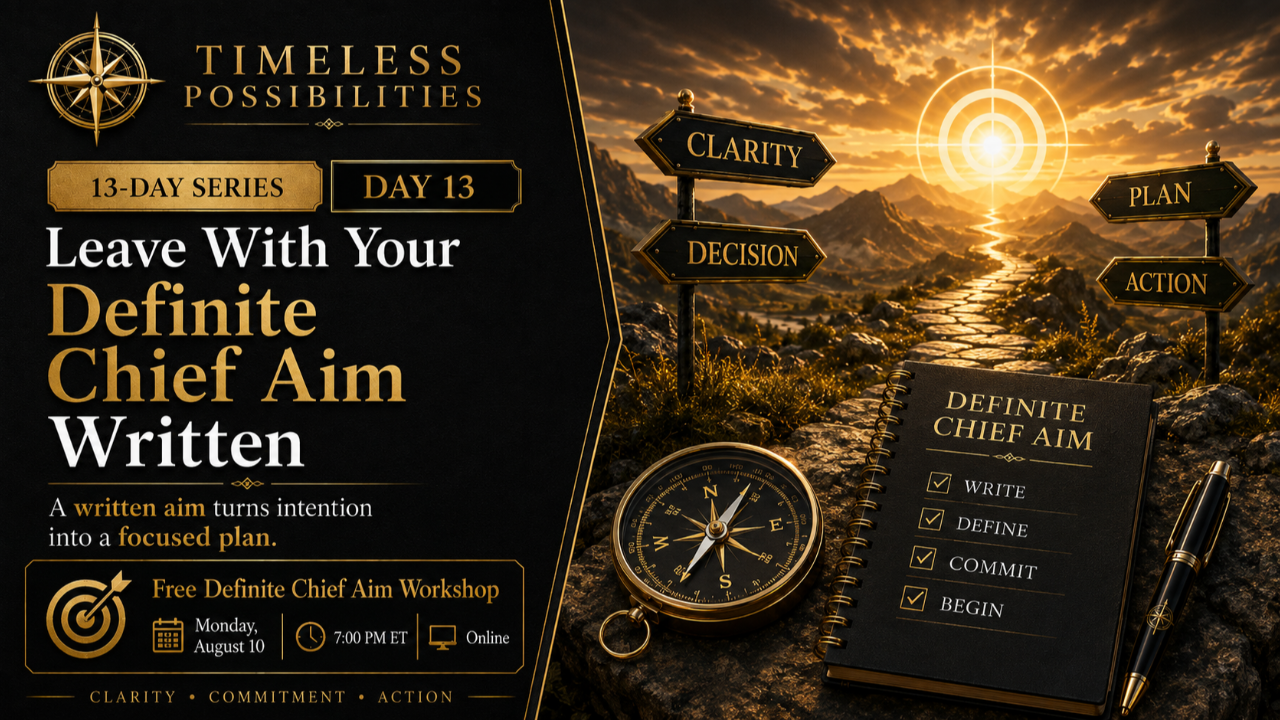
Leave With Your Definite Chief Aim Written
Aug 09, 2026Over the past twelve posts, we have worked through the ideas that make a Definite Chief Aim practical. We started with the danger of drifting, then moved into clarity, specific goals, purposeful daily action, better decisions, commitment, belief, contribution, deadlines, simple planning, identity, and focus. Today, I want to bring those ideas together around one final point: your goal becomes much more useful when you put it into writing.
Thinking about what you want is important, but writing it down forces you to make decisions. It asks you to define the result more clearly, choose a date, consider what you will give in return, and think about the actions that support the goal. A written aim gives shape to an idea that might otherwise remain vague.
That is why the goal for the upcoming workshop is not simply to give you more information. The goal is for you to leave with something concrete that you can continue using after the session ends.
A Written Aim Turns Intention Into Something You Can Use
There is a major difference between saying, “I know what I want,” and being able to clearly state it on paper.
When a goal remains only in your thoughts, it can change depending on your mood, distractions, or circumstances. One day it feels important, and the next day something else takes over your attention. A written Definite Chief Aim gives you a stable reference point.
It becomes something you can return to when you need to make a decision, review your progress, or remind yourself why you started. Instead of relying on memory or motivation, you have a clear statement that represents the direction you chose.
That makes the goal much more practical.
Writing Forces Clarity
One of the reasons writing is so powerful is that vague thinking becomes obvious on paper.
You may believe you know what you want until you try to describe it in a few clear sentences. Suddenly, questions appear. How much do I want to achieve? By when? Why does this matter to me? What am I willing to give in return?
Those questions are valuable because they expose where your thinking still needs work.
A written aim should not be complicated, but it should be clear enough that you understand exactly what you are pursuing. The act of writing helps turn general desire into a more definite commitment.
Bring the Pieces Together
A strong Definite Chief Aim is not simply a number or a sentence about a future result. It brings together several decisions that support one another.
You know what you want, and you can describe it clearly. You have chosen a definite date that gives the goal a timeframe. You have considered the value, effort, service, or personal growth you are willing to give in return.
You also have a simple plan for getting started.
When these pieces are connected, the aim begins to function as more than inspiration. It becomes a framework for action.
You can use it to evaluate opportunities, decide where to focus, and recognize whether your daily behaviour is supporting the future you chose.
Your Written Aim Does Not Have to Be Perfect
Some people hesitate to write their goal because they feel they need to get every word exactly right.
You do not.
Your first written Definite Chief Aim is allowed to improve as your thinking becomes clearer. You may refine the wording, adjust part of the plan, or discover through action that a detail needs to change.
What matters is that you begin with something definite enough to use.
A goal that is written imperfectly but acted on is usually more valuable than a perfect statement that exists only in your imagination.
The purpose of the writing is not literary perfection. It is clarity and commitment.
The Aim Should Point You Toward Action
A written goal becomes most valuable when it tells you something about what to do next.
After reading your aim, you should be able to ask yourself what action would best support it today. If the statement is so abstract that it does not influence your behaviour, it may need to become more specific.
Your next action may be small.
It might involve having a conversation, following up with someone, completing a task, reviewing your numbers, or scheduling focused time to work on the goal. The important thing is that the written aim creates a bridge between the future result and your current behaviour.
That bridge is where progress begins.
Use Your Aim After the Workshop
One of the most important things you can do after writing your Definite Chief Aim is continue using it.
Read it regularly. Review whether your actions still align with it. Pay attention to what is working and what needs to be adjusted.
Your aim should not become something you write during a workshop and then forget.
It should become a working document.
As you gain experience, your plan may improve. Your confidence may grow. Your identity may begin to shift as you create more evidence through action.
The written aim gives those changes a central point of reference.
Let the Aim Help You Make Better Decisions
Over the past several posts, we have talked about how clarity can simplify decision-making.
Your written aim can become part of that process.
When a new opportunity appears, compare it against the direction you chose. When you are unsure what deserves your time, look at the goal and ask what supports it most directly.
When motivation fades, return to the reason you wrote the aim in the first place.
This does not mean you become rigid or refuse to adapt. It means you make changes from a place of intention rather than distraction.
A written aim helps you stay flexible without becoming directionless.
The Real Value Is What Happens After You Write It
Writing the statement is not the finish line.
It is the starting point.
The real value appears when the statement influences the choices you make after the workshop. It shows up in the conversations you start, the actions you complete, the habits you strengthen, and the way you respond when progress is slower than expected.
Your Definite Chief Aim gives you direction, but you still have to move.
That is why the goal of this series has never been simply to help you think differently. It has been to help you connect clearer thinking with more intentional action.
Bring Your Goal and Be Ready to Work
If you have followed this series, you may already have ideas about what you want to write.
You may know the financial result you want, the opportunity you want to pursue, or the personal change you want to create. You may still be unsure about some of the details.
That is completely fine.
Come to the workshop ready to think.
Bring your ideas, your questions, and something you can write with. The purpose is to take what has been floating around in your mind and give it a clearer form.
You do not need to arrive with the perfect answer.
You need to arrive willing to make decisions.
Join the Free Definite Chief Aim Workshop
On Monday, August 10, at 7:00 p.m. Eastern Time, I will be hosting the free online Definite Chief Aim Workshop.
During the workshop, we will bring together the ideas we have been discussing throughout this series. We will work through what you want, why it matters, what you are willing to give in return, the date you are working toward, and the simple plan you can begin using.
Most importantly, you will have the opportunity to put your Definite Chief Aim into writing.
My goal is for you to finish the session with greater clarity about your direction and a written statement you can continue using after the workshop is over. Rather than leaving with another collection of notes, you can leave with a practical point of reference for your decisions and actions.
The workshop is completely free, it will be held online, and we will meet on Monday, August 10 at 7:00 p.m. Eastern Time.

If you have been thinking about what you want but have not yet made it definite, this is your opportunity to put the pieces together. Come ready to turn a desire into a written aim, connect that aim to a practical plan, and leave knowing what your next step will be.
What If You Could Start Creating More Financial Momentum in Just 7 Days?
Reading about financial success can give you ideas. Taking action is what begins to create change.
That's why I created the FREE Money Momentum Starter Guide Workbook—a practical starting point for anyone who wants to make greater financial progress by managing their money more intentionally, exploring opportunities to create additional income, and developing habits that keep them moving forward.
Inside the FREE Starter Guide, you'll discover:
- Where you are financially today and where you'd like to make progress
- Opportunities to take greater control of the money already flowing through your life
- Skills, knowledge, and experience you may be able to turn into additional income
- Practical actions you can begin taking right away
- How to create your own 7-Day Money Momentum Action Plan
You don't need to have everything figured out. You don't need a perfect financial plan or a great business idea. You simply need a starting point and a willingness to take the next step.
Want Some Help Working Through It?
You can complete the Money Momentum Starter Guide entirely on your own for free, or for a one-time $5 upgrade, get 30 days of access to your own Money Momentum AI Assistant to help you work through the workbook.
Your AI Assistant can help you think through questions, explore possibilities when you're unsure what to write, dig deeper into your answers, and turn what you discover into practical next steps and your personalized 7-Day Money Momentum Action Plan.
Start Building Your Money Momentum Today. Download your FREE Money Momentum Starter Guide Workbook and take your first step toward greater financial progress.
