
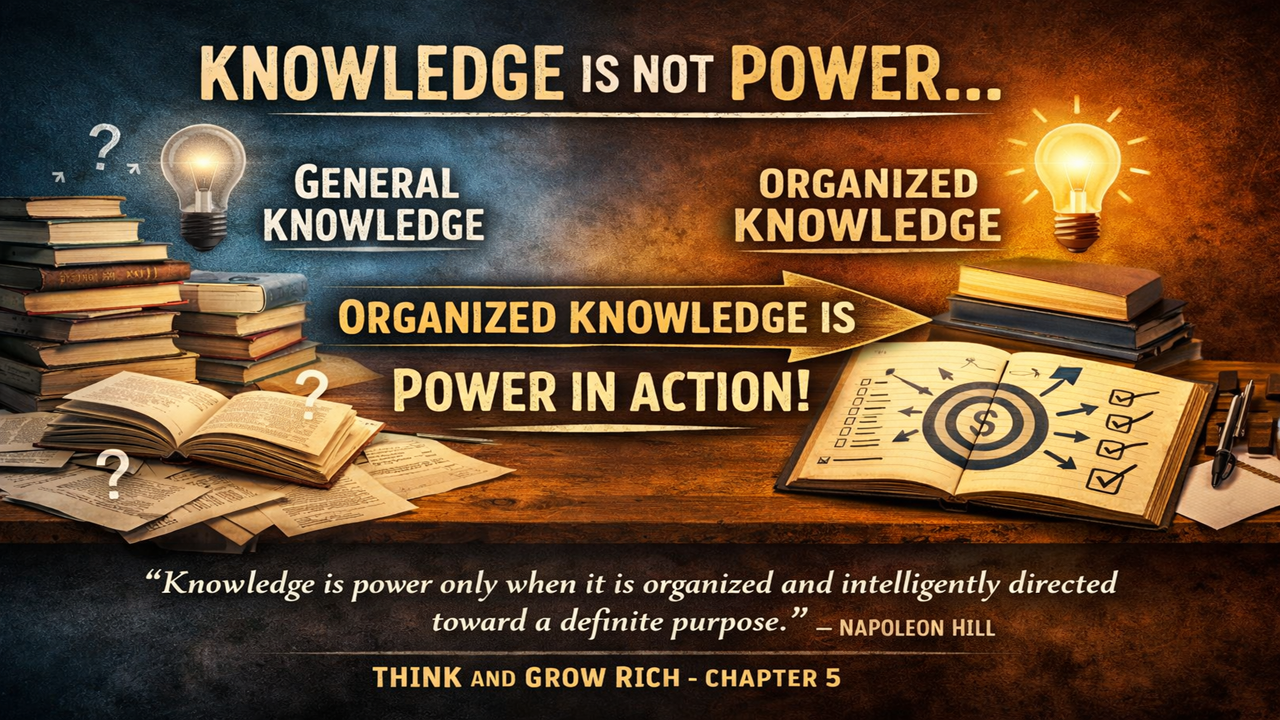
Knowledge Isn’t Power. Applied Knowledge Is Power
Mar 24, 2026General Knowledge Is Not Power; Organized Knowledge Is
What if the reason intelligence doesn’t create wealth, is because intelligence alone doesn’t move anything?
That question quietly dismantles one of the most persistent myths in personal development. Most people believe: If I just learn more, things will change. Napoleon Hill discovered the opposite. He observed brilliant people struggling financially and ordinary people producing extraordinary results. He traced the difference to one factor: Knowledge is not power until it is organized and directed toward a definite purpose.
This is Point 1 of Chapter 5, and it explains why effort, education, and information so often fail to translate into income.
Hill makes a bold claim that unsettles most readers: General knowledge, no matter how extensive, does not produce success. Why? Because general knowledge sits idle. It informs. It entertains. It impresses others. But it does not move the mind toward action unless it is selected deliberately, organized intelligently, and directed toward a specific outcome. Hill’s distinction is surgical: Knowledge becomes power only when it is applied through a plan.
What Hill Really Means by “Organized Knowledge”
Hill is not dismissing education. He is dismissing undirected accumulation. Organized knowledge means knowing what matters now, knowing how it connects to a goal, and knowing when and where to apply it. A small amount of relevant knowledge, applied consistently, will always outperform a vast amount of unused information.
This is why Hill says many highly educated people remain stuck, they possess knowledge, but no structure for using it.
Why General Knowledge Creates Illusion, Not Results
Hill noticed a dangerous psychological trap: People confuse knowing with progress. They read. They study. They attend workshops. They consume content. But nothing changes. Why? Because learning without application creates the illusion of movement while behavior remains unchanged.
Hill would say: Knowledge does not attract money. Applied knowledge does. Until knowledge is organized into action, it remains inert.
How This Principle Directly Supports Your $10K/Month Goal
An additional $10,000 per month does not require you to know everything. It requires you to identify a valuable problem, apply specific knowledge to solve it, and deliver that solution consistently. Organized knowledge turns effort into leverage. Here’s how this principle affects income creation:
- It eliminates over-learning: You stop consuming broadly and start learning selectively.
- It speeds up execution: You apply what you learn immediately instead of waiting to feel “ready.”
- It clarifies your offer: You package specific knowledge into a service or solution others can pay for.
- It builds confidence: Confidence comes from application, not accumulation.
- It produces visible results: Results reinforce belief, which fuels persistence. Income follows clarity.
Why Most People Fail to Organize Knowledge Alone
Left alone, people default to learning more, planning endlessly, and hesitating to apply. Why? Because organization requires external perspective. Hill understood this. That’s why Chapter 5 quietly reinforces one of his most important ideas, association multiplies intelligence.
How a Master Mind Transforms Knowledge Into Power
A Master Mind does what individuals struggle to do alone: It organizes knowledge into action.
- The Group Filters What Matters: Instead of learning everything, the group identifies what’s relevant, what’s unnecessary, and what should be applied next. Noise disappears.
- Knowledge Is Turned Into Plans: Discussion converts information into steps, systems, and timelines. Knowledge becomes executable.
- Borrowed Expertise Accelerates Results: You don’t need to master every skill. You access marketing insight, delivery strategies, and operational knowledge. Hill was explicit: intelligence can be borrowed.
- Application Is Expected, Not Optional: When learning is shared socially, application follows naturally. The group reinforces action.
- Feedback Refines Knowledge Quickly: What doesn’t work is adjusted immediately. Knowledge evolves through use.
Practical Action Steps (Hill-Aligned)
Here’s how to convert general knowledge into organized power:
- Action 1: Identify One Income-Producing Skill: Ask: What knowledge do I have that solves a real problem? Start there.
- Action 2: Tie That Knowledge to a Definite Goal: Example: “I will apply this skill to generate $10K/month by serving X audience.” Purpose organizes knowledge instantly.
- Action 3: Stop Broad Learning Temporarily: Learn only what supports the current objective. Everything else is distraction.
- Action 4: Apply What You Learn Within 24 Hours: Application cements understanding. Delay weakens it.
- Action 5: Discuss Application in the Master Mind: Explain how you used the knowledge. Teaching reinforces mastery.
- Action 6: Borrow What You Don’t Know: Fill gaps through association, not delay.
- Action 7: Review and Refine Weekly: Organization is ongoing, not one-time.
Why Hill Starts Chapter 5 This Way
Because without this understanding people over-study, under-execute, and remain stuck despite effort. Hill’s quiet but firm message is this: You do not need more knowledge. You need better organization of what you already know.
Final Reflection
If knowledge only becomes power when it is organized, what knowledge are you currently holding that has never been given a job to do?
Hill’s insight remains exact: Knowledge alone will not attract money. Applied knowledge will.
What If You Could Start Creating More Financial Momentum in Just 7 Days?
Reading about financial success can give you ideas. Taking action is what begins to create change.
That's why I created the FREE Money Momentum Starter Guide Workbook—a practical starting point for anyone who wants to make greater financial progress by managing their money more intentionally, exploring opportunities to create additional income, and developing habits that keep them moving forward.
Inside the FREE Starter Guide, you'll discover:
- Where you are financially today and where you'd like to make progress
- Opportunities to take greater control of the money already flowing through your life
- Skills, knowledge, and experience you may be able to turn into additional income
- Practical actions you can begin taking right away
- How to create your own 7-Day Money Momentum Action Plan
You don't need to have everything figured out. You don't need a perfect financial plan or a great business idea. You simply need a starting point and a willingness to take the next step.
Want Some Help Working Through It?
You can complete the Money Momentum Starter Guide entirely on your own for free, or for a one-time $5 upgrade, get 30 days of access to your own Money Momentum AI Assistant to help you work through the workbook.
Your AI Assistant can help you think through questions, explore possibilities when you're unsure what to write, dig deeper into your answers, and turn what you discover into practical next steps and your personalized 7-Day Money Momentum Action Plan.
Start Building Your Money Momentum Today. Download your FREE Money Momentum Starter Guide Workbook and take your first step toward greater financial progress.
