
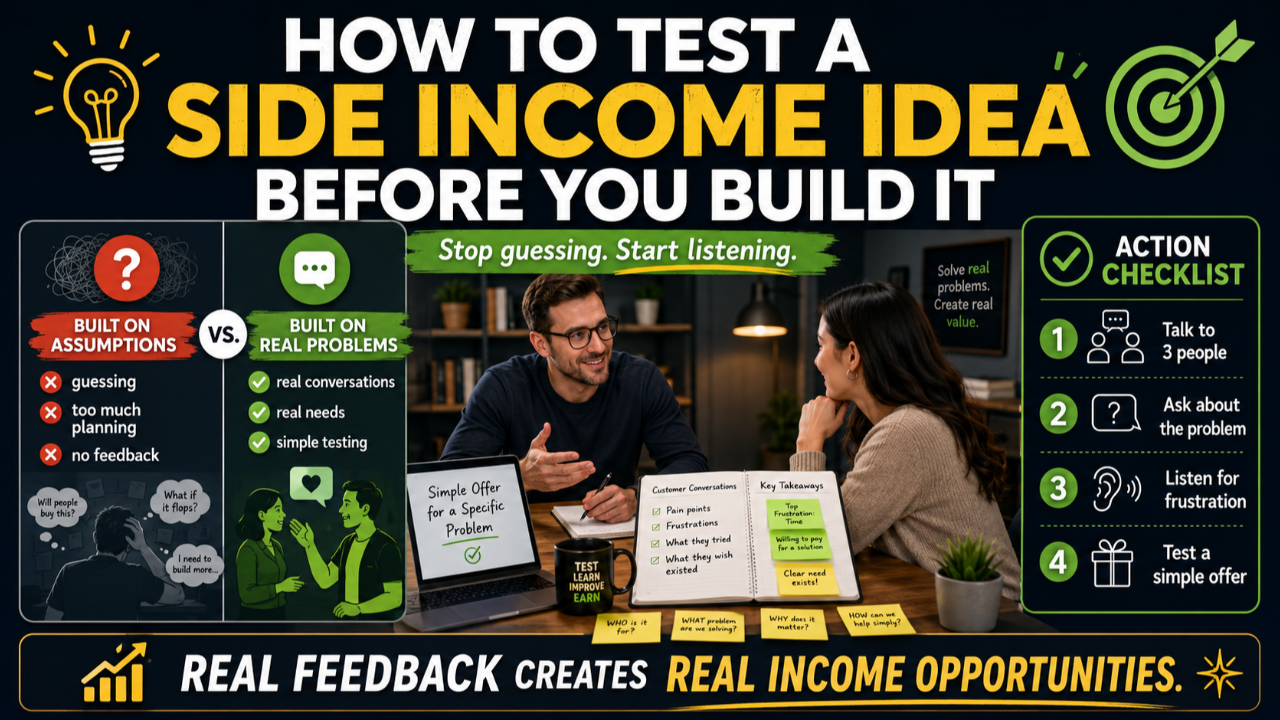
How to Test a Side Income Idea Before You Build It
Jul 01, 2026One of the most painful mistakes a new entrepreneur can make is spending weeks or months building something nobody wants. It usually starts with excitement.
You get an idea. You can see the potential. You imagine people buying it. You start thinking about the name, the offer, the website, the price, and the income it could create.
At first, everything feels possible. But there is a danger hidden inside that excitement. You may be building on imagination instead of evidence. That does not mean your idea is bad. It simply means your idea has not been tested yet. And before you invest too much time, money, or emotion into a side income idea, you want to discover whether real people actually have the problem you want to solve. That is what validation is all about.
Validation Does Not Have to Be Complicated
Many people hear the word validation and think it sounds technical. They imagine market research, surveys, spreadsheets, complicated testing, or business school language. But validation can be much simpler than that.
Validation simply means looking for evidence that people have the problem, care about the problem, and may be willing to pay for help solving it. You are not trying to guarantee success. You are trying to reduce guessing. That distinction matters.
No one can predict the future perfectly. But you can avoid building blindly. You can talk to people. You can listen. You can look for patterns. You can pay attention to what people already do, complain about, avoid, or pay for. Those clues can help you decide whether your idea is worth pursuing.
The Biggest Mistake: Asking People If They Like Your Idea
When someone has a new business idea, one of the first things they often ask is, “Do you think this is a good idea?” That sounds harmless. But it can be one of the least helpful questions you can ask.
Why? Because people are usually polite. Your friends may not want to discourage you. Your family may want to support you. People may say, “That sounds great,” even if they have no intention of ever buying it.
That kind of response can feel encouraging, but it may not be useful. The problem is that compliments do not create income. Real demand creates income.
This is where the lesson from The Mom Test by Rob Fitzpatrick becomes useful. The core idea is simple: do not ask people to validate your dream. Ask about their real life. Instead of asking whether they like your idea, ask about what they already do, what they already struggle with, and what they have already tried. That shift can protect you from false confidence.
Ask About the Problem, Not the Idea
If you want to test a side income idea, start by asking about the problem. Let’s say you are thinking about offering social media help to small businesses.
A weak question would be: “Would you pay someone to help with social media?” A better conversation would sound more like this: “How are you currently handling your social media?”
“What part of it takes the most time?” “What have you tried already?” “Is this something you are actively trying to improve?” “Have you ever paid anyone to help with it?”
Notice the difference. You are not trying to get someone to approve your idea. You are trying to understand their current reality.
If they are already frustrated, already spending time on the problem, or already paying for a partial solution, that is useful information. If they do not care about the problem, that is useful too. Either way, you learn.
Look for Evidence of Pain
People usually pay to solve problems that matter to them. Not every inconvenience becomes an opportunity. Some problems annoy people, but not enough for them to take action. Other problems create enough frustration, cost, embarrassment, delay, stress, or lost opportunity that people are actively looking for help.
That is why you want to listen for emotional language. When someone says, “It drives me crazy,” pay attention. When they say, “I keep putting this off,” pay attention. When they say, “I wish someone could just handle this for me,” pay attention. When they say, “I have tried to fix this three times and it still is not working,” pay attention.
Emotion often reveals importance. A strong side income opportunity usually solves a problem people already care about.
Look for Existing Spending
One of the strongest signs that a problem matters is that people are already spending money to solve it. This does not mean you need to enter a crowded market without a plan. It simply means that existing spending proves demand exists.
If people already pay for tutoring, cleaning, bookkeeping, lawn care, coaching, design, repairs, pet care, resume help, or social media support, that tells you something important. People value solutions in those areas.
Your job is not always to invent a brand-new market. Sometimes your job is to serve an existing need in a clear, simple, trustworthy way. Many beginners make the mistake of trying to be completely original. But originality is not always the goal. Solving a real problem is the goal.
Test With Conversations Before You Build
Before you create a website, design a logo, or spend hours building your offer, have conversations. Talk to people who might actually experience the problem.
If you want to help homeowners, talk to homeowners. If you want to help small business owners, talk to small business owners. If you want to tutor students, talk to parents. If you want to provide virtual assistance, talk to people who are overwhelmed by administrative tasks.
Your goal is to understand their situation. Do not begin by selling. Begin by listening.
You may discover that your original idea needs adjustment. You may discover that the problem is real, but your wording is wrong. You may discover that people care about a different outcome than the one you planned to offer. That is not failure. That is learning. And learning before building can save you a lot of wasted effort.
The Smallest Test Is Often the Best Test
Many people overbuild their first idea. They think they need a complete brand, a finished website, a long sales page, business cards, social media graphics, and a polished presentation. Those things may come later. But in the beginning, the smallest test is often the best test.
Can you explain the problem clearly? Can you describe the result you help create? Can you find one person who wants help? Can you create one simple offer? Can you get one honest conversation? Can you get one person to say, “Yes, I need help with that”?
That is where momentum begins. The first version does not need to be perfect. It needs to teach you something.
A Simple Example
Imagine someone wants to earn extra income by helping people organize garages. They could spend weeks creating a brand name, designing flyers, and building a website. Or they could start by talking to five homeowners.
They might ask what part of the home feels most cluttered. They might ask how long the garage has been disorganized. They might ask whether the clutter causes stress, wasted time, or frustration. They might ask whether the person has tried to organize it before.
If three out of five people immediately start describing the problem with emotion, that is a clue. If one person says, “Honestly, I would pay someone to help me with this,” that is a stronger clue. If someone asks, “What would you charge?” that is even stronger.
Now the idea is no longer just an idea. It has evidence behind it.
Do Not Confuse Silence With Failure
Sometimes you will test an idea and people will not respond. That can feel discouraging. But silence is still information.
It may mean the problem is not painful enough. It may mean you are talking to the wrong audience. It may mean your message is unclear. It may mean the timing is wrong. It may mean the solution needs to be simpler.
The key is not to take every response personally. Validation is not a judgment of your worth. It is a learning process. When something does not work, you adjust. That is how real businesses improve.
Your First Goal Is Not to Impress People
When you are testing an idea, your goal is not to look impressive. Your goal is to learn the truth. That requires humility. It requires listening more than talking. It requires being willing to hear that your idea may need work. This is not always easy, but it is incredibly valuable.
Many people would rather protect their idea than test it. They keep polishing it privately because private preparation feels safer than public feedback. But a private idea cannot create income. At some point, the idea has to meet real people.
The First $1,000 Comes From Real Demand
Your first $1,000 will probably not come from the fanciest idea. It will come from solving a problem that matters. That is why testing is so important.
When you test before you build, you give yourself a better chance of creating something people actually want. You stop guessing. You start listening. You stop trying to impress. You start trying to help. That is a major shift. And that shift can be the difference between staying stuck and creating your first real income opportunity.
A Simple Challenge for This Week
Before you spend another hour building your idea, talk to three people.
Ask them about the problem you are considering solving. Ask how they currently deal with it. Ask what frustrates them most. Ask what they have tried. Ask whether they have ever paid for help.
Then listen carefully. Do not pitch too soon. Do not defend your idea. Do not try to force a yes. Simply gather evidence. By the end of those conversations, you may have more clarity than you would have gained from weeks of thinking alone.
Download Your Free First $1,000 Side Income Starter Guide
If this article helped you see why testing matters, your next step is to begin identifying and validating realistic income opportunities.
That is why I created The First $1,000 Side Income Starter Guide. This free guide will help you think through your skills, notice problems people may be willing to pay to solve, and begin taking the first simple steps toward creating extra income.
You do not need the perfect business idea. You do not need a complicated plan. You do not need to build everything before you begin. You need a clear starting point, honest feedback, and the willingness to take action.
Download your free First $1,000 Side Income Starter Guide today and begin discovering how your skills, experience, and everyday observations could become the foundation for your first $1,000 in extra income. And when you are ready for a step-by-step process, The First $1,000 Side Income Action Plan will walk you through the full 12-week journey of choosing one opportunity, creating a simple offer, taking consistent action, and building momentum toward your first $1,000.
What If You Could Start Creating More Financial Momentum in Just 7 Days?
Reading about financial success can give you ideas. Taking action is what begins to create change.
That's why I created the FREE Money Momentum Starter Guide Workbook—a practical starting point for anyone who wants to make greater financial progress by managing their money more intentionally, exploring opportunities to create additional income, and developing habits that keep them moving forward.
Inside the FREE Starter Guide, you'll discover:
- Where you are financially today and where you'd like to make progress
- Opportunities to take greater control of the money already flowing through your life
- Skills, knowledge, and experience you may be able to turn into additional income
- Practical actions you can begin taking right away
- How to create your own 7-Day Money Momentum Action Plan
You don't need to have everything figured out. You don't need a perfect financial plan or a great business idea. You simply need a starting point and a willingness to take the next step.
Want Some Help Working Through It?
You can complete the Money Momentum Starter Guide entirely on your own for free, or for a one-time $5 upgrade, get 30 days of access to your own Money Momentum AI Assistant to help you work through the workbook.
Your AI Assistant can help you think through questions, explore possibilities when you're unsure what to write, dig deeper into your answers, and turn what you discover into practical next steps and your personalized 7-Day Money Momentum Action Plan.
Start Building Your Money Momentum Today. Download your FREE Money Momentum Starter Guide Workbook and take your first step toward greater financial progress.
