
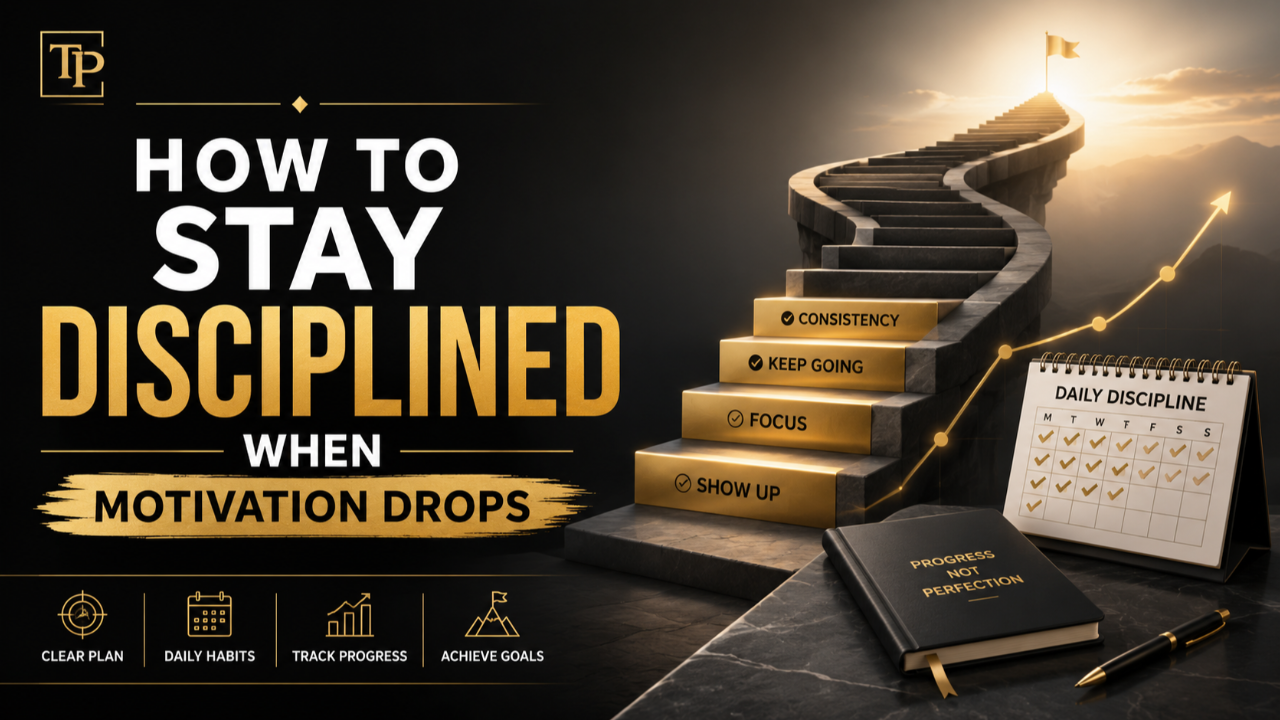
How to Stay Disciplined When Motivation Drops
Jul 23, 2026When you first decide to build a side income, motivation can feel strong.
You may feel excited about the possibility of earning your first $1,000. You may imagine what that extra income could do for your family, your savings, your debt, or your confidence. You may feel ready to choose an opportunity, create an offer, and start taking action.
But motivation does not always stay high.
A few days or weeks later, life gets busy. Work is tiring. Family responsibilities demand attention. Someone does not respond to your message. A conversation does not go the way you hoped. Suddenly, the excitement fades, and the side income goal starts to feel harder than it did at the beginning.
This is where discipline becomes important.
If you want to earn your first $1,000 in side income, you cannot rely on motivation alone. Motivation may help you start, but discipline helps you continue.
Motivation Is Helpful, but Unreliable
Motivation feels good because it gives you energy. When you are motivated, it is easier to dream, plan, and take the first few steps. The problem is that motivation often depends on emotion, and emotions change.
You may feel motivated after reading an inspiring article, attending a workshop, or writing down your goal. But the next day, you may feel tired, uncertain, distracted, or discouraged. If your action depends only on feeling inspired, your progress will be inconsistent.
That does not mean motivation is bad. It simply means motivation should not be in charge.
Discipline gives your goal structure when motivation is weak. It helps you keep moving even when the excitement has faded.
Discipline Means Keeping a Promise to Yourself
Many people think discipline means forcing yourself to do something difficult all the time. But discipline can be understood in a simpler way: it is the practice of keeping a promise to yourself.
If you said you would contact five people this week, discipline means you contact five people. If you said you would follow up with two interested contacts, discipline means you send the follow-up messages. If you said you would spend thirty minutes working on your offer, discipline means you protect that time.
Each time you keep that promise, you strengthen trust with yourself. You begin seeing yourself as someone who follows through.
That identity matters because side income is not built from one dramatic action. It is built from repeated actions done consistently.
Make the Next Step Small Enough to Do
One reason discipline breaks down is that the next step feels too big. If your task is “build my side income,” that is too vague and too overwhelming. If your task is “send one message,” that is much easier to act on.
When motivation drops, shrink the action.
Instead of trying to solve the entire business, choose one small action that keeps you moving. Write one clear offer. Send one referral message. Follow up with one person. Track one conversation. Spend fifteen minutes improving your wording.
Small actions may seem too simple, but they help prevent the most dangerous outcome: stopping completely.
A small action done today is better than a perfect plan postponed until next week.
Use Your System When You Do Not Feel Like It
This is why the action system from the previous week matters. A system helps you decide in advance what actions you will take, so you do not have to rely on how you feel in the moment.
When motivation is high, build the system. When motivation drops, follow the system.
Your system might be simple. Maybe every Monday you identify five people to contact. Every Wednesday you send follow-ups. Every Friday you review what happened and write down one lesson. That rhythm gives your goal a place in your week.
Without a system, every action becomes a new decision. With a system, the next step is already clear.
Expect Resistance
Discipline becomes easier when you stop being surprised by resistance. There will be days when you do not feel like taking action. There will be moments when fear, doubt, or frustration tries to talk you out of following through.
That does not mean something has gone wrong. It means you are doing work that matters enough to stretch you.
Resistance often shows up right before meaningful action. You may feel it before sending a message, posting an offer, following up, or asking for a decision. Instead of treating resistance as a reason to stop, begin seeing it as a signal that you are at the edge of growth.
You do not have to feel fearless. You only have to take the next honest step.
Do Not Let One Bad Day Become a Bad Month
Everyone misses a day sometimes. Everyone gets distracted. Everyone has moments where life interrupts the plan.
The danger is not one missed action. The danger is allowing one missed action to become a new pattern.
If you miss a day, return quickly. Do not waste energy criticizing yourself or deciding that you have failed. Simply ask, “What is the next small action I can take now?”
That question brings you back into motion.
Discipline does not require perfection. It requires recovery. The faster you return to the path, the less momentum you lose.
Connect Discipline to Your Why
Discipline becomes stronger when it is connected to a meaningful reason.
If your first $1,000 is only a number, it may not be enough to keep you going when things get uncomfortable. But if that $1,000 represents reduced stress, proof that you can create income, extra breathing room for your family, or the beginning of a new identity, the goal becomes more personal.
Take time to remember why this matters. What would earning your first $1,000 do for you? What would it prove? What would it make possible? Who would benefit if you followed through?
When discipline is connected to purpose, it becomes easier to keep going.
Track Effort Before Emotion
When motivation drops, it is easy to judge your progress by how you feel. If you feel excited, you assume things are going well. If you feel discouraged, you assume you are failing.
That is not always true.
Instead of tracking only emotion, track effort. Did you complete the action you committed to? Did you share your offer? Did you start a conversation? Did you follow up? Did you learn something from the response?
Effort gives you something measurable. It helps you see that progress is happening even when your emotions are not celebrating yet.
This is especially important in the early stages, when results may take time.
Build Discipline Through Repetition
Discipline is not built in one moment. It is built through repetition.
Each time you do what you said you would do, you strengthen the habit of follow-through. Each time you take action despite uncertainty, you build evidence that you can continue. Each time you return after a missed day, you prove that you are not controlled by one setback.
Over time, disciplined action changes how you see yourself. You stop being someone who only thinks about earning extra income and become someone who takes consistent action toward it.
That identity shift is powerful.
A Simple Challenge for This Week
This week, choose one side income action you will complete every day for five days.
Keep it small enough to actually do. It could be sending one message, following up with one person, writing down one lesson from a conversation, improving one sentence of your offer, or spending fifteen focused minutes on your action plan.
The purpose is not to overwhelm yourself. The purpose is to practice keeping a promise to yourself.
At the end of the five days, write down what changed. Did you feel more confident? Did you create a conversation? Did you notice resistance? Did you learn that action is possible even when motivation is low?
That lesson matters.
Discipline Turns Intention Into Progress
Your first $1,000 will not come from motivation alone. It will come from showing up when motivation is strong and continuing when motivation fades.
Discipline does not mean you never feel tired, nervous, or discouraged. It means those feelings do not get the final vote. You still choose the next small action. You still follow up. You still share the offer. You still return to the plan.
That is how progress is built.
Motivation may start the journey, but discipline keeps it moving.
And if you can keep moving long enough to learn, improve, and serve real people, your first $1,000 becomes much more possible.
Download Your Free First $1,000 Side Income Starter Guide
If this article helped you see why discipline matters when motivation drops, your next step is to begin building a simple plan you can actually follow. That is why I created The First $1,000 Side Income Starter Guide.
This free guide will help you think through your skills, identify real problems, clarify your offer, and begin taking practical steps toward your first $1,000 in extra income.
You do not need to feel motivated every day. You need a clear goal, a simple action system, and the discipline to take the next step even when you do not feel like it.
Download your free First $1,000 Side Income Starter Guide today and begin building your side income with clarity, discipline, and momentum.
And when you are ready for the complete step-by-step process, The First $1,000 Side Income Action Plan will walk you through the full 12-week journey with focused lessons, practical worksheets, weekly action steps, and the structure you need to keep moving forward.
What If You Could Start Creating More Financial Momentum in Just 7 Days?
Reading about financial success can give you ideas. Taking action is what begins to create change.
That's why I created the FREE Money Momentum Starter Guide Workbook—a practical starting point for anyone who wants to make greater financial progress by managing their money more intentionally, exploring opportunities to create additional income, and developing habits that keep them moving forward.
Inside the FREE Starter Guide, you'll discover:
- Where you are financially today and where you'd like to make progress
- Opportunities to take greater control of the money already flowing through your life
- Skills, knowledge, and experience you may be able to turn into additional income
- Practical actions you can begin taking right away
- How to create your own 7-Day Money Momentum Action Plan
You don't need to have everything figured out. You don't need a perfect financial plan or a great business idea. You simply need a starting point and a willingness to take the next step.
Want Some Help Working Through It?
You can complete the Money Momentum Starter Guide entirely on your own for free, or for a one-time $5 upgrade, get 30 days of access to your own Money Momentum AI Assistant to help you work through the workbook.
Your AI Assistant can help you think through questions, explore possibilities when you're unsure what to write, dig deeper into your answers, and turn what you discover into practical next steps and your personalized 7-Day Money Momentum Action Plan.
Start Building Your Money Momentum Today. Download your FREE Money Momentum Starter Guide Workbook and take your first step toward greater financial progress.
