
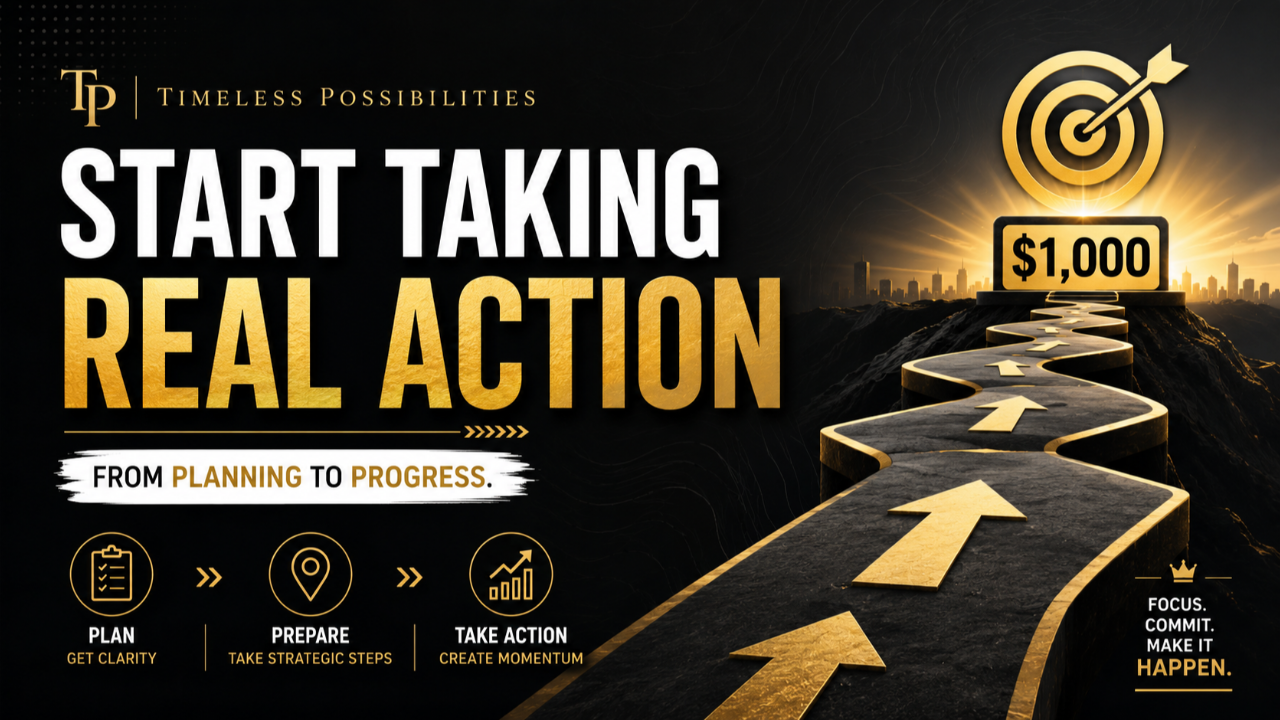
How to Start Taking Real Action
Jul 22, 2026At some point, every side income idea reaches the same moment.
You have thought about the opportunity. You have clarified your goal. You have chosen one path. You have created a simple offer. You may even have a basic action system written down.
But now the real question appears:
Will you actually use it?
This is where many people hesitate. Planning feels safe because it happens privately. Action feels different because it puts your idea in front of real people. Someone might not respond. Someone might ask a question you are not ready for. Someone might say no. Someone might not understand your offer.
That discomfort is real, but it is also where progress begins.
If you want to earn your first $1,000 in side income, you eventually have to move from preparation into action. Real action is what creates feedback, conversations, confidence, customers, and income.
Planning Is Only Useful When It Leads to Action
Planning matters. A clear goal, a focused opportunity, a simple offer, and a weekly system can make your side income much easier to build. But planning was never meant to become the final destination.
The purpose of planning is to prepare you to move.
Many people keep adjusting their plan because it feels productive. They rewrite the offer, rethink the audience, change the price, and look for one more strategy before they begin. Sometimes those adjustments are helpful, but often they become a way to avoid the uncomfortable step of sharing the offer.
A plan only becomes powerful when you use it.
Real Action Creates Real Feedback
One of the most valuable things about action is that it gives you information you cannot get from thinking alone.
You can wonder whether your offer is clear, but a real conversation will show you. You can guess whether people care about the problem, but a real response will tell you more. You can think your price is too high or too low, but the marketplace will give you better feedback than private doubt.
This is why real action matters.
Every message, conversation, follow-up, and offer shared gives you something to learn from. Even if someone does not buy, you may still discover whether your wording was clear, whether the problem matters, whether your audience is right, or whether your next step needs to be simpler.
Feedback is not failure. Feedback is how your offer gets stronger.
Start Smaller Than You Think
Taking action does not mean you need to launch everything at once. You do not need a website, a full social media campaign, a logo, a perfect sales page, or a complicated marketing plan to begin.
You can start with one simple action.
You can send one message. You can ask one person for a referral. You can follow up with one interested contact. You can post one clear announcement. You can have one conversation about the problem you solve.
Small action may not feel dramatic, but it breaks the pattern of delay. It proves that you are no longer only thinking about your side income. You are beginning to move it into the real world.
That first step matters.
Share With the Right People First
When you are starting out, it is usually better to begin with people who may understand the problem or know someone who has it. You do not need to broadcast your offer to everyone. You need to create a few real conversations with the right people.
Think about who is already connected to the problem you solve. If you offer tutoring, who knows parents or students? If you offer bookkeeping support, who knows small business owners? If you offer yard care, who knows busy homeowners, landlords, or seniors who may need help?
Your first action can be simple: “I am starting to help people with [problem]. Do you know anyone who may need that kind of help?”
That question opens a door without pressure.
Do Not Wait for Perfect Confidence
Many people believe they need to feel confident before they act. But confidence usually grows because you act.
The first few times may feel awkward. You may stumble through your wording. You may feel nervous after sending a message. You may wonder whether you said it correctly.
That does not mean you are not ready. It means you are practicing.
Confidence comes from creating evidence. Every time you share your offer and keep going, you prove to yourself that you can handle the process. You can handle questions. You can handle silence. You can handle a no. You can handle learning and improving.
You do not need perfect confidence to start. You need one action completed.
Track the Actions, Not Just the Income
When you are working toward your first $1,000, it is easy to measure only money. Money matters, but in the beginning, income may not show up immediately.
That is why you should also track the actions that lead to income.
How many people did you contact? How many conversations did you start? How many follow-ups did you send? How many referrals did you ask for? What questions did people ask? What did you learn?
Tracking action helps you see progress before the money appears. It also helps you stay honest. If no one is responding, you can look at whether you are taking enough action, whether your message is clear, or whether you are reaching the right people.
Action tracking turns vague effort into useful information.
Expect Some Discomfort
Real action often brings emotion with it. You may feel nervous before sending a message. You may feel disappointed if someone does not respond. You may feel discouraged if the first few conversations do not lead to customers.
That does not mean you are on the wrong path.
It means you are doing something that matters enough to stretch you.
Many people stop because they interpret discomfort as a sign to quit. But discomfort is often just part of learning. You are developing the skill of communicating value, starting conversations, following up, and staying steady.
The goal is not to feel comfortable every step of the way. The goal is to keep taking the next useful action.
Use Repetition to Build Momentum
One action is powerful because it breaks the silence, but repeated action is what builds momentum. If you share your offer once and stop, you may not get enough feedback to learn. If you contact one person and they do not respond, it is too early to decide the offer does not work.
Momentum comes from repetition.
Share the offer. Start conversations. Follow up. Track the response. Adjust the message. Repeat.
This rhythm helps you improve. It also trains you to become someone who follows through instead of someone who only plans.
Your first $1,000 is more likely to come from consistent action than from one perfect attempt.
A Simple Challenge for This Week
This week, choose five real actions that put your offer in front of people.
You might contact five people, ask for five referrals, send three messages and two follow-ups, or post one announcement and follow up with four people who may know someone who needs your help.
Keep it simple. The goal is not to do everything. The goal is to begin.
After each action, write down what happened. Did the person respond? Did they ask a question? Did they seem confused? Did they mention someone else? Did you feel more confident after doing it?
At the end of the week, review what you learned. That feedback will help you improve your next round of action.
Action Turns Possibility Into Proof
Your first $1,000 will not come from having a good idea alone. It will come from putting that idea into motion.
Action turns possibility into proof. It helps you find out whether people understand your offer, whether the problem matters, and whether your message needs adjusting. It also builds confidence because you begin seeing yourself as someone who follows through.
You do not need to take massive action all at once. You need to take real action consistently.
Send the message. Ask for the referral. Share the offer. Follow up. Track what happens. Learn from the response.
That is how your side income moves from idea to reality.
Download Your Free First $1,000 Side Income Starter Guide
If this article helped you see why real action matters, your next step is to begin putting your offer in motion. That is why I created The First $1,000 Side Income Starter Guide.
This free guide will help you think through your skills, identify real problems, clarify your offer, and begin taking practical steps toward your first $1,000 in extra income.
You do not need to wait for perfect confidence. You need a clear offer, a simple action system, and the willingness to take the next step.
Download your free First $1,000 Side Income Starter Guide today and begin building your side income through real action.
And when you are ready for the complete step-by-step process, The First $1,000 Side Income Action Plan will walk you through the full 12-week journey with focused lessons, practical worksheets, weekly action steps, and the structure you need to keep moving forward.
What If You Could Start Creating More Financial Momentum in Just 7 Days?
Reading about financial success can give you ideas. Taking action is what begins to create change.
That's why I created the FREE Money Momentum Starter Guide Workbook—a practical starting point for anyone who wants to make greater financial progress by managing their money more intentionally, exploring opportunities to create additional income, and developing habits that keep them moving forward.
Inside the FREE Starter Guide, you'll discover:
- Where you are financially today and where you'd like to make progress
- Opportunities to take greater control of the money already flowing through your life
- Skills, knowledge, and experience you may be able to turn into additional income
- Practical actions you can begin taking right away
- How to create your own 7-Day Money Momentum Action Plan
You don't need to have everything figured out. You don't need a perfect financial plan or a great business idea. You simply need a starting point and a willingness to take the next step.
Want Some Help Working Through It?
You can complete the Money Momentum Starter Guide entirely on your own for free, or for a one-time $5 upgrade, get 30 days of access to your own Money Momentum AI Assistant to help you work through the workbook.
Your AI Assistant can help you think through questions, explore possibilities when you're unsure what to write, dig deeper into your answers, and turn what you discover into practical next steps and your personalized 7-Day Money Momentum Action Plan.
Start Building Your Money Momentum Today. Download your FREE Money Momentum Starter Guide Workbook and take your first step toward greater financial progress.
