
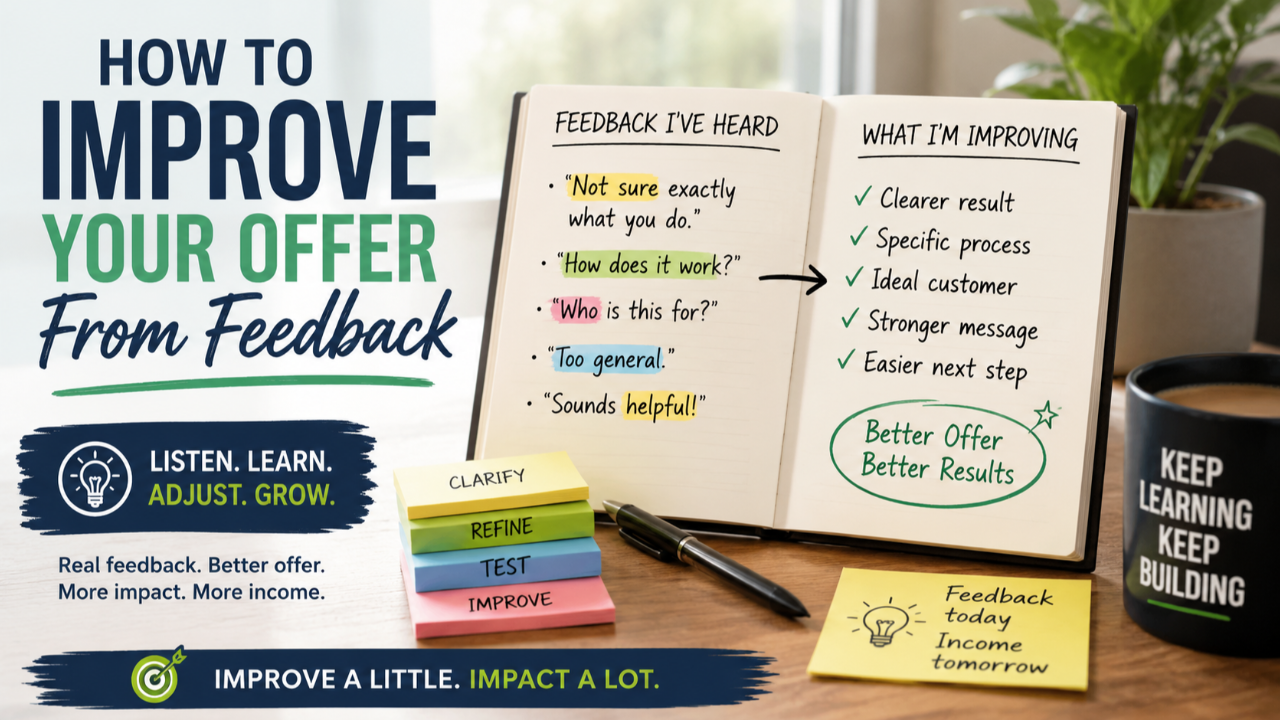
How to Improve Your Offer From Feedback
Jul 24, 2026Once you begin taking real action, feedback will start to appear.
Some people may ask questions. Some may seem interested but not move forward. Some may say no. Some may ignore your message completely. Others may tell you your offer sounds useful, but then never take the next step.
At first, this can feel discouraging. You may wonder if your idea is wrong, if your price is too high, or if people simply are not interested. But before you decide your offer is failing, slow down and look at what the feedback is actually telling you.
Feedback is not always obvious. It does not always arrive as clear advice. Sometimes feedback shows up through silence, confusion, hesitation, questions, objections, referrals, or repeated patterns in conversations.
If you want to earn your first $1,000 in side income, you need to learn how to use feedback wisely. Your first version of an offer is rarely the best version. Feedback helps you improve it.
Feedback Is Information, Not Failure
One of the biggest mistakes people make is treating feedback as proof that something is wrong with them. If someone says no, they feel rejected. If someone does not respond, they feel ignored. If someone asks a hard question, they feel unprepared.
But feedback is not failure. Feedback is information.
When you share your offer with real people, you are gathering evidence. You are learning whether the problem matters, whether the result is clear, whether your message makes sense, whether the price feels aligned, and whether you are speaking to the right audience.
This is how an offer becomes stronger. You do not improve by guessing in private. You improve by paying attention to what happens when your offer meets the marketplace.
Look for Patterns, Not One-Time Responses
One response does not tell the whole story. If one person says no, that does not mean your offer is bad. If one person does not respond, that does not mean nobody cares. If one person thinks the price is too high, that does not automatically mean you need to lower it.
Instead of reacting emotionally to one response, look for patterns.
Are several people confused by the same part of your offer? Are people interested in the result but unsure about the next step? Are they asking similar questions about how it works, how much it costs, or who it is for? Are they saying they like the idea but not taking action?
Patterns are useful because they point to what may need adjusting. One response is only a data point. Repeated responses become a signal.
Questions Reveal What Needs Clarity
When people ask questions, do not see that as a problem. Questions often show interest. They also reveal where your offer may need to become clearer.
If people keep asking, “What exactly do you do?” your offer may be too vague. If they ask, “Who is this for?” your audience may not be clear enough. If they ask, “How does it work?” your process may need a simpler explanation. If they ask, “What happens next?” your next step may not be obvious.
Instead of getting frustrated by questions, write them down. Those questions are showing you what your future messaging needs to address.
A better offer often comes from answering the questions real people are already asking.
Silence Can Teach You Too
Silence can be frustrating because it leaves you guessing. But silence can still be useful if you look at it carefully.
If people are not responding at all, ask yourself a few honest questions. Was the message clear? Did it speak to a real problem? Was it sent to the right person? Was the next step simple? Did the message sound helpful, or did it sound like a pitch? Did you follow up?
Sometimes silence means the person is not interested. Sometimes it means the timing was wrong. Sometimes it means the message was too vague. Sometimes it means you have not reached enough people yet.
Do not let silence stop you immediately. Use it as a reason to review your message, improve your clarity, and keep testing.
Hesitation Shows What May Be Missing
When someone shows interest but does not commit, there may be something missing. They may need more clarity, more trust, more urgency, more confidence in the result, or a simpler next step.
For example, if someone says, “That sounds interesting,” but never moves forward, your offer may need a clearer call to action. If someone says, “I might need that later,” you may need to understand whether the problem is urgent enough. If someone says, “Let me think about it,” you may need to ask what they are unsure about.
You do not need to pressure people. But you can respectfully learn from hesitation.
A simple question like, “What would you need to feel clear about the next step?” can reveal a lot.
Do Not Change Everything at Once
When feedback feels uncomfortable, it is tempting to change the entire offer. You may want to change the audience, the price, the service, the wording, and the platform all at once.
Be careful.
If you change everything at once, you will not know what actually made the difference. It is better to make small adjustments and observe what happens.
You might clarify the result. You might simplify the wording. You might test a different audience. You might make the next step easier. You might adjust the price after enough conversations.
Improve the offer gradually. Small changes based on real feedback are usually better than big changes based on frustration.
Use the Customer’s Language
One of the most valuable parts of feedback is hearing how people describe their own problems. The words they use can make your offer stronger.
For example, you may describe your service as “home organization,” but a potential customer may say, “I just want to stop feeling embarrassed when people come over.” You may describe your service as “bookkeeping support,” but a business owner may say, “I hate not knowing where my money is going.” You may describe tutoring as “academic support,” but a parent may say, “I just want my child to stop feeling defeated.”
Those phrases matter because they reveal the emotional result people care about.
When your offer uses language that reflects the customer’s real experience, it becomes easier for the right person to recognize the value.
Improve the Result, Not Just the Words
Sometimes feedback shows that your wording needs improvement. Other times, it shows that the offer itself needs to create a clearer or stronger result.
If people understand what you do but still do not care, the problem may not feel important enough. If the result sounds vague, people may not see why they should pay. If the offer feels too broad, they may not know what they are actually getting.
Ask yourself, “What result would make this feel worth paying for?”
Maybe your offer needs to be more specific. Instead of “I help with organizing,” you might offer “a two-hour pantry reset for busy families.” Instead of “I help with spreadsheets,” you might offer “a simple income and expense tracker for small business owners.” Instead of “I offer tutoring,” you might offer “three focused math sessions to help your child prepare for an upcoming test.”
Specific results are easier to understand and easier to buy.
Track Feedback Consistently
If you rely only on memory, you may miss important patterns. That is why tracking feedback is so useful.
Create a simple record of who you contacted, what you said, how they responded, what questions they asked, whether they showed interest, whether follow-up is needed, and what you learned.
This does not need to be complicated. A notebook, spreadsheet, or simple document is enough.
The purpose is to turn your conversations into learning. Over time, your tracker will show you which messages work better, which problems get attention, which audiences respond, and where your offer needs improvement.
A Simple Challenge for This Week
This week, review the last five conversations or messages related to your offer. Look for patterns.
What questions did people ask? Where did they seem confused? What words did they use to describe the problem? Did anyone show interest but fail to take the next step? Did silence show up repeatedly? Did one audience respond better than another?
Then choose one small improvement to make.
You might rewrite your offer to make the result clearer. You might simplify your next step. You might add one sentence that answers a common question. You might focus on a more specific audience.
Make one adjustment, then test it again with real people.
Your goal is not to perfect the offer in one day. Your goal is to improve through action.
Feedback Helps You Build a Better Offer
Your first $1,000 will not usually come from the first version of your offer. It will come from testing, listening, adjusting, and continuing.
Feedback helps you see what the marketplace understands, what it ignores, what it questions, and what it values. When you use that information wisely, your offer becomes clearer, stronger, and easier to share.
Do not fear feedback. Do not take every response personally. Do not quit because the first version did not work perfectly.
Listen. Learn. Adjust. Share again.
That is how an offer improves. That is how confidence grows. That is how real conversations turn into real income.
Download Your Free First $1,000 Side Income Starter Guide
If this article helped you see how feedback can improve your offer, your next step is to keep moving with a clear plan. That is why I created The First $1,000 Side Income Starter Guide.
This free guide will help you think through your skills, identify real problems, clarify your offer, and begin taking practical steps toward your first $1,000 in extra income.
You do not need your first offer to be perfect. You need real feedback, simple adjustments, and the willingness to keep taking action.
Download your free First $1,000 Side Income Starter Guide today and begin improving your side income offer with clarity and confidence.
And when you are ready for the complete step-by-step process, The First $1,000 Side Income Action Plan will walk you through the full 12-week journey with focused lessons, practical worksheets, weekly action steps, and the structure you need to keep moving forward.
What If You Could Start Creating More Financial Momentum in Just 7 Days?
Reading about financial success can give you ideas. Taking action is what begins to create change.
That's why I created the FREE Money Momentum Starter Guide Workbook—a practical starting point for anyone who wants to make greater financial progress by managing their money more intentionally, exploring opportunities to create additional income, and developing habits that keep them moving forward.
Inside the FREE Starter Guide, you'll discover:
- Where you are financially today and where you'd like to make progress
- Opportunities to take greater control of the money already flowing through your life
- Skills, knowledge, and experience you may be able to turn into additional income
- Practical actions you can begin taking right away
- How to create your own 7-Day Money Momentum Action Plan
You don't need to have everything figured out. You don't need a perfect financial plan or a great business idea. You simply need a starting point and a willingness to take the next step.
Want Some Help Working Through It?
You can complete the Money Momentum Starter Guide entirely on your own for free, or for a one-time $5 upgrade, get 30 days of access to your own Money Momentum AI Assistant to help you work through the workbook.
Your AI Assistant can help you think through questions, explore possibilities when you're unsure what to write, dig deeper into your answers, and turn what you discover into practical next steps and your personalized 7-Day Money Momentum Action Plan.
Start Building Your Money Momentum Today. Download your FREE Money Momentum Starter Guide Workbook and take your first step toward greater financial progress.
