
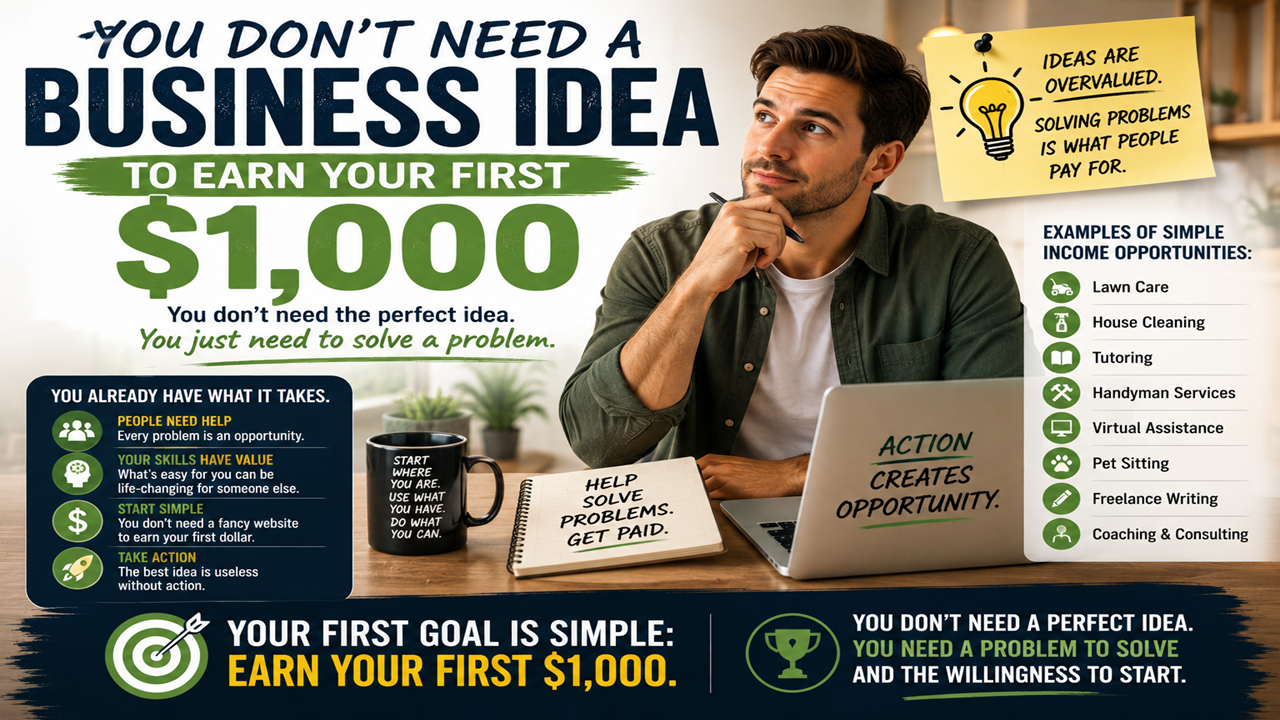
How To Earn Your First $1000 Without A Brilliant Business Plan
Jun 14, 2026One of the most common reasons people never start creating extra income is surprisingly simple. They believe they need a great business idea.
They tell themselves: "I don't know what business to start." "I haven't found the right idea yet." "Someone else has probably already done it." "I'm waiting for inspiration."
As a result, they stay stuck. They continue researching, thinking, waiting, and months or even years later, nothing has changed. The truth is that most people don't need a business idea. They need a problem they can help solve.
The Myth of the Million-Dollar Idea
Many people imagine successful entrepreneurs suddenly discovering a brilliant idea that changes their life overnight. The reality is usually much less exciting.
Most successful businesses started by solving a simple problem for a specific group of people. Someone needed help. Someone offered a solution. Money changed hands. A business was born.
The opportunity wasn't created through genius. It was created through service.
People Pay for Solutions
Think about the last few things you spent money on. Why did you buy them? Most likely because they solved a problem.
Examples:
- A mechanic solves a vehicle problem.
- A tutor solves a learning problem.
- A cleaner solves a time problem.
- A coach solves a clarity problem.
- A lawn care company solves a maintenance problem.
- A bookkeeper solves an organization problem.
People rarely buy products. They buy outcomes. They buy convenience. They buy solutions and that creates opportunities everywhere.
Stop Asking "What Business Should I Start?" Instead ask: "What problems can I help solve?" This small shift changes everything. Suddenly you don't need a revolutionary idea. You simply need to identify people who have a problem and offer help. That is much easier and much more practical.
The Opportunity Is Often Already Around You
Many people overlook opportunities because they assume opportunities must be complicated. In reality, some of the best opportunities are hiding in plain sight.
Ask yourself: What do people ask me for help with? What skills do I use regularly? What knowledge have I gained through work or life experience? What tasks come naturally to me? What problems frustrate people around me? Your answers may reveal opportunities you have never considered.
Your Experience Has Value
One of the biggest mistakes people make is underestimating their own experience. They assume: "I don't know enough." But expertise is relative.
You don't need to know everything. You simply need to know more than the person you're helping.
Consider someone who:
- Knows how to use spreadsheets effectively.
- Understands bookkeeping.
- Has experience with social media.
- Knows how to organize a home.
- Has gardening skills.
- Has parenting experience.
- Understands fitness basics.
There are people willing to pay for help in all of these areas. What feels ordinary to you may be valuable to someone else.
The First $1,000 Usually Comes From Simplicity
When people imagine entrepreneurship, they often think websites, funnels, branding, marketing campaigns, and product launches, while those things can be useful later, they are rarely necessary to earn your first $1,000.
Many people earn their first extra income through simple services.
Examples include:
- Lawn care
- Snow removal
- House cleaning
- Tutoring
- Freelance writing
- Virtual assistance
- Handyman work
- Pet sitting
- Coaching
- Consulting
None of these require a revolutionary idea. They require action.
Action Creates Clarity
One of the biggest misconceptions about business is that clarity comes first.
Many people believe: "Once I know exactly what to do, then I'll start." In reality, clarity usually comes after action. You learn:
- What people want
- What they don't want
- What they will pay for
- What problems matter most
The market teaches you, but only if you're willing to engage with it.
The Real Problem Isn't Lack of Ideas
Most people actually have too many ideas. The problem isn't lack of ideas. The problem is lack of decision. People keep searching for something better. Something easier. Something perfect.
Meanwhile, people with ordinary ideas are taking action and creating results. Remember: A good idea executed is worth far more than a perfect idea that never leaves your notebook.
What Napoleon Hill Taught
In Think and Grow Rich, Napoleon Hill repeatedly emphasized the importance of decision. Successful people make decisions and act. Unsuccessful people often remain trapped in indecision. Many people delay because they are trying to eliminate all uncertainty. But uncertainty is part of the process.
The people who succeed are not the people who know exactly how everything will work. They are the people willing to begin before they know all the answers.
Your First Goal Is Not Perfection
Your first goal is not to build a massive business. Your first goal is not financial freedom. Your first goal is not replacing your income. Your first goal is much simpler. Earn your first dollar. Then your first hundred. Then your first thousand. Each step builds confidence. Each step builds experience. Each step creates momentum.
A Simple Exercise
Grab a piece of paper and answer these questions:
- What skills do I already have?
- What problems do people frequently ask me for help with?
- What tasks would I be willing to do for someone else?
- What knowledge have I gained through work or life experience?
- Which of these could help someone achieve a result?
You may discover that your next income opportunity is already sitting on that page.
Ready to Find Your Income Opportunity? The First $1,000 Side Income Action Plan was designed to help ordinary people identify realistic income opportunities and take action.
What If You Could Start Creating More Financial Momentum in Just 7 Days?
Reading about financial success can give you ideas. Taking action is what begins to create change.
That's why I created the FREE Money Momentum Starter Guide Workbook—a practical starting point for anyone who wants to make greater financial progress by managing their money more intentionally, exploring opportunities to create additional income, and developing habits that keep them moving forward.
Inside the FREE Starter Guide, you'll discover:
- Where you are financially today and where you'd like to make progress
- Opportunities to take greater control of the money already flowing through your life
- Skills, knowledge, and experience you may be able to turn into additional income
- Practical actions you can begin taking right away
- How to create your own 7-Day Money Momentum Action Plan
You don't need to have everything figured out. You don't need a perfect financial plan or a great business idea. You simply need a starting point and a willingness to take the next step.
Want Some Help Working Through It?
You can complete the Money Momentum Starter Guide entirely on your own for free, or for a one-time $5 upgrade, get 30 days of access to your own Money Momentum AI Assistant to help you work through the workbook.
Your AI Assistant can help you think through questions, explore possibilities when you're unsure what to write, dig deeper into your answers, and turn what you discover into practical next steps and your personalized 7-Day Money Momentum Action Plan.
Start Building Your Money Momentum Today. Download your FREE Money Momentum Starter Guide Workbook and take your first step toward greater financial progress.
