
How to Create a Simple Offer People Understand
Jul 19, 2026Once you have chosen one income opportunity, the next step is to turn that opportunity into a simple offer.
This is where many people get stuck. They may know they want to help with tutoring, organizing, lawn care, bookkeeping, coaching, writing, design, or some other service, but they struggle to explain it clearly. When someone asks what they offer, they either say too little or explain too much.
The result is confusion.
And confusion makes it difficult for people to say yes.
If you want to earn your first $1,000 in side income, your offer does not need to be complicated. It needs to be clear. A simple offer helps people quickly understand who you help, what problem you solve, and what result you help create.
An Idea Is Not the Same as an Offer
An idea lives in your mind. An offer is something another person can understand, consider, and respond to.
For example, “I want to help people with organizing” is an idea. It becomes a clearer offer when you say, “I help busy families organize one cluttered area of their home so the space feels calmer and easier to use.”
That difference matters. The first statement describes a general category. The second statement gives people a picture of the problem, the person, and the result.
Your first offer should not leave people wondering what you actually do. It should make the value easy to see.
Start With the Person You Help
A strong offer begins with the person you want to serve. If your offer is for everyone, it becomes harder for anyone to recognize themselves in it.
You do not need to define your audience perfectly at the beginning, but you do need a clear starting point. Are you helping busy homeowners, parents, students, small business owners, seniors, job seekers, new entrepreneurs, or local families?
When you know who you are speaking to, your message becomes more focused. You can describe the problem in language they understand, and you can explain the result in a way that matters to them.
For example, “I help students with math” is clear enough to understand, but “I help students who are struggling in math rebuild confidence and understand the basics more clearly” is much stronger. It speaks to a specific person with a specific problem.
Focus on One Problem
One common mistake is trying to include everything you can do in your first offer. You may be capable of helping in several ways, but listing too many services can overwhelm people.
A simple offer should focus on one main problem.
If you help with bookkeeping, the problem may be messy records. If you help with lawn care, the problem may be lack of time or energy to maintain the yard. If you help with tutoring, the problem may be a child falling behind or losing confidence. If you help with home organization, the problem may be clutter that creates stress.
When the problem is clear, the offer becomes easier to understand. People do not need to hear every possible detail at first. They need to know whether you can help with something they already care about.
Explain the Result
People do not only buy services. They buy results.
They want relief, confidence, progress, time, organization, peace of mind, or a better outcome. Your offer should help them see what changes because of your help.
Instead of saying, “I offer spreadsheet support,” you might say, “I help small business owners set up simple spreadsheets so they can track income and expenses with more confidence.”
Instead of saying, “I offer meal planning,” you might say, “I help busy families create simple meal plans so weeknight dinners feel less stressful.”
The result does not need to be dramatic. It just needs to matter to the person who has the problem.
Use a Simple Offer Formula
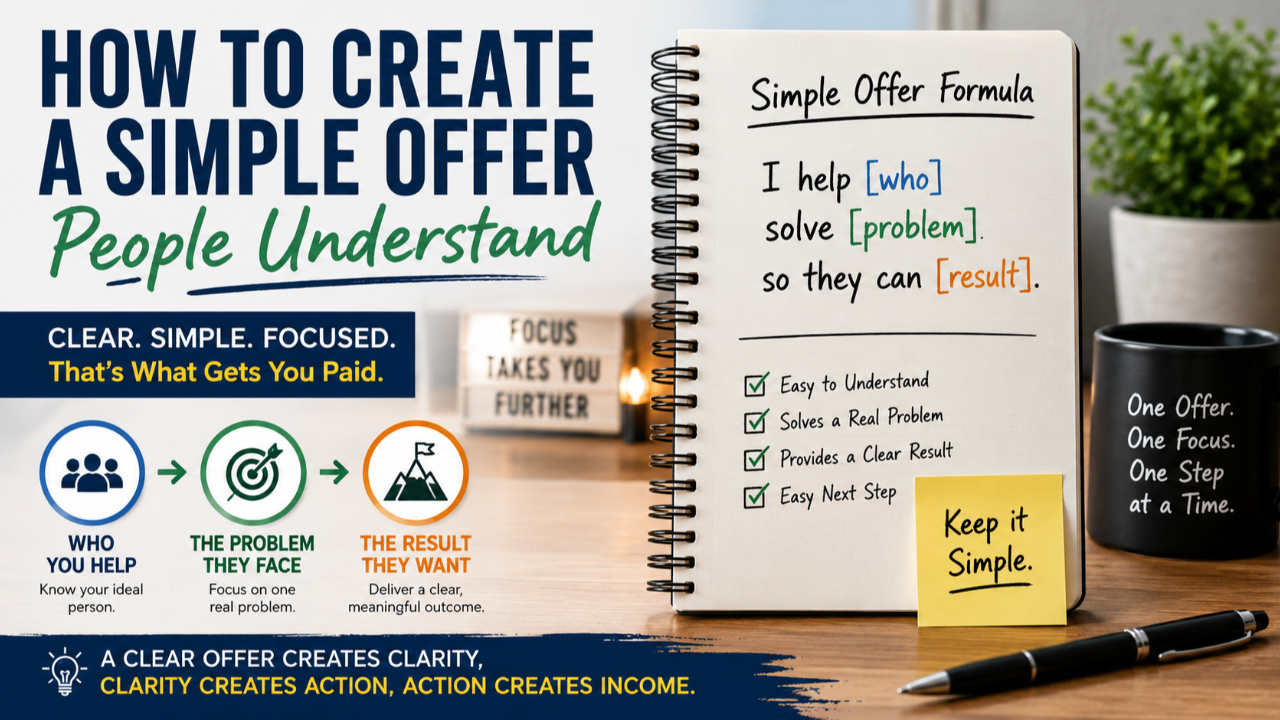
A helpful formula is:
I help [who] solve [problem] so they can [result].
This formula works because it keeps your offer focused. It prevents you from rambling, overexplaining, or hiding behind vague language.
Here are a few examples:
“I help busy homeowners keep their yards looking cared for so they can enjoy their weekends.”
“I help parents support children who are struggling in math so their child can rebuild confidence at school.”
“I help small business owners organize simple records so they feel less stressed and more prepared.”
“I help job seekers improve their resumes so they can present themselves more clearly to employers.”
Each example is simple. Each one identifies the person, the problem, and the result. That is what makes the offer easier to remember and easier to share.
Keep the First Version Small
Your first offer does not need to include every possible service, package, bonus, or future idea. In fact, it is usually better if it does not.
A smaller offer is easier to explain, easier to price, easier to deliver, and easier to improve. It also helps you avoid becoming overwhelmed before you have even started.
Instead of offering complete home organization, you might start with one room or one problem area. Instead of offering full business support, you might start with one spreadsheet setup. Instead of offering ongoing tutoring packages, you might start with a short assessment and a few focused sessions.
Starting small does not mean thinking small. It means making the first step clear.
Make the Next Step Obvious
A good offer should also make it easy for someone to know what to do next. If they are interested, what happens?
Do they send you a message? Book a short call? Answer a few questions? Schedule a time? Receive a simple quote?
Do not make the next step complicated. When someone shows interest, you might say, “The simplest next step is a ten-minute conversation so I can understand what you need.” Or, “Send me a message and I can ask a few quick questions to see if this is a fit.”
Simple next steps create momentum. Confusing next steps create delay.
Test the Offer With Real People
Once you write your offer, do not hide it in a notebook. Share it with real people and pay attention to the response.
Do people understand it quickly? Do they ask questions? Do they know someone who might need it? Do they seem confused? Do they respond more strongly to one word or result than another?
This feedback helps you improve. Your first version is not supposed to be perfect. It is supposed to be clear enough to start conversations.
The marketplace will teach you what private thinking cannot.
A Simple Challenge for This Week
This week, write your offer using this formula:
I help [who] solve [problem] so they can [result].
Then read it out loud. If it feels confusing, simplify it. Remove extra details. Avoid clever wording. Focus on the person, the problem, and the result.
After that, share it with three people and ask whether it is easy to understand. Do not ask if they like it. Ask if they understand who it is for and what problem it solves.
That feedback will help you strengthen your offer.
A Clear Offer Creates Confidence
Your first $1,000 becomes much more possible when people understand what you offer.
A simple offer gives you something clear to say in conversations. It makes referrals easier. It helps interested people know whether your service is a fit. It also gives you more confidence because you are no longer trying to explain everything at once.
Do not wait until the offer is perfect. Make it clear enough to share, then improve it through action.
Your first offer is not the final version of your business. It is the starting point that helps you move from idea to income.
Download Your Free First $1,000 Side Income Starter Guide
If this article helped you understand how to create a simple offer, your next step is to begin putting that clarity into action. That is why I created The First $1,000 Side Income Starter Guide.
This free guide will help you think through your skills, identify real problems, clarify your opportunity, and begin taking practical steps toward your first $1,000 in extra income.
You do not need a complicated business plan. You need one clear offer that solves a real problem for a real person.
Download your free First $1,000 Side Income Starter Guide today and begin building your side income with clarity, confidence, and focus.
And when you are ready for the complete step-by-step process, The First $1,000 Side Income Action Plan will walk you through the full 12-week journey with focused lessons, practical worksheets, weekly action steps, and the structure you need to keep moving forward.
What If You Could Start Creating More Financial Momentum in Just 7 Days?
Reading about financial success can give you ideas. Taking action is what begins to create change.
That's why I created the FREE Money Momentum Starter Guide Workbook—a practical starting point for anyone who wants to make greater financial progress by managing their money more intentionally, exploring opportunities to create additional income, and developing habits that keep them moving forward.
Inside the FREE Starter Guide, you'll discover:
- Where you are financially today and where you'd like to make progress
- Opportunities to take greater control of the money already flowing through your life
- Skills, knowledge, and experience you may be able to turn into additional income
- Practical actions you can begin taking right away
- How to create your own 7-Day Money Momentum Action Plan
You don't need to have everything figured out. You don't need a perfect financial plan or a great business idea. You simply need a starting point and a willingness to take the next step.
Want Some Help Working Through It?
You can complete the Money Momentum Starter Guide entirely on your own for free, or for a one-time $5 upgrade, get 30 days of access to your own Money Momentum AI Assistant to help you work through the workbook.
Your AI Assistant can help you think through questions, explore possibilities when you're unsure what to write, dig deeper into your answers, and turn what you discover into practical next steps and your personalized 7-Day Money Momentum Action Plan.
Start Building Your Money Momentum Today. Download your FREE Money Momentum Starter Guide Workbook and take your first step toward greater financial progress.
