
How Successful People Use Failure Differently
Feb 10, 2026What if the thing you’ve been calling “failure” is actually the feedback you’ve been avoiding?
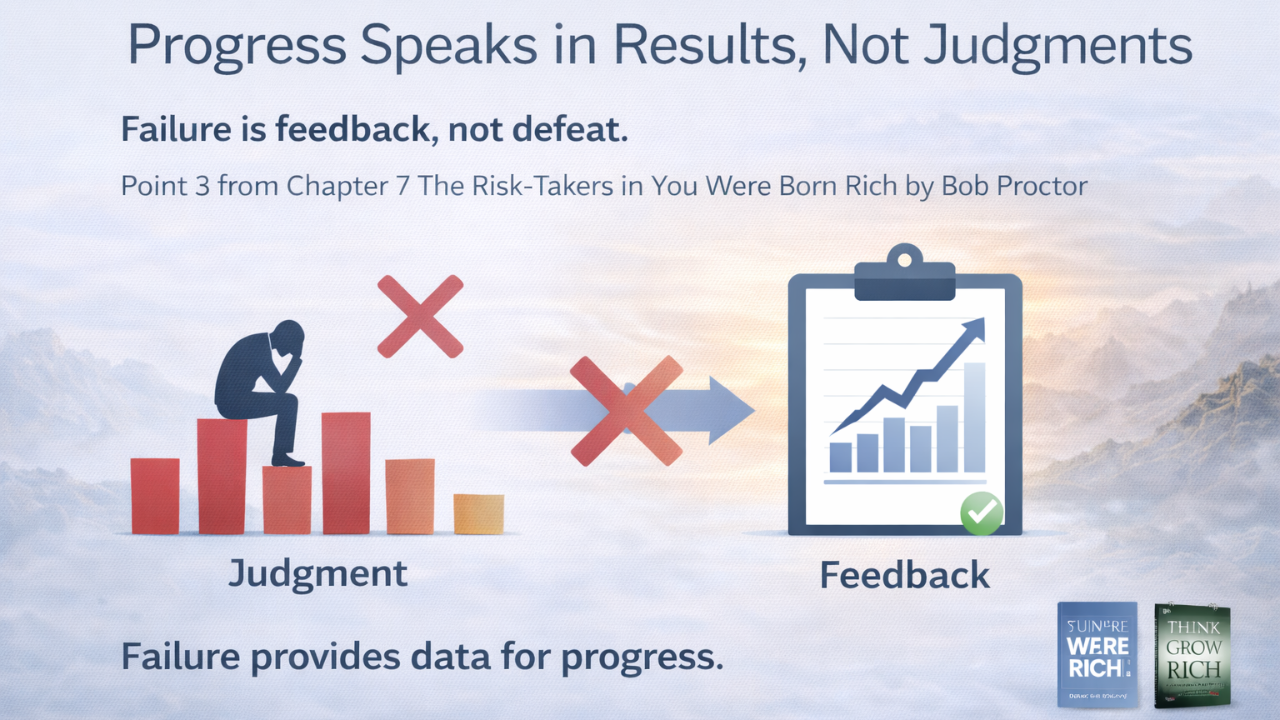
Most people don’t quit because they fail. They quit because they interpret failure as proof they shouldn’t continue. This is the core insight behind Point 3 from Chapter 7 The Risk-Takers in You Were Born Rich by Bob Proctor: Failure is feedback, not defeat.
Progress Speaks in Results, Not Judgments
Bob Proctor reframes failure in a way that instantly removes its emotional sting. Failure, he explains, is not a verdict on your ability or worth. It is information, neutral, precise, and useful. Every attempt produces a result. Every result tells you something. Growth happens when you listen instead of retreat.
The people who move forward fastest are not the ones who avoid mistakes. They are the ones who extract lessons without attaching identity to outcomes. Failure only becomes defeat when you stop using it as data. When feedback is taken personally, people freeze. When it’s taken professionally, they adjust and continue.
How This Relates Directly to Think and Grow Rich
Napoleon Hill delivered the same principle, clearly and repeatedly, in Think and Grow Rich by Napoleon Hill. Hill taught that: Every adversity carries the seed of an equal or greater benefit. Persistence is meaningless without course correction. Temporary defeat is part of achievement, not the opposite of it.
Here’s the alignment: Proctor shows failure as feedback for intelligent adjustment. Hill shows adversity as raw material for progress. The difference between success and stagnation is not the absence of setbacks, it’s the response to them. Both men insist: progress requires experimentation, and experimentation guarantees imperfect results.
Why This Principle Frees You to Move Faster
When failure is no longer a personal judgment action becomes easier, learning accelerates, and fear loses authority. You stop asking, “What if I fail?” You start asking, “What is this teaching me?” That shift alone increases momentum.
Would Studying With a Group Be Helpful?
Absolutely, because perspective sharpens in conversation
- A Group Normalizes Learning Curves: Hearing others share missteps removes shame and restores objectivity.
- A Group Extracts Lessons Faster: What takes weeks to see alone often becomes obvious in discussion.
- A Group Keeps Feedback Constructive: Groups help you separate data from drama.
- A Group Sustains Persistence: When setbacks happen, community keeps momentum alive.
Action Items to Implement Point 3
- Action 1: Re-label a Recent “Failure”: Write one recent result you disliked and label it Feedback, not failure.
- Action 2: Ask One Neutral Question: “What did this result teach me?” No emotion. No blame.
- Action 3: Identify One Adjustment: What would you do differently next time based on the data?
- Action 4: Take the Next Action Quickly: Apply the adjustment within 48 hours to prevent hesitation from returning.
- Action 5: Track Lessons, Not Losses: Keep a simple list titled What I’m Learning.
A Line Worth Sitting With
Growth doesn’t ask you to be perfect. It asks you to be responsive.
If you’re ready to stop interpreting feedback as failure and start using it as fuel for progress, we invite you to study these principles with us. Visit https://www.timelesspossibilities.com/ and sign up for our free live online study group now. This is a space to learn, discuss, and apply timeless principles together.
What If You Could Start Creating More Financial Momentum in Just 7 Days?
Reading about financial success can give you ideas. Taking action is what begins to create change.
That's why I created the FREE Money Momentum Starter Guide Workbook—a practical starting point for anyone who wants to make greater financial progress by managing their money more intentionally, exploring opportunities to create additional income, and developing habits that keep them moving forward.
Inside the FREE Starter Guide, you'll discover:
- Where you are financially today and where you'd like to make progress
- Opportunities to take greater control of the money already flowing through your life
- Skills, knowledge, and experience you may be able to turn into additional income
- Practical actions you can begin taking right away
- How to create your own 7-Day Money Momentum Action Plan
You don't need to have everything figured out. You don't need a perfect financial plan or a great business idea. You simply need a starting point and a willingness to take the next step.
Want Some Help Working Through It?
You can complete the Money Momentum Starter Guide entirely on your own for free, or for a one-time $5 upgrade, get 30 days of access to your own Money Momentum AI Assistant to help you work through the workbook.
Your AI Assistant can help you think through questions, explore possibilities when you're unsure what to write, dig deeper into your answers, and turn what you discover into practical next steps and your personalized 7-Day Money Momentum Action Plan.
Start Building Your Money Momentum Today. Download your FREE Money Momentum Starter Guide Workbook and take your first step toward greater financial progress.
