
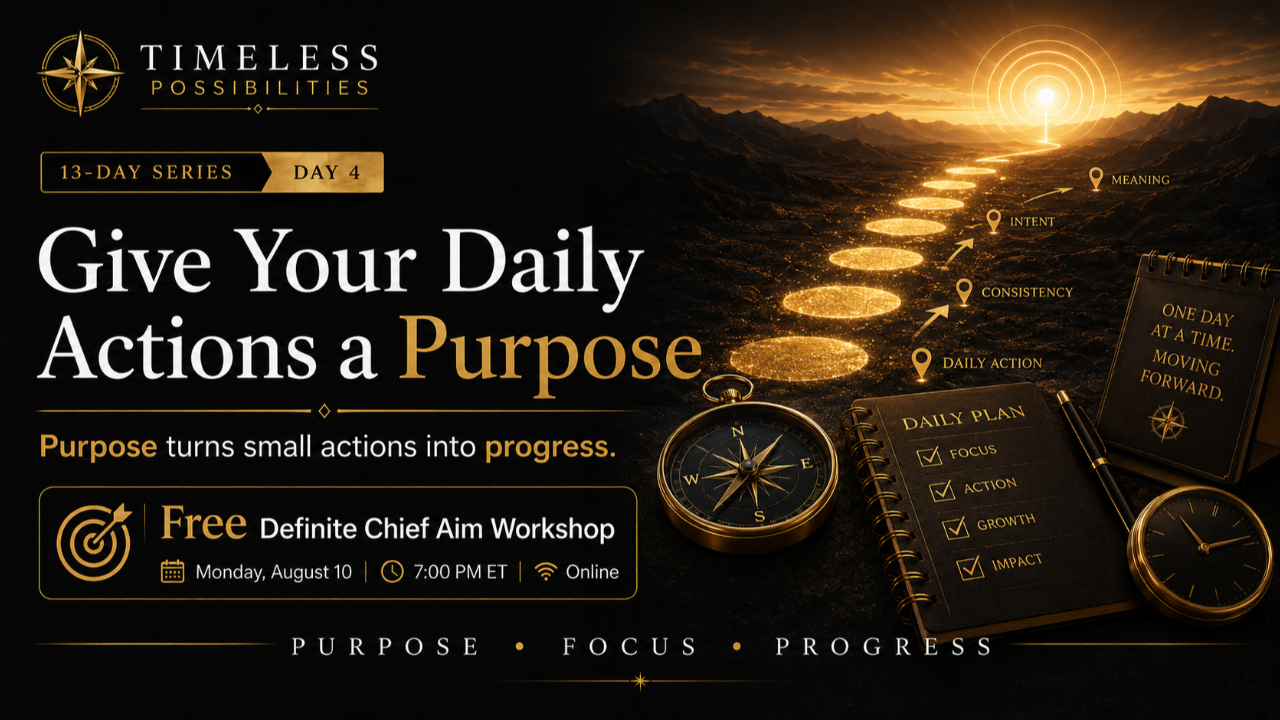
Give Your Daily Actions a Purpose
Jul 31, 2026Over the first three days of this series, we have talked about stopping the drift, getting clear about what you really want, and making your goal specific enough to guide you. Today, I want to focus on what happens next, because a goal only becomes useful when it begins to influence the way you spend your time.
A lot of people have goals they genuinely care about, but their daily routines do not reflect those goals. They may write the goal down, think about it often, and feel excited about what could happen in the future, yet when the day begins they return to the same habits, the same distractions, and the same priorities they had before. That is where progress usually breaks down. A goal cannot change your life if it never changes what you do.
A Goal Should Influence the Way You Spend Your Day
One of the greatest benefits of having a Definite Chief Aim is that it gives your daily activity a sense of direction. Without a clear aim, it is easy to spend most of your time reacting to whatever feels urgent. Messages need answers, problems need solving, responsibilities need attention, and before long the day is over.
None of those things are necessarily unimportant. The problem is that they can consume so much of your attention that the future you say you want receives very little of your time.
A Definite Chief Aim gives you a better question to ask yourself each day: What can I do today that moves me closer to the result I have chosen?
That does not mean ignoring your responsibilities. It means making sure your future is one of them.
Progress Usually Comes From Small, Purposeful Actions
People often imagine progress as something dramatic. They think they need a major breakthrough, a perfect opportunity, or a surge of motivation before they can really move forward. In reality, progress is usually much less dramatic and much more consistent.
If your goal is to create additional income, one meaningful conversation may matter more than an hour of random research. If you want to grow a business, following up with someone who has already shown interest may be more valuable than redesigning your website. If your financial goal is greater stability, reviewing your spending and making one better decision can matter more than simply hoping things improve.
These actions may seem small, but their value comes from the fact that they are connected to a clear purpose. When you repeat small, relevant actions consistently, they begin to create momentum.
Busyness Can Feel Productive Without Producing Progress
One of the easiest traps to fall into is confusing activity with progress. You can have a full schedule and still avoid the actions that matter most.
Sometimes productive-looking tasks feel safer than meaningful ones. Research feels safer than making an offer. Planning feels safer than starting a conversation. Organizing feels safer than following up. Learning feels safer than putting your idea in front of someone and asking for a response.
There is nothing wrong with preparation, but preparation becomes a problem when it turns into a hiding place.
A clear goal makes this easier to recognize. When you know the result you are trying to produce, you can look at your daily activities and ask whether they are actually helping you move toward it. That kind of honesty can be uncomfortable, but it is also useful.
Purpose Changes the Meaning of Small Actions
A clear aim can make ordinary actions feel more important because you can see how they connect to something larger.
Suppose your goal is to create a new source of income. Sending one message to a potential customer may not feel significant on its own. But when that message is part of a deliberate effort to build something new, it takes on a different meaning.
The same is true of learning a skill, making a phone call, reviewing your spending, writing an offer, or setting aside focused time to complete work you have been postponing. The action itself may be small, but it becomes meaningful when it supports a larger objective.
That is one of the reasons clarity matters so much. It gives ordinary actions a reason.
Let the Goal Help You Decide What Matters Today
A useful shift is to stop asking, “What do I feel like doing today?” and start asking, “What does my goal require from me today?”
Those two questions lead to very different behaviour.
When your decisions are based mainly on mood, important actions are easy to postpone. When they are based on direction, you become more intentional. Some days the required action may be simple. You may need to send a message, complete a task, make a phone call, or spend thirty focused minutes on something important. Other days may require more effort.
You do not need to do everything every day. You do need to make sure that something you do supports the future you are trying to create.
Your Goal Should Have a Place in Your Calendar
A Definite Chief Aim is not meant to live only in a notebook or in your thoughts. It should begin showing up in the way you schedule your time.
This does not mean every part of your day has to revolve around your goal. Life includes responsibilities that have to be handled. But your goal should not always receive whatever time happens to be left over after everything else is done.
Even a small amount of focused time can make a difference when it is used consistently. Fifteen or thirty minutes spent on a meaningful action can be far more valuable than hours spent doing things that only make you feel busy.
The key is intention. Your future deserves a place in your schedule.
Action Builds Confidence Through Evidence
Daily action matters for another reason: it gives you evidence that you are following through.
Every time you act on your goal, you show yourself that the goal is more than a good idea. You demonstrate that you are willing to move, willing to learn, and willing to keep a commitment you made to yourself.
That evidence is important because confidence is often built after action, not before it.
You do not need to wait until you feel fully confident before you begin. You begin, and then confidence starts to grow because you can point to what you have actually done.
Over time, this begins to influence your identity. You stop thinking of yourself as someone who only talks about what they want and start becoming someone who takes action on it.
Give Tomorrow One Clear Purpose
Before today ends, choose one action that you can complete tomorrow that directly supports your goal. Make it clear enough that you will know when it is done.
Instead of telling yourself that you will “work on the business,” decide what that actually means. It may mean contacting three people, finishing an offer, reviewing your spending, completing one part of a project, or following up with someone you have been avoiding.
The specific action will depend on your goal, but the principle is the same. Decide what matters before the day begins, then make sure it gets done.
That simple habit can begin changing the relationship between what you say you want and how you actually spend your time.
Join the Free Definite Chief Aim Workshop
On Monday, August 10, at 7:00 p.m. Eastern Time, I will be leading a free online Definite Chief Aim Workshop.
The workshop is designed to help you do more than simply choose a goal. We will work through how to clarify what you really want, make the result more specific, choose a definite date, identify what you are willing to give in return, and create a practical starting plan.
Just as importantly, we will connect that aim to action so that it does not remain something you only think about. The purpose is for you to leave with a written Definite Chief Aim and a clearer understanding of what you can begin doing right away.
The workshop is free, it is online, and it takes place on Monday, August 10 at 7:00 p.m. Eastern Time.

A goal becomes powerful when it begins showing up in your choices, your schedule, and your behaviour. Give your daily actions a purpose, and those actions can begin building the future you have chosen.
What If You Could Start Creating More Financial Momentum in Just 7 Days?
Reading about financial success can give you ideas. Taking action is what begins to create change.
That's why I created the FREE Money Momentum Starter Guide Workbook—a practical starting point for anyone who wants to make greater financial progress by managing their money more intentionally, exploring opportunities to create additional income, and developing habits that keep them moving forward.
Inside the FREE Starter Guide, you'll discover:
- Where you are financially today and where you'd like to make progress
- Opportunities to take greater control of the money already flowing through your life
- Skills, knowledge, and experience you may be able to turn into additional income
- Practical actions you can begin taking right away
- How to create your own 7-Day Money Momentum Action Plan
You don't need to have everything figured out. You don't need a perfect financial plan or a great business idea. You simply need a starting point and a willingness to take the next step.
Want Some Help Working Through It?
You can complete the Money Momentum Starter Guide entirely on your own for free, or for a one-time $5 upgrade, get 30 days of access to your own Money Momentum AI Assistant to help you work through the workbook.
Your AI Assistant can help you think through questions, explore possibilities when you're unsure what to write, dig deeper into your answers, and turn what you discover into practical next steps and your personalized 7-Day Money Momentum Action Plan.
Start Building Your Money Momentum Today. Download your FREE Money Momentum Starter Guide Workbook and take your first step toward greater financial progress.
