
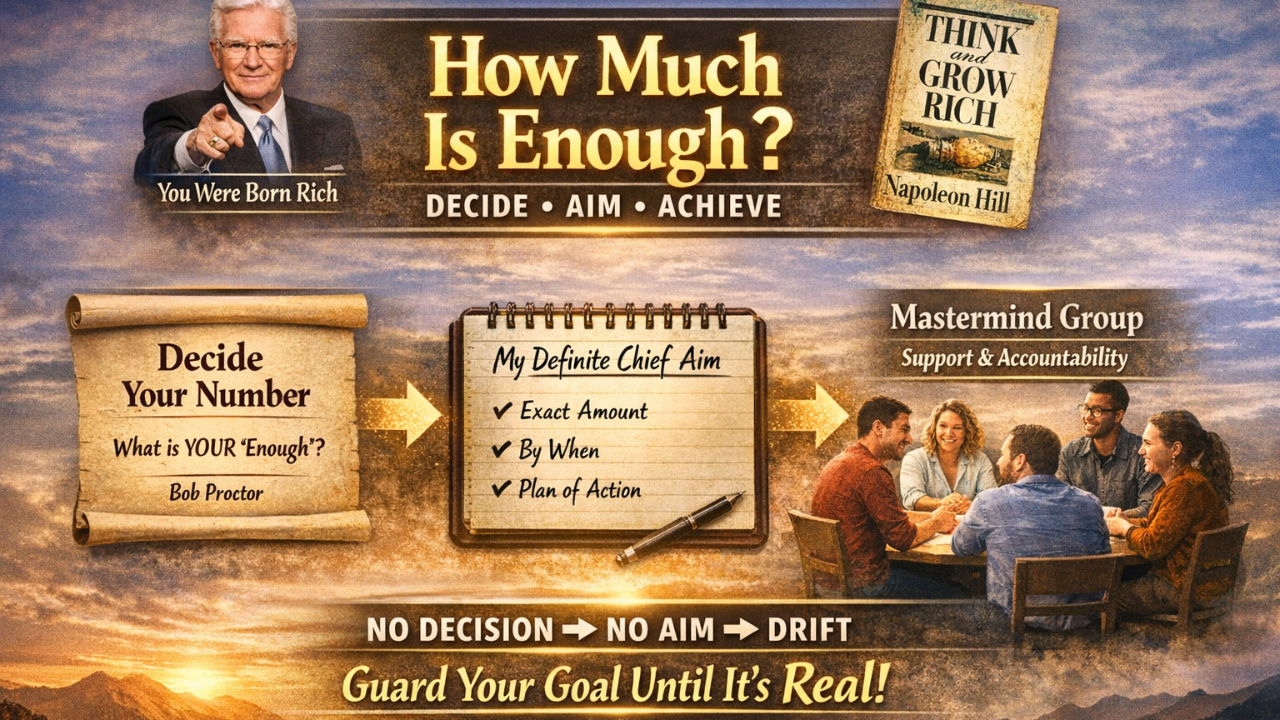
“Enough” Is a Decision: What Proctor and Hill Really Meant About Money
Jan 19, 2026“Enough” Is a Decision: What Bob Proctor and Napoleon Hill Really Meant About Money
Most people never fail financially. They simply never decide. In Chapter 2 of You Were Born Rich, Bob Proctor isn’t asking you to pick a number for fun. He’s asking something far more confronting: How much will you allow yourself to want?
That single decision quietly determines whether you drift through life… or step into the kind of financial clarity Napoleon Hill later demands in Think and Grow Rich. Because until “enough” is chosen consciously, it will always be chosen for you, by family, culture, peers, and fear.
Enough Is a Decision, Not a Number Someone Else Gives You
What Bob Proctor Is Really Teaching in Chapter 2 of You Were Born Rich is not asking you to pick a number casually. He is asking you to claim authorship over your financial life.
Most people do not fail because they aim too high. They fail because they never decide at all. Instead of choosing consciously, people inherit their parents’ comfort ceiling, society’s definition of “reasonable,” or their peer group’s income norms. This creates a silent internal rule: “This is how much someone like me is allowed to earn.” That rule becomes a self-imposed limit.
How This Directly Relates to Think and Grow Rich
Napoleon Hill opens Think and Grow Rich with a requirement that mirrors Proctor’s teaching almost perfectly. Hill’s First Demand: Definiteness. Hill insists that you must decide exactly how much money you want, by when, and what you will give in return. “The starting point of all achievement is desire.”
But here’s the key insight many miss: Desire without decision is just wishing. Bob Proctor’s “How much is enough?” is the pre-decision Hill assumes you’ve already made. Proctor: Decide what you will allow yourself to want. Hill: Turn that decision into a Definite Chief Aim. Without Proctor’s step, Hill’s 6-Step Formula collapses at Step 1.
Why This Decision Is So Difficult
Deciding “how much is enough” triggers: Fear of judgment (“Who do I think I am?”), Fear of responsibility (“What if I get it?”), or Fear of failure (“What if I don’t?”).
Some people stay vague: “I just want to be comfortable.” “I want financial freedom someday.” “I want more money.”
Hill calls this drifting. Proctor calls it paradigm protection. Different words. Same warning.
Would a Mastermind Group Be Helpful?
Yes, and this is why it’s critical at this stage:
- A Mastermind Breaks Inherited Limits: When everyone around you thinks small, small feels normal. A mastermind exposes you to bigger numbers, bolder decisions, and expanded possibilities. You don’t rise to your goals; you rise to your environment. Hearing others confidently state clear aims gives you permission to do the same.
- A Mastermind Protects the Decision: Decisions are fragile before belief solidifies. Hill warns that doubt kills desire before action begins. A mastermind reflects your stated aim back to you, prevents quiet shrinking of the goal, and holds the line when fear appears. Isolation erodes decisions. Community reinforces them.
- A Mastermind Converts Decision into Commitment: Hill makes it clear: a Definite Chief Aim must be written, spoken, and repeated. A mastermind naturally enforces this through verbal declaration, public accountability, and regular review. Once spoken aloud, a goal becomes harder to abandon.
- Collective Faith Accelerates Belief: Hill defines faith as belief emotionalized. A mastermind supplies borrowed belief when yours wavers, emotional reinforcement through shared expectation, and proof through others’ progress. Faith grows faster in groups than alone.
Bob Proctor teaches you to decide what ‘enough’ is. Napoleon Hill teaches you how to achieve it. A mastermind makes sure you don’t back out.
Proctor: Decide how much you will allow yourself to want. Hill: Turn that decision into a Definite Chief Aim. Mastermind: Protects, reinforces, and activates the decision
- Without the decision → no aim
- Without the aim → no plan
- Without the plan → drift
Without a mastermind? Most people quietly lower the number.
What If You Could Start Creating More Financial Momentum in Just 7 Days?
Reading about financial success can give you ideas. Taking action is what begins to create change.
That's why I created the FREE Money Momentum Starter Guide Workbook—a practical starting point for anyone who wants to make greater financial progress by managing their money more intentionally, exploring opportunities to create additional income, and developing habits that keep them moving forward.
Inside the FREE Starter Guide, you'll discover:
- Where you are financially today and where you'd like to make progress
- Opportunities to take greater control of the money already flowing through your life
- Skills, knowledge, and experience you may be able to turn into additional income
- Practical actions you can begin taking right away
- How to create your own 7-Day Money Momentum Action Plan
You don't need to have everything figured out. You don't need a perfect financial plan or a great business idea. You simply need a starting point and a willingness to take the next step.
Want Some Help Working Through It?
You can complete the Money Momentum Starter Guide entirely on your own for free, or for a one-time $5 upgrade, get 30 days of access to your own Money Momentum AI Assistant to help you work through the workbook.
Your AI Assistant can help you think through questions, explore possibilities when you're unsure what to write, dig deeper into your answers, and turn what you discover into practical next steps and your personalized 7-Day Money Momentum Action Plan.
Start Building Your Money Momentum Today. Download your FREE Money Momentum Starter Guide Workbook and take your first step toward greater financial progress.
