
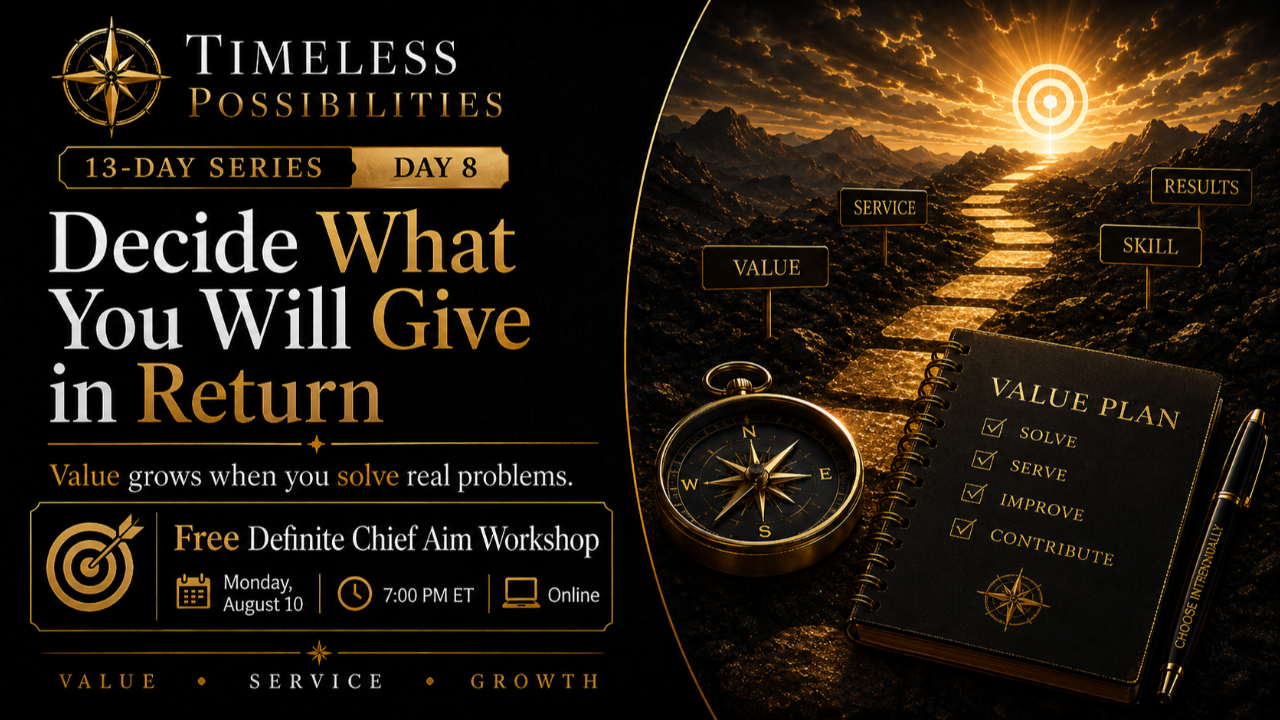
Decide What You Will Give in Return
Aug 04, 2026In the last post, we talked about creating a goal you can genuinely believe in. A meaningful goal should stretch you, but it should also feel connected enough to reality that you are willing to act on it. Today, I want to take that idea one step further, because belief alone is not enough. At some point, you have to ask an equally important question: What are you willing to give in return for the result you want?
This is one of the most practical ideas in Napoleon Hill’s approach to a Definite Chief Aim, yet it is also one of the easiest to overlook. Many people are very clear about what they would like to receive. They want more income, greater freedom, a stronger business, more opportunity, or a different financial future. But they spend far less time thinking about the value, effort, service, discipline, or personal growth that will be required to create that result.
A Definite Chief Aim is not simply a statement about what you want from life. It is also a decision about what you are prepared to contribute.
Achievement Is an Exchange
If you want to create additional income, the money has to come from somewhere. In most cases, it will come because you helped someone solve a problem, save time, improve a result, gain knowledge, reduce frustration, or receive something they valued enough to pay for. That means the goal cannot be only about the amount of money you want to earn. It also has to include some thought about the value you intend to create.
This is where the idea of exchange becomes important. Instead of asking only, “How much money do I want?” you begin asking, “What can I become better at providing?” That change in perspective moves you away from simply wanting more and toward becoming more useful.
For someone building a side income, this may mean turning an existing skill into a service. For someone growing a business, it may mean improving the quality of an offer, becoming better at communication, or understanding customers more deeply. For someone pursuing a personal goal, the exchange may involve time, disciplined effort, learning, or the willingness to practise something that initially feels uncomfortable.
The specific exchange will be different for everyone, but the principle is the same. Results usually require contribution.
Wanting the Result Is the Easy Part
It is easy to want the outcome. The harder question is whether you are willing to accept the work attached to it.
Someone may say they want to build a business, but are they willing to speak with potential customers before they feel completely confident? Someone may want greater financial freedom, but are they willing to pay closer attention to how they use money today? Someone may want to become more successful, but are they willing to develop the habits and skills that success will require?
This is not meant to make your goal feel heavy. It is meant to make it real.
When you decide what you are willing to give, the goal begins to move out of the world of wishful thinking and into the world of responsibility. You stop seeing the result as something that should somehow arrive and begin seeing yourself as an active participant in creating it.
That shift can be powerful because responsibility gives you something you can control.
Focus on Value, Not Just Effort
There is another important distinction to make. Giving more in return does not always mean working longer hours or exhausting yourself. More effort is not automatically more valuable.
The better question is whether your effort is creating something useful.
You could spend ten hours working on a service that nobody wants and still create very little value. On the other hand, you might spend one focused hour helping someone solve an urgent problem and create a result they consider extremely valuable.
This is particularly important when your Definite Chief Aim involves income. Money tends to follow value more reliably than it follows busyness.
Instead of asking how much more work you can fit into your life, consider what you can do that becomes more useful to other people. Perhaps you can solve a problem faster, communicate an idea more clearly, provide better service, reduce uncertainty, or make someone’s next step easier.
The goal is not simply to work harder. It is to become more intentional about what your work produces.
Your Existing Experience May Already Be Valuable
Many people underestimate what they already know because their skills feel ordinary to them.
If you have done something for years, you may assume that everyone knows what you know. You may overlook professional experience, practical knowledge, organizational ability, technical skills, communication skills, or lessons you learned through solving your own problems.
Yet something that feels simple to you may be extremely valuable to someone who does not know how to do it.
This becomes especially important when you are trying to create additional income. You may not need to invent an entirely new version of yourself. You may need to look more carefully at what you already know and ask how it could help someone else.
Think about the problems people regularly ask you about. Consider the tasks that seem easy to you but difficult to others. Look at what you have learned through your work, your interests, or your own experiences.
Your first form of value may be closer than you think.
The Goal May Require You to Grow
Sometimes the value you need to provide does not exist yet.
You may need to develop a new skill, become better at presenting your ideas, improve your ability to sell, learn how to manage your time, or become more consistent with follow-up. That does not mean you chose the wrong goal. It may simply mean the goal is asking you to grow.
This is one of the most valuable aspects of a meaningful Definite Chief Aim. It gives you a reason to develop abilities that you might otherwise never strengthen.
A person who wants to create income from a service may need to become more confident speaking with people. Someone who wants to build an online business may need to become more comfortable writing, teaching, or communicating an offer. Someone pursuing a larger leadership goal may need to become more disciplined, patient, or decisive.
In that sense, what you give in return is not only the service you provide to others. It also includes the effort you are willing to invest in becoming more capable.
Contribution Gives the Goal More Meaning
There is something else that happens when you think in terms of contribution. The goal becomes less self-centered and often more motivating.
Instead of thinking only about how much you want to earn, you begin thinking about who you can help. Instead of focusing entirely on what success will give you, you begin considering what your success will allow you to provide.
That can create a much stronger emotional connection to the goal.
If earning more income means helping your family, creating greater financial stability, supporting causes you care about, or having more freedom to do meaningful work, the goal begins to represent something larger than a number.
At the same time, knowing that your income is connected to solving real problems can make the process more rewarding. You are not simply trying to get something. You are trying to create something valuable enough that people willingly exchange money, time, attention, or opportunity for it.
That is a healthier foundation for growth.
Make the Exchange Specific
Take a look at your own goal and ask yourself what you are prepared to give in return.
If your goal is financial, avoid vague answers such as “I will work hard.” Try to define the kind of value you intend to provide. Perhaps you will offer a service, teach a skill, solve a specific problem, create a useful product, or become more dependable in the work you already do.
Then think about the personal exchange that may be required as well. You may need to invest time each week, practise a skill, initiate more conversations, follow up consistently, or reduce distractions that have been consuming your attention.
The clearer you become about this part of the goal, the easier it becomes to build a realistic plan around it.
You begin to see that your Definite Chief Aim is not simply a demand you are making of the future. It is an agreement you are making with yourself about how you will participate in creating that future.
Do Not Promise What You Are Unwilling to Give
There is also value in being honest about what you are not willing to exchange.
You may discover that a particular goal would require a lifestyle you do not actually want. You may realize that the hours, risk, or type of work required do not fit your priorities. That information matters.
A goal should challenge you, but it should still be aligned with the life you are trying to build.
This is another reason the “what will I give in return?” question is so valuable. It helps you evaluate whether you genuinely want the goal or simply like the idea of the result.
If you are unwilling to accept any of the responsibility associated with achieving it, the goal may need to be reconsidered, adjusted, or approached differently.
Honesty at this stage can save a great deal of frustration later.
Your Definite Chief Aim Becomes More Complete
When you combine a clear goal with a definite timeframe and a clear understanding of what you are willing to contribute, something important happens. The goal becomes more grounded.
You are no longer simply saying, “This is what I want.” You are saying, “This is what I intend to create, and this is how I am willing to participate in creating it.”
That is a much stronger position.
It gives you more useful questions to ask each day. Are you creating the value you said you would create? Are you developing the skills the goal requires? Are you following through on the actions that support the exchange?
Those questions bring the Definite Chief Aim into your daily life, where results are actually produced.
Join the Free Definite Chief Aim Workshop
On Monday, August 10, at 7:00 p.m. Eastern Time, I will be hosting a free online Definite Chief Aim Workshop where we will work through these ideas together. We will focus on clarifying what you really want, making the goal specific, choosing a definite date, and identifying what you are willing to give in return for the result you intend to create.
We will also connect those decisions to a practical starting plan so that your goal does not remain something you simply think about. The purpose is for you to leave with a written Definite Chief Aim that reflects both the result you want and the contribution you are prepared to make.
If you have been thinking seriously about creating a different financial future, starting a business, developing another source of income, or simply becoming more intentional about where your life is going, this workshop can help you put those ideas into a clearer structure. The workshop is completely free, it will be held online, and we will meet on Monday, August 10 at 7:00 p.m. Eastern Time.

Your goal tells you what you want to receive, but your commitment becomes much stronger when you also decide what you are willing to contribute. When those two sides come together, a Definite Chief Aim begins to feel less like a wish and much more like a plan you are prepared to participate in creating.
What If You Could Start Creating More Financial Momentum in Just 7 Days?
Reading about financial success can give you ideas. Taking action is what begins to create change.
That's why I created the FREE Money Momentum Starter Guide Workbook—a practical starting point for anyone who wants to make greater financial progress by managing their money more intentionally, exploring opportunities to create additional income, and developing habits that keep them moving forward.
Inside the FREE Starter Guide, you'll discover:
- Where you are financially today and where you'd like to make progress
- Opportunities to take greater control of the money already flowing through your life
- Skills, knowledge, and experience you may be able to turn into additional income
- Practical actions you can begin taking right away
- How to create your own 7-Day Money Momentum Action Plan
You don't need to have everything figured out. You don't need a perfect financial plan or a great business idea. You simply need a starting point and a willingness to take the next step.
Want Some Help Working Through It?
You can complete the Money Momentum Starter Guide entirely on your own for free, or for a one-time $5 upgrade, get 30 days of access to your own Money Momentum AI Assistant to help you work through the workbook.
Your AI Assistant can help you think through questions, explore possibilities when you're unsure what to write, dig deeper into your answers, and turn what you discover into practical next steps and your personalized 7-Day Money Momentum Action Plan.
Start Building Your Money Momentum Today. Download your FREE Money Momentum Starter Guide Workbook and take your first step toward greater financial progress.
