
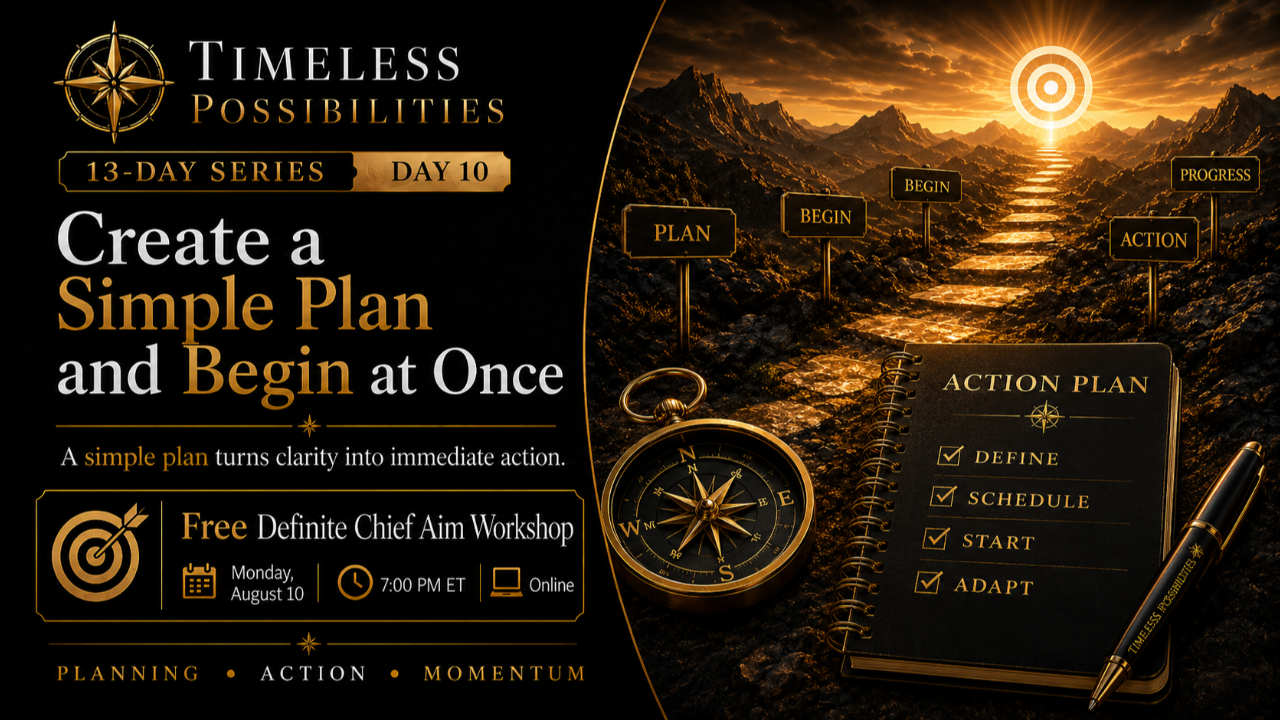
Create a Simple Plan and Begin at Once
Aug 06, 2026In the last post, we talked about the importance of putting a definite date on your goal. A date gives your goal a boundary, creates a stronger sense of urgency, and helps you work backward from the result you want. Today, I want to focus on what happens after that date is chosen, because a goal with a deadline still needs a path forward. That path does not have to be complicated, but it does need to begin.
This is where many people get stuck. They believe they need a complete plan before they can move. They wait until every step is clear, every question is answered, and every possible obstacle has been considered. In reality, most meaningful plans are refined through action, not before it.
The goal is not to create a perfect roadmap. The goal is to create enough direction to take the next useful step.
A Plan Should Reduce Confusion, Not Create More of It
A good plan should make action easier. If your plan is so complicated that you keep reorganizing it instead of using it, then the plan may be working against you.
This is especially common when someone is trying to create a new source of income or start something unfamiliar. They may spend weeks deciding on branding, researching platforms, comparing software, designing websites, and studying strategies before they have ever spoken with a potential customer. All of that activity can feel productive, but it may have very little connection to the first result they actually need.
A simpler plan asks a more practical question: what needs to happen first?
If you want to earn your first $1,000 in side income, the first step may not be building a perfect online presence. It may be deciding what problem you can solve and having conversations with people who might need that solution. Once you receive real feedback, the rest of the plan becomes easier to improve.
Start With the Result and Work Backward
One of the easiest ways to create a practical plan is to begin with the result you have already defined and work backward. If your Definite Chief Aim has a clear amount, outcome, and date, you can begin asking what would need to be true shortly before that result is achieved.
Suppose your goal is to create an additional $1,000 per month. Before that can happen consistently, you will probably need paying customers. Before you have customers, you may need an offer. Before you have a strong offer, you may need to understand a problem someone is willing to pay you to solve.
Working backward helps you identify sequence.
Instead of trying to solve everything at once, you begin to see what deserves attention now and what can wait until later. That reduces overwhelm and makes the goal feel more manageable.
You Do Not Need the Entire Road Before You Start Walking
One of the biggest mistakes people make is assuming that uncertainty means they are not ready.
Most worthwhile goals include uncertainty.
You may not know exactly which offer will work best, which audience will respond, or how long a particular step will take. You may have to adjust your pricing, change your message, improve your service, or choose a different approach as you learn.
That is normal.
A plan is not a promise that everything will happen exactly as expected. It is a starting structure that helps you move.
Think about driving to a destination you have never visited before. You may know the general route, but traffic, construction, or a wrong turn can force you to adjust along the way. The existence of those unknowns does not mean you stay parked.
You start the journey and make corrections as needed.
Your Definite Chief Aim works the same way.
Action Gives You Information Planning Cannot
There is a point where more thinking stops helping.
You can imagine how people might respond to an offer, but a real conversation will teach you more. You can guess what customers value, but feedback will give you better information. You can spend hours deciding whether an idea will work, but a small test may answer the question much faster.
Action creates data.
That data helps you improve the plan.
This is why beginning is so important. Until you act, many of your assumptions remain untested. You may be worrying about problems that never happen while overlooking opportunities that only become visible once you are moving.
A simple plan gives you permission to learn through experience.
Begin Before You Feel Completely Ready
There is a reason “begin at once” is such an important idea when building a Definite Chief Aim. If you wait for complete readiness, the starting line can keep moving.
You tell yourself you will begin after you learn a little more, after your schedule becomes less busy, after you feel more confident, or after you figure out the perfect strategy. Each delay can sound reasonable on its own, but together they can keep a meaningful goal in the planning stage for months or even years.
Beginning does not mean acting recklessly.
It means taking the smallest responsible action that gives you useful information or moves the goal forward.
That might mean writing the first draft of your offer, contacting one person, setting up a simple conversation, reviewing your numbers, or blocking time in your calendar to complete the next important task.
Small does not mean insignificant.
A small action completed today can be more valuable than a perfect plan you never use.
Make the First Step Specific
A vague plan often produces the same problem as a vague goal.
If your next action is “work on my business,” you still have to decide what that means when the time arrives. That extra decision can make procrastination easier.
A better next step is something you can recognize as finished.
For example, you might decide to contact three potential customers, write a one-paragraph description of your service, review your spending for the past month, or schedule two conversations with people who understand the market you want to enter.
The action should be simple enough to begin and specific enough to complete.
When you finish it, you create momentum and information. You can then decide what the next step should be based on what you learned.
That is how a simple plan grows into a stronger one.
Do Not Confuse Planning With Progress
Planning is valuable, but it can become a comfortable substitute for action.
You may feel productive because you are thinking about the goal, organizing ideas, or improving your strategy. Yet if the plan never reaches the point where you test it in the real world, you may be standing still while feeling busy.
This can happen because action introduces uncertainty. Once you make an offer, someone can say no. Once you share your idea, someone can criticize it. Once you begin, you can discover that part of the plan needs improvement.
Planning feels safer because the goal can remain perfect in your imagination.
But progress requires contact with reality.
The purpose of your plan is not to protect you from feedback. It is to help you create enough structure to receive feedback and use it.
Adjust the Plan Without Abandoning the Goal
A good plan is flexible.
If you discover that something is not working, you do not necessarily need to abandon your Definite Chief Aim. You may simply need to change the route.
Perhaps your original offer does not connect with people, but the conversations reveal a different problem they care about more. Maybe the price is wrong, the message is unclear, or the audience is not a good fit. Those discoveries are not proof that the goal was a mistake.
They are information.
This is why action and adaptation belong together. You begin with the best plan you have, observe what happens, and then improve it.
The destination can remain steady while the route evolves.
Give Your Plan a Place in Your Calendar
A plan becomes more real when it has time attached to it.
If you know your next action but never decide when you will complete it, the task can continue getting pushed aside by more urgent responsibilities. Putting the action into your calendar creates a stronger bridge between intention and behaviour.
This does not require hours every day.
Depending on the goal, you may begin with thirty focused minutes, a single conversation, or one meaningful task. The important thing is consistency.
When your plan receives scheduled attention, your goal stops depending entirely on leftover time.
That is an important shift.
You are no longer hoping the work gets done. You are creating space for it to happen.
Decide What You Can Begin Today
Take your current goal and look at the plan you have around it.
If the plan feels complicated, simplify it.
Ask yourself what the next useful action is, not the next twenty actions. Choose something that gives you progress, information, or both. Then decide when you will complete it.
Do not wait until everything feels certain.
You can improve the plan after you begin.
The first step does not need to be impressive. It needs to be real.
Join the Free Definite Chief Aim Workshop
On Monday, August 10, at 7:00 p.m. Eastern Time, I will be hosting a free online Definite Chief Aim Workshop where we will work through how to turn a meaningful desire into a clear written direction.
We will focus on defining what you want, making the goal specific, deciding what you are willing to give in return, choosing a definite date, and building a simple plan you can begin using right away. The purpose is not to create a complicated strategy that looks good on paper. The purpose is to help you leave with enough clarity to know what your next action should be.
If you have been thinking about a goal but keep waiting until you feel completely ready, this workshop can help you move from planning into purposeful action. The workshop is completely free, it will be held online, and we will meet on Monday, August 10 at 7:00 p.m. Eastern Time.

A simple plan does not need to answer every question. It only needs to help you take the next meaningful step, because once you begin, action will give you information that planning alone never can.
What If You Could Start Creating More Financial Momentum in Just 7 Days?
Reading about financial success can give you ideas. Taking action is what begins to create change.
That's why I created the FREE Money Momentum Starter Guide Workbook—a practical starting point for anyone who wants to make greater financial progress by managing their money more intentionally, exploring opportunities to create additional income, and developing habits that keep them moving forward.
Inside the FREE Starter Guide, you'll discover:
- Where you are financially today and where you'd like to make progress
- Opportunities to take greater control of the money already flowing through your life
- Skills, knowledge, and experience you may be able to turn into additional income
- Practical actions you can begin taking right away
- How to create your own 7-Day Money Momentum Action Plan
You don't need to have everything figured out. You don't need a perfect financial plan or a great business idea. You simply need a starting point and a willingness to take the next step.
Want Some Help Working Through It?
You can complete the Money Momentum Starter Guide entirely on your own for free, or for a one-time $5 upgrade, get 30 days of access to your own Money Momentum AI Assistant to help you work through the workbook.
Your AI Assistant can help you think through questions, explore possibilities when you're unsure what to write, dig deeper into your answers, and turn what you discover into practical next steps and your personalized 7-Day Money Momentum Action Plan.
Start Building Your Money Momentum Today. Download your FREE Money Momentum Starter Guide Workbook and take your first step toward greater financial progress.
