
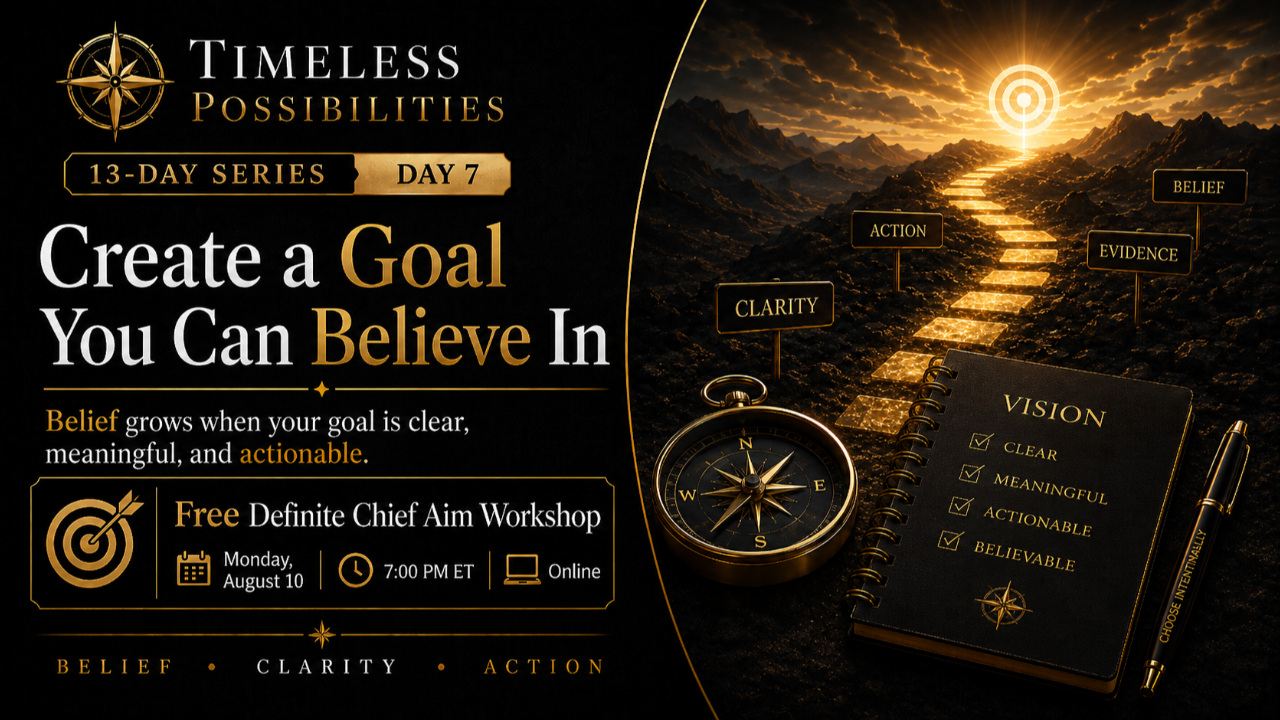
Create a Goal You Can Believe In
Aug 03, 2026Over the past several days, we have been building toward a clearer and more intentional way of thinking about goals. We started by talking about the danger of drifting, then moved into clarity, specific goals, purposeful daily action, better decisions, and commitment. Today, I want to focus on something that sits underneath all of those ideas and often determines whether a goal ever becomes more than words on a page: belief.
A goal can be specific, measurable, and well written, yet still fail to move you if you do not genuinely believe that it is possible for you. That does not mean your goal should be easy or comfortable. A worthwhile goal should stretch you beyond your current habits and require you to grow, but it should also feel connected enough to reality that you are willing to take meaningful action toward it.
Finding that balance matters because a goal that feels too small may not inspire much growth, while a goal that feels completely disconnected from your current experience may be difficult to take seriously. The goal should challenge you while still allowing you to imagine yourself becoming the person capable of achieving it.
Belief Changes the Way You Act
Think about how differently you behave when you truly believe something is possible. You are more willing to start before you have every answer, more willing to learn from mistakes, and more likely to continue when progress is slower than expected. You may still experience uncertainty, but uncertainty does not automatically stop you because you believe there is a worthwhile reason to keep moving.
Now consider what happens when you quietly believe a goal is impossible. You may still talk about it, write it down, or tell yourself that you are working toward it, but your behaviour often reveals the doubt underneath. You delay important actions, spend too much time preparing, avoid uncomfortable conversations, or find reasons to change direction before you have given the plan a real chance.
This is why belief matters so much. What you believe about your goal influences what you are willing to do for it, and your actions ultimately determine whether the goal has an opportunity to become real.
A Believable Goal Can Still Be Ambitious
Creating a goal you can believe in does not mean lowering your expectations until the goal feels safe. It means choosing a result that stretches your thinking without becoming so disconnected from your current situation that you cannot see any reasonable path forward.
Imagine someone who has never earned income from a side business deciding that they will make one million dollars next month. There is nothing wrong with thinking big, but without an offer, customers, experience, or a plan, the number may feel more like fantasy than direction. Because they cannot connect the goal to anything they can realistically do today, the goal may actually create less action rather than more.
Now imagine that same person chooses a goal of earning their first additional $1,000 within a realistic timeframe by solving a problem for a specific group of people. That goal can still require courage, discipline, new skills, conversations, and repeated effort, but there is a clearer relationship between the desired result and the actions available today. As progress begins, the person can expand the goal from a stronger foundation.
A believable goal is not necessarily a small goal. It is a goal that gives you enough confidence to begin.
Action Can Strengthen Belief
One of the most useful things to understand about belief is that you do not always need to have complete confidence before you act. Sometimes we assume that we must first believe strongly and then take action, but the relationship can work in the opposite direction as well. Taking action can create evidence, and that evidence can strengthen belief.
Suppose your goal is to create an additional source of income, but you are unsure whether anyone would pay for what you can offer. You may begin by speaking with someone about a problem they need solved. That conversation leads to a second conversation, and eventually you make a simple offer and someone responds positively. Even if the first result is small, you now have evidence that what once felt uncertain may actually be possible.
This is one reason small wins matter so much. A completed action, a positive response, a first customer, or a kept commitment gives you something more reliable than motivation. It gives you proof that you are capable of moving forward, and each piece of evidence can make the next action easier to believe in.
Do Not Build Your Goal Around Someone Else’s Life
Sometimes the problem is not that the goal is too large. The problem is that it was never really your goal in the first place. It is easy to borrow goals from people we admire, especially when we are constantly exposed to someone else’s business results, lifestyle, income, or definition of success.
You may decide that you should want a certain level of income because someone online says that is what success looks like. You may pursue a business model because it worked for someone else, even though it does not fit your interests, abilities, or values. Over time, it becomes difficult to stay committed because the goal never had enough personal meaning to begin with.
A Definite Chief Aim should matter to you for reasons that go beyond appearances. Perhaps you want additional income because it would reduce financial pressure, give you greater choice, allow you to help your family, or provide the freedom to spend more time on meaningful work. When the reason behind the goal is personal, belief becomes easier to develop because you understand why the effort matters.
Your Past Is Information, Not a Prediction
Another obstacle to belief is allowing previous failures to determine what you think is possible now. If you have attempted something before and it did not work, it is natural to feel cautious. The danger comes when you turn one unsuccessful attempt into a permanent conclusion about your ability.
Maybe the earlier plan was incomplete, the timing was wrong, or the offer was not strong enough. Perhaps you did not take enough action, stopped too early, or tried to solve a problem people were not willing to pay to solve. Those are valuable lessons, but none of them automatically mean that you are incapable of creating a different result.
Your past can provide information without becoming your identity. Instead of asking, “Why didn’t I succeed before?” in a way that reinforces disappointment, ask what the experience taught you and how you can use that information to make a better decision now. Growth comes from carrying the lesson forward without carrying the limitation with it.
Connect the Goal to the Person You Are Becoming
A Definite Chief Aim is not only about achieving an external result. It also asks you to consider who you will need to become in order to create that result. This is one of the reasons a meaningful goal can have such a powerful effect on personal growth.
If your goal requires you to become more disciplined, then every time you follow through you are strengthening that quality. If it requires greater confidence, each conversation you are willing to start gives you an opportunity to practise it. If it requires you to become more consistent, then every promise you keep to yourself becomes evidence that your identity is changing.
This can make an ambitious goal easier to believe in because you stop viewing the result as something your current self must somehow produce instantly. Instead, you recognize that you are growing into the person capable of producing it. The question changes from “Am I already capable of this?” to “Am I willing to become capable of this?”
Give Yourself a Reason to Believe
Take a moment to look at the goal you are currently pursuing and consider how you actually feel about it. Does the goal have personal meaning, or are you pursuing it because you think you are supposed to? Does it stretch you while still allowing you to see actions you can take, or does it feel so distant that you continually avoid beginning?
If belief is weak, you may not need to abandon the goal. You may need to make it clearer, strengthen the reason behind it, adjust the timeframe, or identify smaller milestones that can provide evidence of progress. Sometimes the goal becomes much more believable when you can see the first few steps instead of staring only at the final destination.
Most importantly, give yourself permission to begin before your belief is perfect. You do not need complete confidence to take one meaningful step. That step may become the evidence that helps you believe enough to take the next one.
Create Your Definite Chief Aim With Me
On Monday, August 10, at 7:00 p.m. Eastern Time, I will be hosting a free online Definite Chief Aim Workshop designed to help you move from a general desire toward a goal that is clear, meaningful, and actionable. We will work through what you really want, why it matters, how to make the result specific, and how to choose a definite timeframe that gives your goal direction.
We will also explore what you are willing to give in return for the result you want and how to turn your aim into a practical starting plan. The goal is not for you to leave with an impressive statement that gets placed in a drawer. I want you to leave with a Definite Chief Aim that feels meaningful enough to inspire you, believable enough to act on, and clear enough to guide your decisions after the workshop is over.
If you have a goal that has been sitting in the back of your mind, or if you know you want something different but have struggled to define exactly what that should look like, I invite you to join us. The workshop is completely free, it will be held online, and we will meet on Monday, August 10 at 7:00 p.m. Eastern Time.

You do not have to know exactly how everything will happen before you choose your destination. Start with a goal that matters enough to stretch you, then begin creating the evidence that allows your belief to grow along with your actions.
What If You Could Start Creating More Financial Momentum in Just 7 Days?
Reading about financial success can give you ideas. Taking action is what begins to create change.
That's why I created the FREE Money Momentum Starter Guide Workbook—a practical starting point for anyone who wants to make greater financial progress by managing their money more intentionally, exploring opportunities to create additional income, and developing habits that keep them moving forward.
Inside the FREE Starter Guide, you'll discover:
- Where you are financially today and where you'd like to make progress
- Opportunities to take greater control of the money already flowing through your life
- Skills, knowledge, and experience you may be able to turn into additional income
- Practical actions you can begin taking right away
- How to create your own 7-Day Money Momentum Action Plan
You don't need to have everything figured out. You don't need a perfect financial plan or a great business idea. You simply need a starting point and a willingness to take the next step.
Want Some Help Working Through It?
You can complete the Money Momentum Starter Guide entirely on your own for free, or for a one-time $5 upgrade, get 30 days of access to your own Money Momentum AI Assistant to help you work through the workbook.
Your AI Assistant can help you think through questions, explore possibilities when you're unsure what to write, dig deeper into your answers, and turn what you discover into practical next steps and your personalized 7-Day Money Momentum Action Plan.
Start Building Your Money Momentum Today. Download your FREE Money Momentum Starter Guide Workbook and take your first step toward greater financial progress.
