
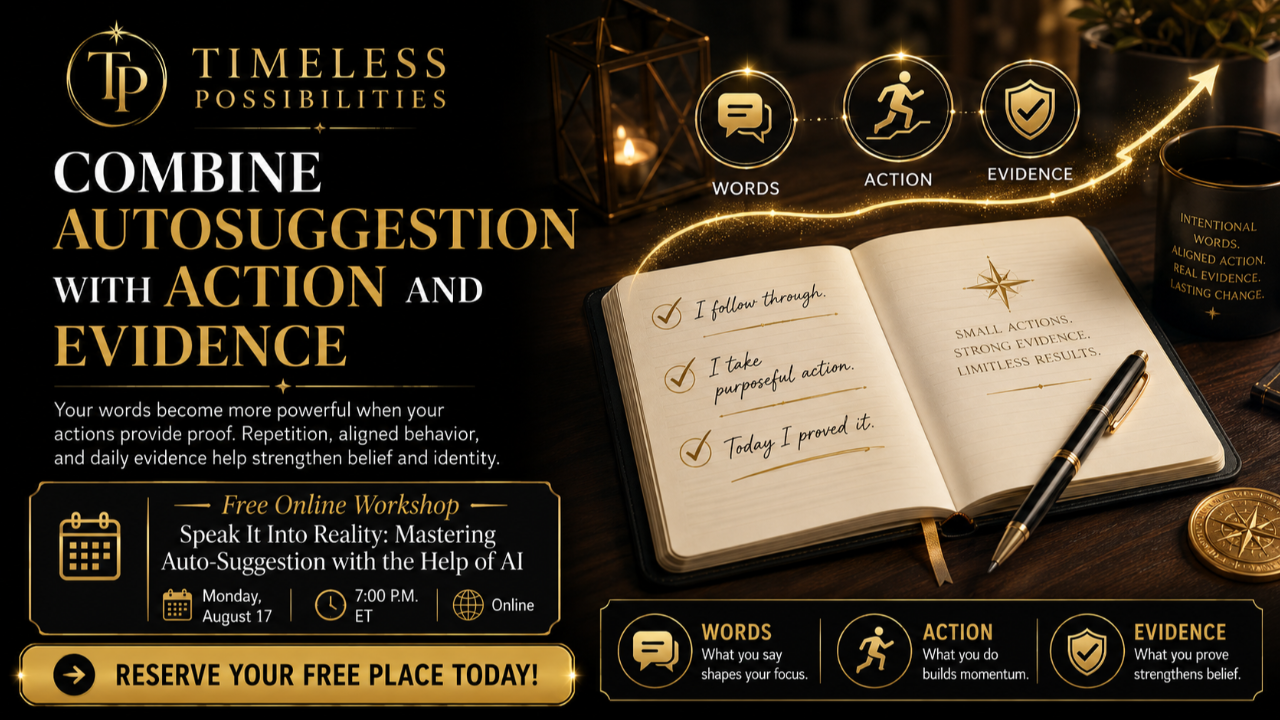
Combine Autosuggestion With Action and Evidence
Aug 16, 2026What if the missing piece is not another better statement, but stronger evidence that the statement is becoming true?
Autosuggestion can help direct your thoughts, strengthen your focus, and reinforce the identity you are building. But if the words you repeat are never connected to behaviour, they can remain little more than hopeful language. The real power begins when your actions start providing evidence that supports the message you are intentionally repeating.
That is where autosuggestion becomes practical. You are not simply telling yourself who you want to become. You are giving yourself proof, one action at a time, that you are becoming that person.
Words Need Something to Attach To
Suppose you repeat, “I am becoming more disciplined and consistent.” That can be a useful autosuggestion, but it becomes much stronger when you complete the action you said you would complete, even on a day when motivation is low.
Now the statement has evidence behind it.
The same thing happens with confidence. You may repeat, “I am becoming more confident in sharing my ideas,” but confidence grows faster when you actually speak up, make the call, send the message, or have the conversation you might previously have avoided.
Each action gives the words more weight.
Instead of trying to force yourself to believe something with repetition alone, you begin collecting proof that the new identity is taking shape.
Action Makes the Message More Believable
One reason people struggle with affirmations is that the words can feel too far removed from reality. If the statement says one thing but daily behaviour says another, the internal conflict can make the autosuggestion harder to accept.
Action helps close that gap.
Imagine someone who wants to become more confident in business. Rather than repeating only, “I am confident,” they might use a statement such as, “I am becoming more confident every time I take purposeful action.”
That language leaves room for growth and gives the person something to prove.
Every completed action becomes evidence. A conversation becomes evidence. A follow-up becomes evidence. An offer becomes evidence.
Over time, the belief begins to feel more natural because it is being supported by experience.
Evidence Changes Identity
In the previous post, we talked about speaking to the person you are becoming. This is where that identity starts becoming real.
Identity is not built only through the words you repeat. It is strengthened by the patterns you can point to.
If you say, “I am someone who follows through,” and then repeatedly complete what you committed to, the identity becomes more credible. If you say, “I am someone who creates value,” and you consistently solve useful problems for other people, the statement becomes grounded in evidence.
That matters because your mind tends to trust what it can see happening repeatedly.
The more aligned your actions become with your autosuggestion, the less the new identity feels like something you are trying to become and the more it begins to feel like who you are.
Small Evidence Counts
People sometimes overlook small actions because they are waiting for dramatic proof.
They think the evidence only counts when they reach the big goal, earn the full amount, or produce a major result. But identity is usually built long before the final outcome appears.
If your goal is to create side income, evidence might begin with making your first offer, having a useful conversation, receiving feedback, or following up when you normally would have avoided it. If your goal is greater discipline, the evidence may be as simple as completing one important task you had scheduled.
Those small moments matter because they reinforce the direction.
They tell you, “I am doing what this version of me would do.”
That is how belief grows.
Let Your Autosuggestion Point Toward Behaviour
A useful autosuggestion should make it easier to recognize the action that supports it.
If the statement is too vague, it may sound encouraging without helping you decide what to do next. A stronger statement connects identity and behaviour.
Instead of saying, “I am successful,” you might say, “I create value and take consistent action toward my goals.” Instead of saying, “I am disciplined,” you might say, “I strengthen my discipline by following through on the commitments I make.”
Now the statement has a practical standard.
At the end of the day, you can ask whether your behaviour supported the message. If it did, you have evidence. If it did not, you have information about where the next action needs to happen.
Do Not Use Autosuggestion to Avoid Reality
There is an important distinction here.
Autosuggestion should help you engage with reality more effectively, not avoid it.
If an offer is not working, repeating that everything is perfect will not improve the offer. If your plan is producing no results, autosuggestion should not become a substitute for honest review and adjustment.
The better approach is to use your inner dialogue to support constructive action.
You might remind yourself, “I learn from feedback and improve quickly,” then look honestly at what needs to change. That keeps the autosuggestion grounded while still reinforcing a useful identity.
The goal is not denial.
The goal is resilience, clarity, and purposeful response.
Keep a Record of Your Evidence
One simple way to strengthen this process is to keep track of the actions that support the identity you are building.
At the end of the day, ask yourself where you acted in alignment with your autosuggestion. Maybe you followed through, made a difficult decision, completed something uncomfortable, or chose a better response than you would have in the past.
Write it down.
This creates a growing record of evidence.
On days when doubt returns, you are no longer relying only on motivation. You can look back and see proof that change is already happening.
That can make your autosuggestion far more believable.
Action and Autosuggestion Should Reinforce Each Other
Think of autosuggestion and action as two parts of the same process.
The statement gives your mind a direction. The action gives the statement credibility. The evidence strengthens the belief, and the stronger belief makes it easier to take the next action.
That cycle can become powerful over time.
You are no longer simply trying to “think positively.” You are creating a feedback loop between your thoughts, your behaviour, and your identity.
This is where autosuggestion becomes much more than words.
Choose One Statement and One Action
Take one autosuggestion you are currently using and ask yourself what action would provide evidence for it today.
If the statement says you are becoming more disciplined, what would discipline look like before the day ends? If the statement says you are becoming more confident, what action would confidence take? If the statement says you create value, what useful problem could you help solve?
Choose one action.
Then complete it.
The goal is not to create perfect evidence every day. The goal is to keep building enough proof that the new message becomes increasingly believable.
Join the Free Mastering Auto-Suggestion Workshop
On Monday, August 17, at 7:00 p.m. Eastern Time, I will be hosting the free online workshop Speak It Into Reality: Mastering Auto-Suggestion with the Help of AI.
During the workshop, we will explore how to create autosuggestions that are not only meaningful to repeat but practical enough to connect with action. We will look at how your words, identity, and daily behaviour can work together so that the statements you use are reinforced by real evidence.
We will also use AI to help refine your autosuggestions so they feel personal, believable, and aligned with the actions your goals actually require. The purpose is not to create empty affirmations. It is to create language that helps you think more intentionally, act more consistently, and recognize the evidence that you are becoming the person you intend to be.
The workshop is completely free, it will be held online, and we will meet on Monday, August 17 at 7:00 p.m. Eastern Time.

Autosuggestion becomes far more powerful when your words and your actions tell the same story. Repeat the message, act in alignment with it, and collect the evidence that proves the new identity is becoming real.
What If You Could Start Creating More Financial Momentum in Just 7 Days?
Reading about financial success can give you ideas. Taking action is what begins to create change.
That's why I created the FREE Money Momentum Starter Guide Workbook—a practical starting point for anyone who wants to make greater financial progress by managing their money more intentionally, exploring opportunities to create additional income, and developing habits that keep them moving forward.
Inside the FREE Starter Guide, you'll discover:
- Where you are financially today and where you'd like to make progress
- Opportunities to take greater control of the money already flowing through your life
- Skills, knowledge, and experience you may be able to turn into additional income
- Practical actions you can begin taking right away
- How to create your own 7-Day Money Momentum Action Plan
You don't need to have everything figured out. You don't need a perfect financial plan or a great business idea. You simply need a starting point and a willingness to take the next step.
Want Some Help Working Through It?
You can complete the Money Momentum Starter Guide entirely on your own for free, or for a one-time $5 upgrade, get 30 days of access to your own Money Momentum AI Assistant to help you work through the workbook.
Your AI Assistant can help you think through questions, explore possibilities when you're unsure what to write, dig deeper into your answers, and turn what you discover into practical next steps and your personalized 7-Day Money Momentum Action Plan.
Start Building Your Money Momentum Today. Download your FREE Money Momentum Starter Guide Workbook and take your first step toward greater financial progress.
