
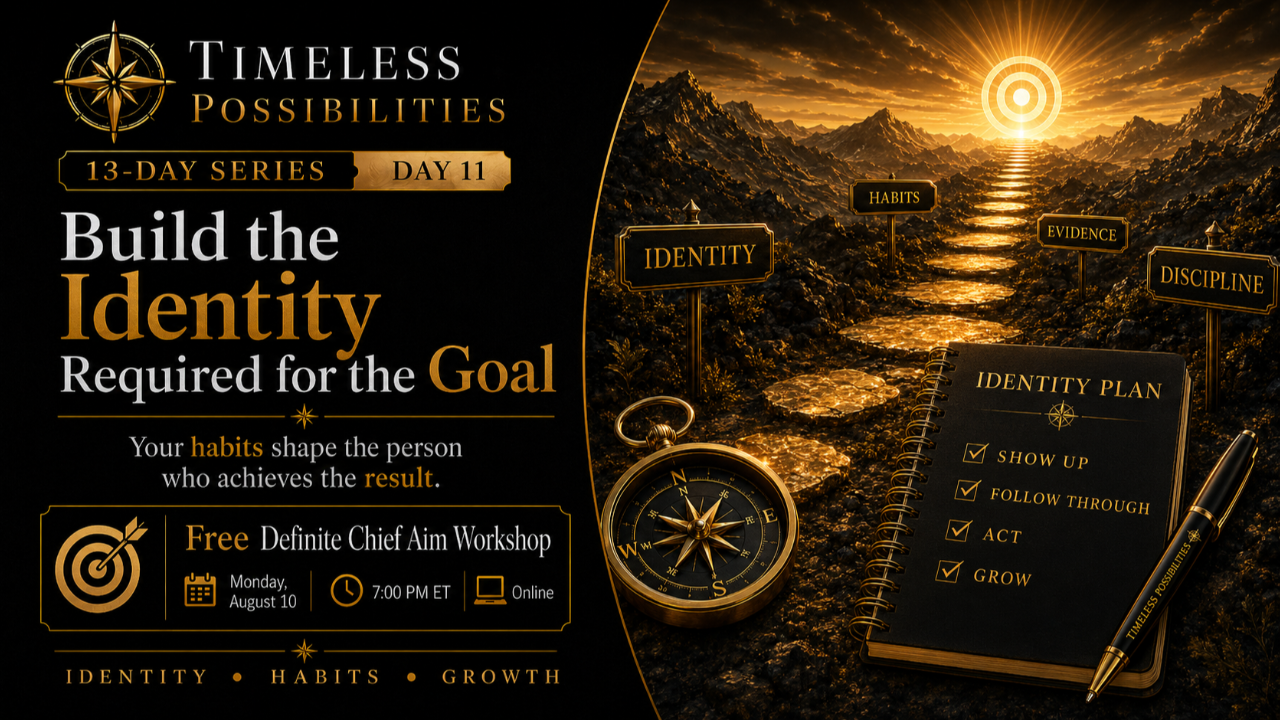
Build the Identity Required for the Goal
Aug 07, 2026In the last post, we talked about creating a simple plan and beginning at once. A clear plan helps you move, and action gives you the feedback you need to improve that plan as you go. Today, I want to take the conversation deeper, because every meaningful goal eventually asks something more personal of you. It asks you to become the kind of person who can consistently produce the result you say you want.
This is where goal setting becomes more than a matter of schedules, strategies, and deadlines. At some point, the question is no longer only, “What do I need to do?” It becomes, “Who do I need to become in order to keep doing what this goal requires?”
That shift matters because many goals are not lost through lack of information. They are lost because our current habits, beliefs, and identity are not yet strong enough to support the result we are trying to create.
Your Goal Will Ask You to Grow
A meaningful goal should require something from you that your current routine does not. If the goal can be achieved without changing anything about how you think, decide, communicate, or follow through, then it may not be asking you to grow very much.
Suppose your Definite Chief Aim involves creating an additional source of income. At first, it may appear that the challenge is simply finding an idea or creating an offer. But as you begin taking action, you may discover that the real challenge is becoming more comfortable speaking with people, following up consistently, asking for the sale, managing your time, or continuing after receiving a disappointing response.
The goal begins revealing the person you need to become.
That is not a problem. In many ways, that is the opportunity.
The external result gives you a reason to develop internal qualities that may benefit you long after the original goal has been achieved.
Identity Shapes What Feels Natural
Think about the way identity influences behaviour.
If you see yourself as someone who always procrastinates, delaying important work can begin to feel normal. If you think of yourself as someone who is uncomfortable talking about money, you may avoid conversations that could create income. If you believe you are someone who starts projects but rarely finishes them, stopping halfway can begin to feel like confirmation of something you already believe about yourself.
Over time, these beliefs can become self-reinforcing.
You behave in a certain way, then use that behaviour as evidence for the identity. The identity then makes the same behaviour easier to repeat.
But that cycle can work in the opposite direction as well.
When you deliberately begin acting like the person your goal requires, your behaviour starts creating new evidence.
Identity Is Built Through Evidence
It is easy to think that you need to change the way you see yourself before your actions can change. Sometimes that happens, but often identity is strengthened through what you repeatedly do.
You may not initially feel like a disciplined person. But every time you complete the action you said you would complete, you create evidence of discipline. You may not feel confident speaking about your offer, but each conversation gives you experience that can strengthen your confidence.
This is why small acts of follow-through matter so much.
They are not only moving the goal forward. They are also teaching you something about yourself.
If you repeatedly keep the promises you make to yourself, you begin to see yourself differently. If you continue acting when motivation is low, you begin to build evidence that you can be consistent. If you recover after setbacks rather than quitting, you begin to identify less with failure and more with resilience.
The identity grows from the evidence.
Do Not Wait to “Feel Like” the New Person
One of the easiest traps to fall into is waiting for your feelings to catch up before you act.
You may tell yourself that you will start speaking more confidently when you feel confident, become more consistent when you feel motivated, or take bigger action when you finally feel ready. The problem is that those feelings may only develop after you have practised the behaviour.
The person you want to become is often built in the period when you do not yet fully feel like that person.
You become more decisive by making decisions. You become more disciplined by acting on commitments. You become more confident by doing difficult things and surviving the discomfort.
This does not mean pretending to be someone you are not. It means giving yourself enough repeated evidence to grow into a stronger version of who you already are.
Your Language Can Reinforce the Old Identity
Pay attention to the way you describe yourself.
People often make identity statements without realizing how powerful they can become. Someone may say, “I am terrible with money,” “I am not good at sales,” “I am not consistent,” or “I always lose motivation.”
Those statements can sound harmless, but they make temporary behaviour sound permanent.
There is a big difference between saying, “I have not been consistent lately,” and saying, “I am an inconsistent person.” One describes a pattern that can change. The other turns the pattern into an identity.
That distinction matters because your Definite Chief Aim may require you to stop treating old behaviour as a fixed description of who you are.
You can acknowledge where you are without deciding that you have to stay there.
Create an Identity That Supports the Goal
A useful exercise is to look at your goal and ask what qualities would make achieving it more likely.
If you want to create additional income, you may need to become more proactive, resourceful, and willing to initiate conversations. If you want to build a business, you may need to become more consistent, more comfortable with feedback, and better at following through.
Instead of trying to change everything at once, choose one quality that matters most right now.
Then connect that quality to behaviour.
If the identity you want to strengthen is “I am someone who follows through,” the evidence might be completing the one important action you scheduled for the day. If the identity is “I am someone who creates value,” the evidence might be solving one real problem for someone instead of spending another hour thinking about what you could do.
Identity becomes practical when it can be seen in action.
The Goal Is Training You
Sometimes a difficult goal can feel as though it is constantly exposing your weaknesses.
You notice where you procrastinate, where you doubt yourself, where you avoid uncomfortable conversations, or where you struggle with consistency. It can be tempting to interpret that as evidence that the goal is not for you.
A more useful interpretation is that the goal is showing you where growth is needed.
If the goal requires more confidence, then the uncomfortable conversations become training. If it requires discipline, then the days when you do not feel motivated become training. If it requires better decision-making, then every choice becomes an opportunity to practise.
The goal is not only producing a future result.
It is training the person who will be capable of sustaining that result.
Be Careful Not to Build an Identity Around the Outcome Alone
There is another side to this conversation that matters.
Your identity should not depend entirely on whether you hit one number or reach one deadline.
If your entire sense of progress depends on achieving the final goal exactly when planned, then a setback can feel like a statement about your worth rather than information about your strategy.
A healthier identity is connected to the qualities you are developing along the way.
You may not have reached the income target yet, but perhaps you have become more consistent. You may not have built the business you want yet, but perhaps you are now willing to make offers, ask for feedback, and adapt instead of avoiding the market.
Those changes are meaningful.
They are evidence that you are becoming more capable, even while the external result is still developing.
Use Your Definite Chief Aim as an Identity Reminder
Your written Definite Chief Aim can do more than remind you of what you want. It can remind you of how you have chosen to behave.
When you read your aim, think about the qualities required to create it. Ask yourself whether your current decisions reflect the person who would naturally produce that result.
This is where a written aim becomes especially useful.
It gives you a point of reference when old habits try to pull you back into familiar behaviour.
You may not act perfectly every day. Nobody does.
But each time you return to the direction you have chosen, you strengthen the new identity a little more.
Choose One Piece of Evidence Today
Look at your goal and ask yourself a simple question: what would the person capable of achieving this goal do today?
Do not turn the answer into a long list.
Choose one piece of evidence.
Maybe that person would follow up instead of avoiding the conversation. Maybe they would complete the work they scheduled, review their numbers honestly, ask for feedback, or protect thirty minutes for focused action.
Then do that one thing.
You are not trying to prove that you have completely changed overnight.
You are creating evidence.
And enough evidence, repeated over time, can change the way you see yourself.
Join the Free Definite Chief Aim Workshop
On Monday, August 10, at 7:00 p.m. Eastern Time, I will be hosting a free online Definite Chief Aim Workshop where we will work through how to turn a meaningful desire into a clear written direction.
We will focus on defining what you want, deciding what you are willing to give in return, choosing a definite date, and building a simple plan you can begin using. Just as importantly, we will look at the kind of person your goal may require you to become so that the aim is not only something you want to achieve, but something that begins shaping the way you think and act.
The purpose is for you to leave with more than a written goal. I want you to leave with a clearer understanding of the identity, habits, and actions that can support that goal after the workshop is over.
If you know what you want but feel as though your old habits keep pulling you backward, this workshop can help you create a stronger connection between your future aim and the person you are becoming. The workshop is completely free, it will be held online, and we will meet on Monday, August 10 at 7:00 p.m. Eastern Time.

A meaningful goal does more than change what you accomplish. It gives you a reason to strengthen the qualities, habits, and identity that make greater results possible. As you build evidence through action, you begin becoming the person your future requires.
What If You Could Start Creating More Financial Momentum in Just 7 Days?
Reading about financial success can give you ideas. Taking action is what begins to create change.
That's why I created the FREE Money Momentum Starter Guide Workbook—a practical starting point for anyone who wants to make greater financial progress by managing their money more intentionally, exploring opportunities to create additional income, and developing habits that keep them moving forward.
Inside the FREE Starter Guide, you'll discover:
- Where you are financially today and where you'd like to make progress
- Opportunities to take greater control of the money already flowing through your life
- Skills, knowledge, and experience you may be able to turn into additional income
- Practical actions you can begin taking right away
- How to create your own 7-Day Money Momentum Action Plan
You don't need to have everything figured out. You don't need a perfect financial plan or a great business idea. You simply need a starting point and a willingness to take the next step.
Want Some Help Working Through It?
You can complete the Money Momentum Starter Guide entirely on your own for free, or for a one-time $5 upgrade, get 30 days of access to your own Money Momentum AI Assistant to help you work through the workbook.
Your AI Assistant can help you think through questions, explore possibilities when you're unsure what to write, dig deeper into your answers, and turn what you discover into practical next steps and your personalized 7-Day Money Momentum Action Plan.
Start Building Your Money Momentum Today. Download your FREE Money Momentum Starter Guide Workbook and take your first step toward greater financial progress.
